
Formation
Jozani sits in a shallow basin where the water table rises close to the surface, creating a groundwater forest — the roots draw on a freshwater lens floating above denser seawater, so the trees stay green through the dry months while the surrounding coral rag scrub bakes. The bedrock is fossil coral limestone, the raised skeleton of ancient reefs that grew when sea levels were higher; on the thin, fast-draining soils above it grows the coral rag thicket, while the deeper, moister hollow holds the tall closed-canopy forest. That contrast — parched limestone woodland a few metres from dripping evergreen forest — is the geological signature of the whole eastern side of the island.
Zanzibar's climate shapes the year here as much as the geology. The island sits just south of the Equator and receives roughly 1,500–2,000 mm of rain, split between the long rains (masika) of April and May and the short rains (vuli) of November. During the long rains the boardwalk hollows can flood and the colobus retreat high into the canopy, which is why the drier months rate far higher for visits. Toward Chwaka Bay the forest gives way to mangrove, rooted in tidal mud where salt and fresh water mix — a nursery zone whose leaf litter feeds the food chain that ultimately supports the offshore coral reefs.
Wildlife
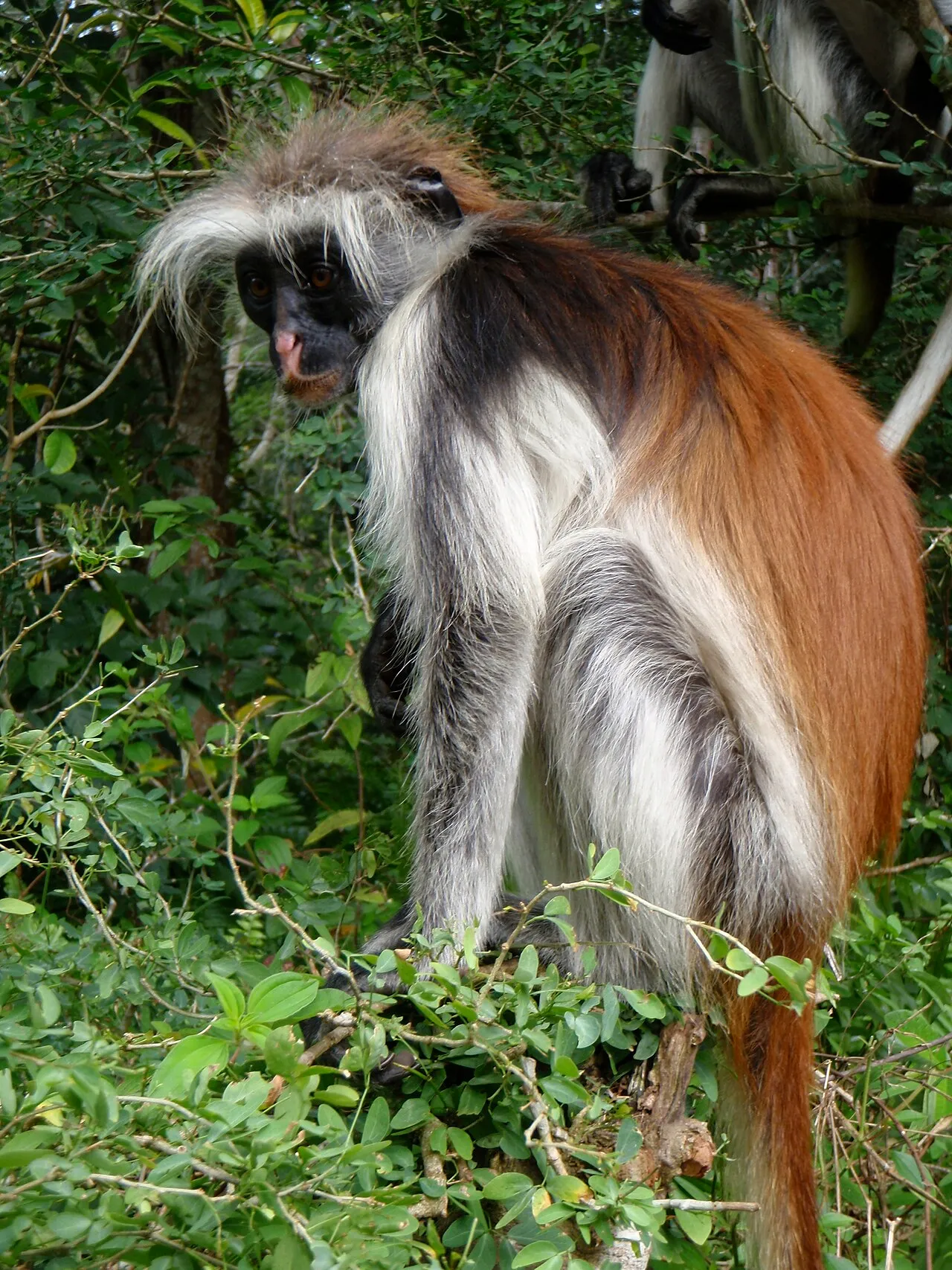
The Zanzibar red colobus is the headline act, but Jozani shelters a cast of endemics and rarities found almost nowhere else. The tiny suni antelope (Neotragus moschatus) — barely 35 centimetres at the shoulder and one of Africa's smallest antelopes — freezes in the understorey shadow and is easy to walk straight past without a ranger's pointing finger. The forest is also the stronghold of the Zanzibar servaline genet (Genetta servalina archeri), a secretive spotted carnivore so elusive it was not confirmed on the island until camera traps caught it in the 1990s.
Overhead and underfoot, the smaller life is just as distinctive: Sykes' (blue) monkeys share the canopy and occasionally mob the colobus, bush babies call after dark, and more than 40 species of butterfly drift through the sun-flecked clearings. The mangrove boardwalk opens a second world — fiddler crabs waving a single oversized claw, mudskippers hauling across the flats at low tide, and oysters clamped to the stilt roots — a living demonstration of how the tidal creek nurses the juvenile fish that later populate the reef.
Trails
A visit follows two linked circuits, both flat and undemanding. The forest loop threads the tall groundwater forest where the colobus troops feed, on packed-earth paths shaded by fig and mahogany; this is where most sightings happen, often within minutes of the trailhead. From there a raised mangrove boardwalk carries you dry-footed over the tidal creek toward Chwaka Bay, opening at its far end to a viewpoint where the woodland suddenly frames the turquoise water.
- Forest loop — roughly 45–60 minutes of level walking through the closed canopy, the core colobus-viewing circuit
- Mangrove boardwalk — a 20–30 minute elevated walk over the tidal creek, ecologically the richest short stretch in the park
- Full circuit — combining both takes about 2 to 2.5 hours at an unhurried, wildlife-watching pace
Every route starts and ends at the visitor centre by the park gate on the main road, so there is no risk of getting lost and no steep ground — the walk suits families, older visitors, and anyone happy on a well-kept path.
Jozani Forest timeline
-
Colobus named for John Kirk
The naturalist John Gray described the Zanzibar red colobus and named it for Sir John Kirk, the British administrator and botanist then based on the island.
- 1960s
Forest reserve declared
The Jozani groundwater forest was protected as a reserve to halt logging of its old-growth timber and safeguard the island's freshwater catchment.
-
Community conservation begins
The Jozani-Chwaka Bay Conservation Project channelled park revenue to surrounding villages, aligning local livelihoods with protecting the colobus.
-
National park gazetted
Jozani-Chwaka Bay became Zanzibar's first and only national park, giving the forest its highest tier of legal protection.
When to Visit
Jozani National Park is open daily from 7:30 AM to 5 PM. The best time to visit is early morning between 7:30 and 10 AM, when the colobus troops are actively foraging and moving through the lower canopy — visible at close range from the marked trails. The guided forest walk typically takes 1.5 to 2 hours; the full circuit including the mangrove boardwalk takes around 2.5 hours. Midday visits in the hotter months can feel humid under the closed canopy, though the forest provides significant shade. Avoid visiting immediately after heavy rainfall — during the long rains of April and May in particular — when the colobus monkeys shelter deeper in the canopy and the boardwalk paths turn muddy. If you are pairing Jozani with a morning spice plantation tour, the early-afternoon slot still delivers good sightings once the midday heat eases.
Admission and Costs
National park entrance fee: $10 per person (payable at the park gate; cash or mobile money). This fee includes a mandatory guided walk with a park ranger, making Jozani exceptional value compared to other East African national parks — and, because a share returns to the surrounding villages, a direct contribution to keeping the forest standing. Additional tips for rangers — $5–10 per group — are appreciated and support community conservation revenues. Transport from Stone Town is typically $15–25 per person in a shared minibus tour, or $50–80 for a private hire car. Most Stone Town guesthouses arrange combined spice plantation and Jozani day tours for $35–55 per person including transport and entry. Bring the entry fee in small bills; there is no ATM at the gate.
The Case for a Guide
The ranger walk is bundled into the entrance fee, so the question is not whether to take a guide but how much to draw out of the one you are given — and the difference between a silent stroll and a genuinely rich hour is entirely in the asking.
- Species identification — a ranger identifies which colobus troop is present, reads the social hierarchy in their behaviour, and distinguishes the endemic Zanzibar colobus from mainland red colobus by coloration and habitat use
- Forest ecology — guides connect the mangrove boardwalk's species to the coral reef offshore, tracing the nutrient cycle that flows from leaf litter through the tidal creeks to the sea
- Conservation stakes — understanding why this small fragment matters globally, and how the village revenue-sharing scheme prevents further habitat loss, turns a wildlife walk into something that genuinely counts
- Suni and genet tracking — spotting the diminutive suni antelope, or reading the signs of the near-invisible servaline genet, needs the trained eye of someone who walks these paths daily
Tips for Visitors
Wear comfortable, closed-toe walking shoes — the forest trails are well-maintained but can be muddy after rain. Bring insect repellent; mosquitoes are present in the mangrove sections, and Zanzibar is a malaria area, so cover up toward dusk. Do not touch, feed, or approach the colobus monkeys — they carry bacteria that can cause infections if they bite, and their habituation depends on them staying genuinely wild; keeping a few metres back also yields better, more natural photographs. The park's mangrove boardwalk is one of the most ecologically informative short walks in East Africa; ask your ranger to name the mangrove species and explain the difference between the stilt-root and pneumatophore breathing-root adaptations. Combine Jozani with a Zanzibar spice plantation tour for a full day in the island's interior, and reserve your afternoon for a beach or a return to Stone Town via the coastal road.
Frequently Asked Questions
How likely am I to see the red colobus monkeys?
Sightings are nearly guaranteed — the resident colobus troops in the national park have been habituated to human visitors over many years and are typically encountered within minutes of entering the designated forest areas. The troops spend much of the day foraging in the canopy and along the forest floor paths, so most visits result in extended close-range observation. Morning visits from 7 to 10 AM catch the most active feeding periods.
How far is Jozani Forest from Stone Town?
The forest lies approximately 40 kilometres south-east of Stone Town, a 45-minute drive along the island's main road. Most visitors join a group tour from Stone Town that combines Jozani with another site — typically a spice plantation tour in the morning and Jozani in the afternoon, making an efficient full-day island interior excursion. Private hire is also widely available.
Is Jozani Forest suitable for children?
Yes — the flat, well-maintained boardwalk paths and the near-certain close-up monkey encounters make Jozani one of the most reliably engaging wildlife experiences available for children anywhere in East Africa. The mangrove boardwalk section is educational and scenic without requiring any physical effort. Children should be reminded not to approach, touch, or feed the monkeys, whose bites — though uncommon — carry infection risk.
What makes the Zanzibar red colobus so rare?
The Zanzibar red colobus (Piliocolobus kirkii) is a full species found on no other island or mainland — it evolved in isolation after rising seas severed Zanzibar from the African continent roughly 10,000 to 15,000 years ago. The IUCN lists it as Endangered, with the largest surviving population concentrated inside Jozani-Chwaka Bay National Park. Because the whole species depends on a few square kilometres of protected forest, the modest $10 park fee is one of the most direct conservation contributions a visitor to Zanzibar can make.
Is Jozani Forest worth visiting?
For anyone with any interest in wildlife, yes — it is the only place on Earth to see the endemic Zanzibar red colobus, sightings are near-certain within minutes of the trailhead, and a $10 fee covering a ranger-guided walk makes it one of the best-value nature outings on the island. Skip it only if your trip is short and purely beach-focused, or if you are visiting at the peak of the long rains in April and May, when the boardwalk floods and the monkeys climb high out of view. Paired with a morning spice plantation tour or the giant tortoises of Changuu Prison Island, it easily justifies a full day away from the coast.
Do I need a guide to visit Jozani Forest?
Yes — independent walking is not permitted, and every ticket includes a compulsory park ranger who leads you along the forest loop and the mangrove boardwalk. You do not hire or pay the guide separately; the ranger walk is bundled into the $10 national park entrance fee. A tip of $5–10 per group is customary and feeds the community-conservation fund. Far from a formality, the ranger reads the colobus troop's behaviour and picks out near-invisible residents such as the suni antelope, so the mandatory guide is the whole point rather than an add-on.
Is Jozani Forest National Park the same as Jozani Forest?
They are two names for one protected area. Its full official title is Jozani-Chwaka Bay National Park, gazetted in 2004 as Zanzibar's first and only national park, but operators, drivers, and signage usually shorten it to "Jozani Forest" after its best-known groundwater-forest section. The wider park also takes in coral rag thicket, the Chwaka Bay mangroves, and coastal salt marsh across roughly 50 square kilometres, so "Jozani Forest" really names the headline habitat inside a larger reserve.
Can I reach Jozani Forest by public transport from Stone Town?
Yes, with some patience. The Paje- and Makunduchi-bound dala-dala minibuses that leave Stone Town's Darajani terminal on Creek Road run along the main tarmac road and pass directly by the Jozani gate — tell the conductor you want the park, and the fare is only a few thousand Tanzanian shillings (well under $2). The minibuses are slow and stop often, so allow one to two hours each way and set off early. Most visitors still choose a shared day-tour or private car for the time saved, but the dala-dala is the genuine budget route.
What is the best time of year to visit Jozani Forest?
The dry months are the most reliable — June to October and the shorter dry spell from December to February bring firmer boardwalk paths and colobus troops feeding low in the canopy where they are easy to watch. Avoid the long rains of April and May, when the groundwater forest floods, humidity spikes, and the monkeys retreat high out of view — the two lowest-rated months of the year here. Whatever the season, arrive between 7:30 and 10 AM, when the troops are most active in the cool of the morning.