
Glasgow Necropolis timeline
-
John Knox Monument raised
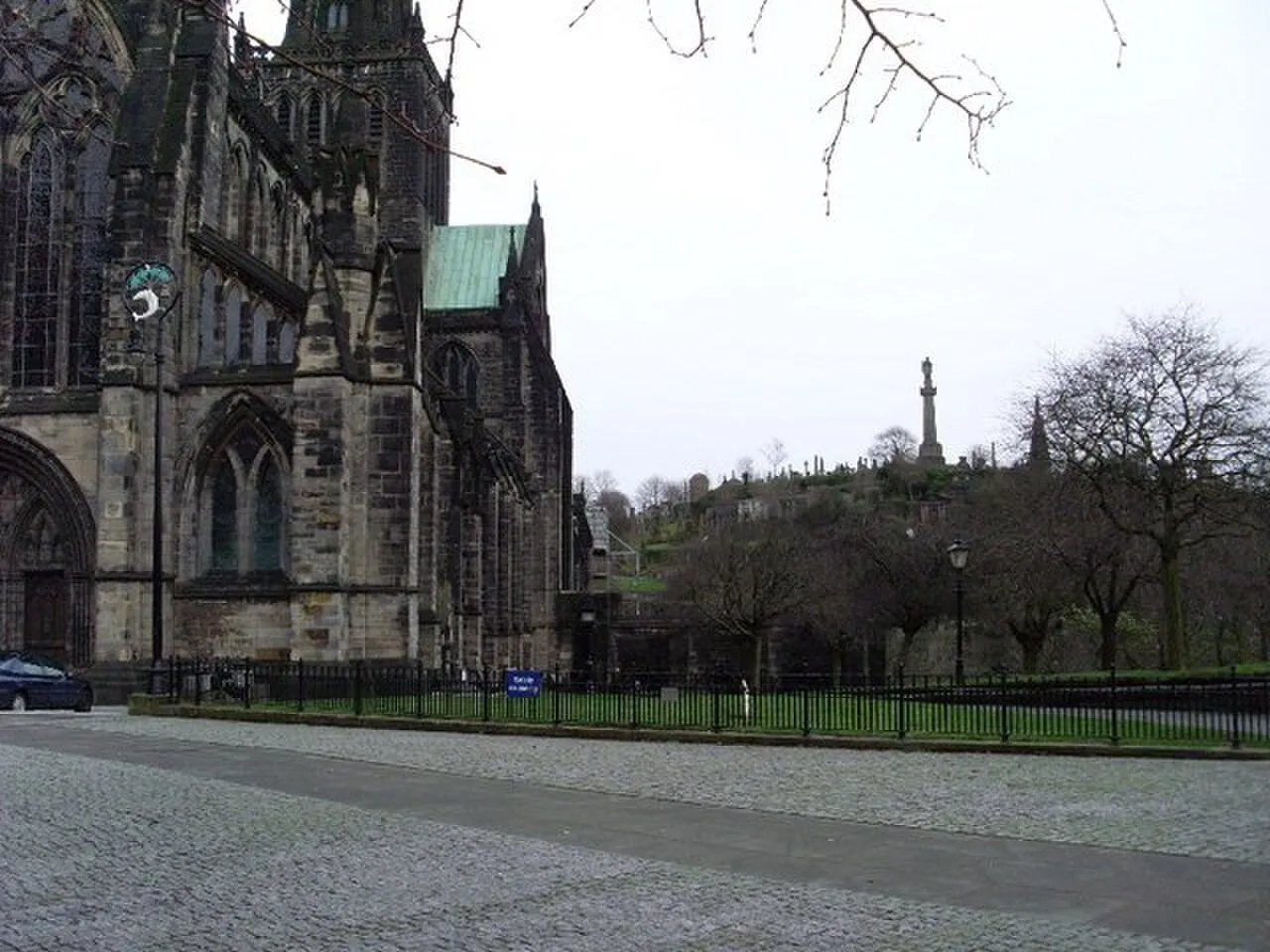
A Doric column topped by a statue of the Reformer crowned Fir Park eight years before the cemetery, and still marks its summit.
-
Strang proposes a garden cemetery
John Strang's pamphlet Necropolis Glasguensis championed a Père Lachaise for Glasgow on the Merchants House's Fir Park.
-
First burial — Joseph Levi
The interment of a Jewish merchant established the non-denominational principle before the grounds formally opened.
-
The Necropolis opens
The hilltop garden cemetery received its first monuments as Victorian Glasgow began commemorating itself in stone.
-
Bridge of Sighs completed
David Hamilton's arch carried funeral processions across the ravine from the Cathedral precinct to the cemetery gates.
-
Monteath Mausoleum built
The circular, Templar-inspired tomb of Major Archibald Douglas Monteath became the Necropolis's most photographed monument.
Architecture
The Necropolis is best understood as an outdoor museum of nineteenth-century funerary architecture, laid out as a designed landscape rather than a grid of plots. Three set pieces frame the approach and the summit:
- The John Knox Monument — A 12-metre Doric column carrying a statue of the Reformer crowns the hilltop. It was raised in 1825, eight years before the cemetery existed, so the whole burial ground was effectively planned around a monument that was already there — which is why Knox appears to preside over graves he has no connection to.
- The Bridge of Sighs — The ceremonial entrance crosses the ravine of the old Molendinar Burn (now Wishart Street) on an arched bridge by David Hamilton, completed around 1834 and named after its Venetian counterpart because funeral processions passed over it. Beneath and beside the approach lie the Façade and the catacombs, where coffins could be interred above ground in locked vaults — a Victorian response to the era's fear of grave-robbing.
- The Monteath Mausoleum — The single most photographed monument, a circular stone tomb built in 1842 for Major Archibald Douglas Monteath and modelled on the round Knights Templar and Holy Sepulchre churches, is attributed to the architect David Cousin.
Beyond these, the roughly 3,500 monuments form a catalogue of competing revival styles — Egyptian Revival obelisks and pylons, Gothic spires and canopied tombs, Neoclassical temples and sarcophagi, and Celtic Revival crosses — many designed by Glasgow's foremost architects. Alexander 'Greek' Thomson, the city's great classical designer, contributed several tombs, and the towering column and statue of the chemical manufacturer Charles Tennant is one of the tallest structures on the hill. The whole ensemble is protected as a Category A site and listed on Historic Environment Scotland's Inventory of Gardens and Designed Landscapes.
Historical Significance
The Necropolis is a document of Victorian Glasgow's social hierarchy and commercial ambitions encoded in stone. Reading the monuments reveals the city's economic history: the tobacco lords who preceded the industrial era are gone, but the ironmasters, shipbuilders, thread manufacturers, and India rubber merchants who built the city's Victorian wealth are commemorated in obelisks, temples, and sarcophagi that cost the equivalent of hundreds of thousands of pounds at today's values. The cemetery's founding as a non-denominational burial ground was radical for 1833 — the decision to admit Protestant, Catholic, Jewish, and other non-established church members side by side was a statement of commercial pragmatism and civic inclusivity that reflected Glasgow's role as a trading city drawing workers and merchants from across the British Isles and beyond. Fittingly, the very first interment — that of Joseph Levi, a Jewish merchant, in 1832 — established the non-denominational principle before the grounds had formally opened.
When to Visit
The Necropolis is open daily, year-round, free of charge. There are no set opening or closing hours, but access is most practical between dawn and dusk. Guided tours are organised by Glasgow City Council and the Friends of the Glasgow Necropolis, typically on weekends in spring and summer — check their programme for dates. A self-guided visit takes 1–1.5 hours for a thorough circuit of the main monuments; allow longer for detailed exploration of the upper hill and the outer sections. The cemetery is particularly atmospheric in autumn when the trees colour, and on misty mornings when the Victorian monuments emerge from the fog.
Admission and Costs
Entirely free to visit. Guided group tours when available: typically £5–10 per person. Private guide for a Necropolis tour (combined with the Cathedral): £60–120 for up to 6 people (1.5–2 hours total). The combination of the Cathedral and the Necropolis makes a natural morning visit from Glasgow city centre (approximately 20 minutes' walk from Central Station through the Merchant City), and folds easily into a fuller day that also takes in the West End's free Kelvingrove Art Gallery and neighbouring Kelvin Hall.
The Case for a Guide
The Necropolis rewards guided interpretation enormously:
- Reading the monuments — The architectural styles (Egyptian Revival, Gothic, Neoclassical, Celtic Revival) reflect different fashions in nineteenth-century funerary practice; a guide who can identify and date the styles tells the cultural history of Victorian Glasgow through stone
- Individual stories — The people commemorated here range from the self-made chemical magnate Charles Tennant, whose statue crowns one of the tallest columns, to the poet William Miller, who gave the world 'Wee Willie Winkie'; their monuments trace the social mobility of a booming industrial city
- Landscape architecture — The Necropolis was designed as a garden as well as a cemetery; a guide explains how the layout of paths, planting, and viewpoints was deliberate and how the Victorian landscape has matured
- Views — From the summit beside the John Knox Monument, a guide can orient visitors to the Cathedral below, the city centre, the Clyde, and the surrounding industrial landscape
Tips for Visitors
Wear sturdy shoes — the paths are uneven, sometimes slippery in wet weather, and some sections are steep. The summit, beside the monument to John Knox, offers the best elevated views of Glasgow Cathedral immediately below and the city spreading westward. The Necropolis is reached via the Bridge of Sighs directly behind the Cathedral, so the two sites are a natural morning combination. The Friends of the Glasgow Necropolis have published an excellent self-guided tour booklet available from the Cathedral visitor desk.
For photography, the light rewards planning:
- The Monteath Mausoleum and the ranks of Gothic and Egyptian monuments are strongest in low, raking morning or late-afternoon light, when the carved detail casts long shadows
- The Cathedral's east front frames beautifully from the Bridge of Sighs and the lower paths on the climb up
- Misty autumn mornings turn the whole hilltop atmospheric, with monuments emerging from the fog — the Necropolis at its most photogenic
Frequently Asked Questions
Is the Glasgow Necropolis open to visitors?
Yes, the Necropolis is open to the public daily throughout the year, free of charge. It remains an active burial ground, though new burials are now very limited. Visitors are welcome to walk the paths, read the monuments, and take photographs. The Friends of the Glasgow Necropolis and Glasgow City Council organise guided tours at certain times of year; these tours are especially recommended as the complexity of the monuments and the stories of those buried here are not fully accessible without expert explanation.
Who is buried in the Glasgow Necropolis?
The majority of those buried here were prominent figures of Victorian Glasgow's commercial and professional class — merchants, industrialists, bankers, lawyers, and their families. The chemical manufacturer Charles Tennant, founder of the vast St Rollox works, is commemorated by a statue crowning one of the cemetery's tallest columns, and the poet William Miller — author of the nursery rhyme 'Wee Willie Winkie' — has a memorial here too, alongside figures from the tobacco trade, iron industry, and shipping that made Glasgow rich. The very first interment, in 1832, was that of Joseph Levi, a Jewish merchant — a detail that reflects the Necropolis's founding as a non-denominational burial ground, open to every faith from its first day.
What makes the Necropolis architecturally significant?
The Necropolis was conceived in 1831 by John Strang, chamberlain of the Merchants House of Glasgow, who was inspired by the Père Lachaise cemetery in Paris. Its 37 acres are laid out across a volcanic hill with winding paths, formal avenues, and dramatic viewpoints, planted with trees and shrubs that have matured over 190 years into a genuine designed landscape. The roughly 3,500 individual monuments — obelisks, Egyptian temples, Gothic spires, Classical sarcophagi, and elaborate family mausoleums — represent an extraordinary catalogue of nineteenth-century funerary architecture, with contributions from Glasgow's leading architects including Alexander 'Greek' Thomson. The site is Category A listed and appears on Historic Environment Scotland's Inventory of Gardens and Designed Landscapes.
How do I get to the Glasgow Necropolis?
The Necropolis is reached across the ornamental Bridge of Sighs directly behind Glasgow Cathedral, at the top of High Street on the eastern edge of Glasgow's city centre. From Central Station or Queen Street Station it is a level walk of about 20 minutes through the Merchant City; High Street railway station is the nearest stop, roughly 10 minutes away, and frequent buses run along Castle Street. Because the entrance adjoins the Cathedral, nearly every visitor pairs the two into a single heritage morning.
Is the Glasgow Necropolis accessible for visitors with limited mobility?
The Necropolis is a steep volcanic hill crossed by uneven, sometimes cobbled paths that can be slippery in wet weather, so the upper sections and the summit around the John Knox Monument are challenging for wheelchair users and those with limited mobility. The lower avenues near the entrance and the Bridge of Sighs are more manageable and still take in many of the finest monuments. There is no admission barrier and no set closing time, but a visit is best made in daylight and dry conditions; the Friends of the Glasgow Necropolis can advise on the easier routes and run occasional accessible-focused tours.