
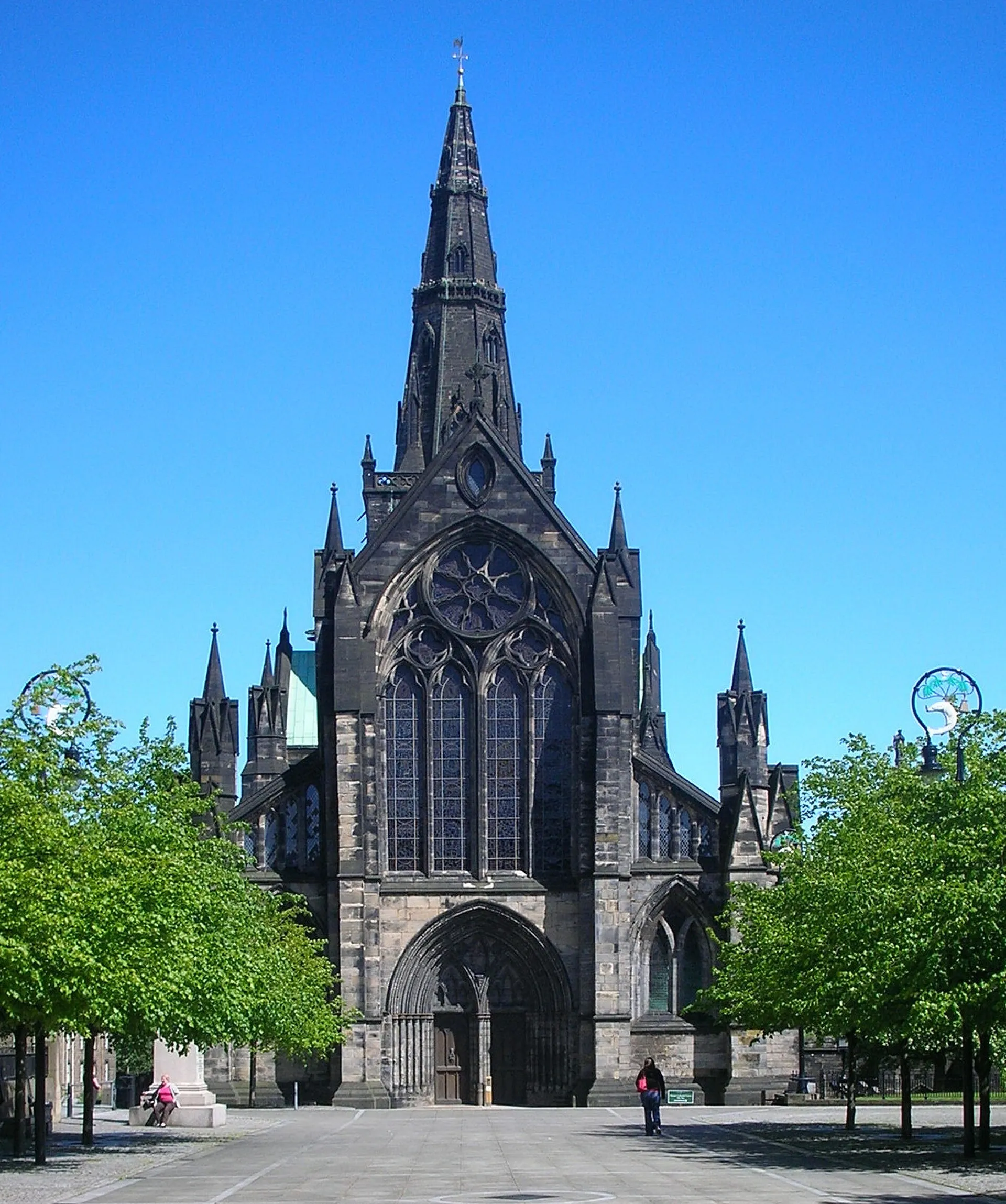
Spiritual Significance
The founding of Glasgow by Saint Mungo is woven into the city's identity. Its motto — Let Glasgow Flourish, shortened from Mungo's prayer "Let Glasgow flourish by the preaching of the word and the praising of Thy name" — and the four emblems of the city's coat of arms all recall miracles attributed to the saint:
Here's the bird that never flew
Here's the tree that never grew
Here's the bell that never rang
Here's the fish that never swam
Each line points to a separate legend — the robin Mungo restored to life, the frozen hazel branch he kindled into flame, the bell he is said to have brought from Rome, and the salmon that recovered a queen's lost ring from the Clyde. The tomb at the heart of the Lower Church is the reason the entire building exists, and it drew pilgrims from across medieval Christendom: Pope Honorius III granted in 1220 that two pilgrimages to Glasgow were worth one to Rome, and the offerings left at the shrine helped fund the cathedral's thirteenth-century expansion. The survival of this complete Gothic church through the Scottish Reformation is genuinely exceptional: St Andrews, Elgin, Jedburgh, and Kelso — nearly every other great Scottish cathedral — was gutted in the iconoclasm of 1560, yet Glasgow's was spared. Because worship has continued here unbroken — from sixth-century Celtic Christianity through medieval Catholicism to today's Church of Scotland — the cathedral is the longest continuously used site of Christian worship in Scotland.
Visitor Etiquette
Glasgow Cathedral is first and foremost a living place of worship, not only a monument, and a little awareness makes for a better visit:
- Services take priority — the building may close to sightseeing during worship, so keep Sunday mornings flexible and enter quietly if a service is under way; step back if a congregation is at prayer near the Lower Church or the choir.
- Photography for personal use is welcome, but avoid flash and tripods, and be discreet during services or at weddings and funerals.
- Dress is relaxed — there is no strict code — but modest, respectful behaviour is appreciated in what remains a sacred space.
- Accessibility — the nave and choir are reached close to street level, but the Lower Church is down a flight of worn stone steps; ask the welcome staff about assistance and step-free routes. Assistance dogs are welcome, and there is seating throughout for those who need to rest.
- Donations keep the building open freely to all — the box by the door, or the shop, is the simplest way to give something back.
When to Visit
April–September: Monday–Saturday 10 AM–5:30 PM; Sunday 1–5:30 PM. October–March: Monday–Saturday 10 AM–4 PM; Sunday 1–4 PM. Admission is free — the fabric is publicly maintained by Historic Environment Scotland, so there is no ticket to buy. The building closes to general sightseeing during worship, so Sunday mornings and the occasional wedding or funeral can interrupt a visit; check ahead if your schedule is tight. Allow 45 minutes to 1 hour for a thorough visit, and longer if you explore the Lower Church in detail, study the post-war stained glass, or read the interpretation boards carefully. Pairing the cathedral with a climb to the Necropolis immediately behind makes a natural heritage morning of about 2 hours.
Admission and Costs
Entirely free to enter, with a donation box near the door and a small gift shop inside. Guided group tours arranged in advance through the cathedral run about £5–8 per person for a 45-minute tour. A private guide covering the cathedral and the Necropolis together typically costs £60–120 for up to 6 people (around 1.5 hours). Broader Glasgow walking tours that fold in the cathedral usually cost £15–25 per person across a 2-hour circuit of the Cathedral Quarter, while full-day city tours that also take in the Kelvingrove Art Gallery run higher.
The Case for a Guide
Glasgow Cathedral's history combines Celtic Christianity, Norman foundations, Gothic construction, Reformation survival, and Victorian and post-war restoration in ways that reward expert guidance:
- The Lower Church — The crypt's complex vaulted architecture, built into the fall of the hillside in the thirteenth century, is the most technically accomplished part of the building; a guide explains the structural ingenuity of raising a level choir over Saint Mungo's grave
- The pulpitum and Blackadder Aisle — The rare surviving stone rood screen and the white-vaulted early-sixteenth-century aisle are easy to walk past unremarked; a guide reveals why they matter within Scottish medieval architecture
- The Mungo cult — Understanding Saint Mungo's tomb and the medieval pilgrimage tradition that brought wealth to Glasgow draws on Celtic Christian hagiography and the four civic miracles
- Reformation survival — The story of the trades guilds protecting the cathedral in 1560 is one of the most dramatic episodes in Scottish urban history
- Stained glass — The cathedral holds a notable twentieth-century glazing programme by Francis Spear and others; a guide with knowledge of modern ecclesiastical art explains its symbolism
Tips for Visitors
Visit the Lower Church even if time is short — it is the finest part of the building architecturally and houses the tomb that is the reason the cathedral exists. Climb to the gallery level (when open) for an elevated view down the nave and choir. For photographers, the east window blazes in morning light while the west rose window is better in the afternoon; the long vista through the medieval pulpitum toward the choir is the building's signature interior shot, and the cathedral's east front is best framed from the footbridge on the way up to the Necropolis. That Victorian hilltop cemetery lies immediately behind across the bridge, so combining both in a single morning from Glasgow city centre is natural and takes about 2 hours total. Wear layers — the interior is cool even in summer — and sturdy shoes for the crypt steps and the Necropolis paths.
Frequently Asked Questions
Why did Glasgow Cathedral survive the Reformation when most Scottish cathedrals were destroyed?
When the Scottish Reformation swept through the country in 1560, mobs stripped and destroyed most of Scotland's Catholic cathedrals and abbeys. Glasgow Cathedral survived because the craftsmen's guilds of the city physically interposed themselves between the reformers and the building — the trades guilds regarded the cathedral as their spiritual home and refused to allow its destruction. This is an extraordinary episode in urban history that a guide can tell in full.
What is the most significant part of Glasgow Cathedral?
The Lower Church (the crypt), which dates from the twelfth and thirteenth centuries, is architecturally the most remarkable part of the building — a complete and intact lower church with its original stone vaulting. At its heart is the tomb of Saint Mungo (also known as Saint Kentigern), the patron saint of Glasgow and the founder of the original church on this site in the sixth century. The tomb has been a place of pilgrimage since the medieval period.
Is Glasgow Cathedral free to visit?
Yes, admission to Glasgow Cathedral is free, though donations are welcome. The cathedral is an active Church of Scotland congregation; services are held regularly, and visitors are welcome between services. Check the cathedral's website for service times, especially on Sundays, when the building may be closed to general tourism during worship.
How do I get to Glasgow Cathedral?
The cathedral stands at the top of High Street in Cathedral Square, on the eastern edge of Glasgow's city centre beside the Glasgow Royal Infirmary — the medieval Provand's Lordship and the St Mungo Museum of Religious Life and Art face it across the square. From Central Station or Queen Street Station it is a level walk of about 20 minutes through the Merchant City; High Street railway station is the nearest stop, roughly a 10-minute walk downhill, and frequent buses run along Castle Street and George Street. Most visitors combine the cathedral with the Necropolis reached by the footbridge directly behind it.
What are the must-see features inside Glasgow Cathedral?
Head first to the Lower Church to see Saint Mungo's tomb and its intact thirteenth-century stone vaulting — the reason the whole building exists. Above it, the choir is screened from the nave by a rare medieval stone pulpitum (rood screen), one of very few to survive in a Scottish church, while the early-sixteenth-century Blackadder Aisle, projecting from the south, is prized for its delicate white-vaulted ceiling and carved bosses. Don't miss the twentieth-century stained glass — much of it by Francis Spear — which replaced windows lost over the centuries and is best read with a guide who can explain its programme.