

Overview
The Binnenhof ("Inner Court") has served as the seat of Dutch political power since Count Floris IV built a hunting lodge here around 1230. Over eight centuries, that lodge expanded into a complex of Gothic, Renaissance, and neoclassical buildings surrounding a central courtyard where today the Dutch Prime Minister's office, the Senate, and the Council of State conduct the business of governing 17 million people. The Ridderzaal (Hall of Knights), a 13th-century Gothic hall with a spectacular wooden-beamed ceiling, hosts the annual Prinsjesdag ceremony each September when the King arrives in a golden coach to deliver the Speech from the Throne — the Dutch equivalent of a State of the Union address, complete with medieval pageantry that the pragmatic Dutch find simultaneously embarrassing and indispensable.
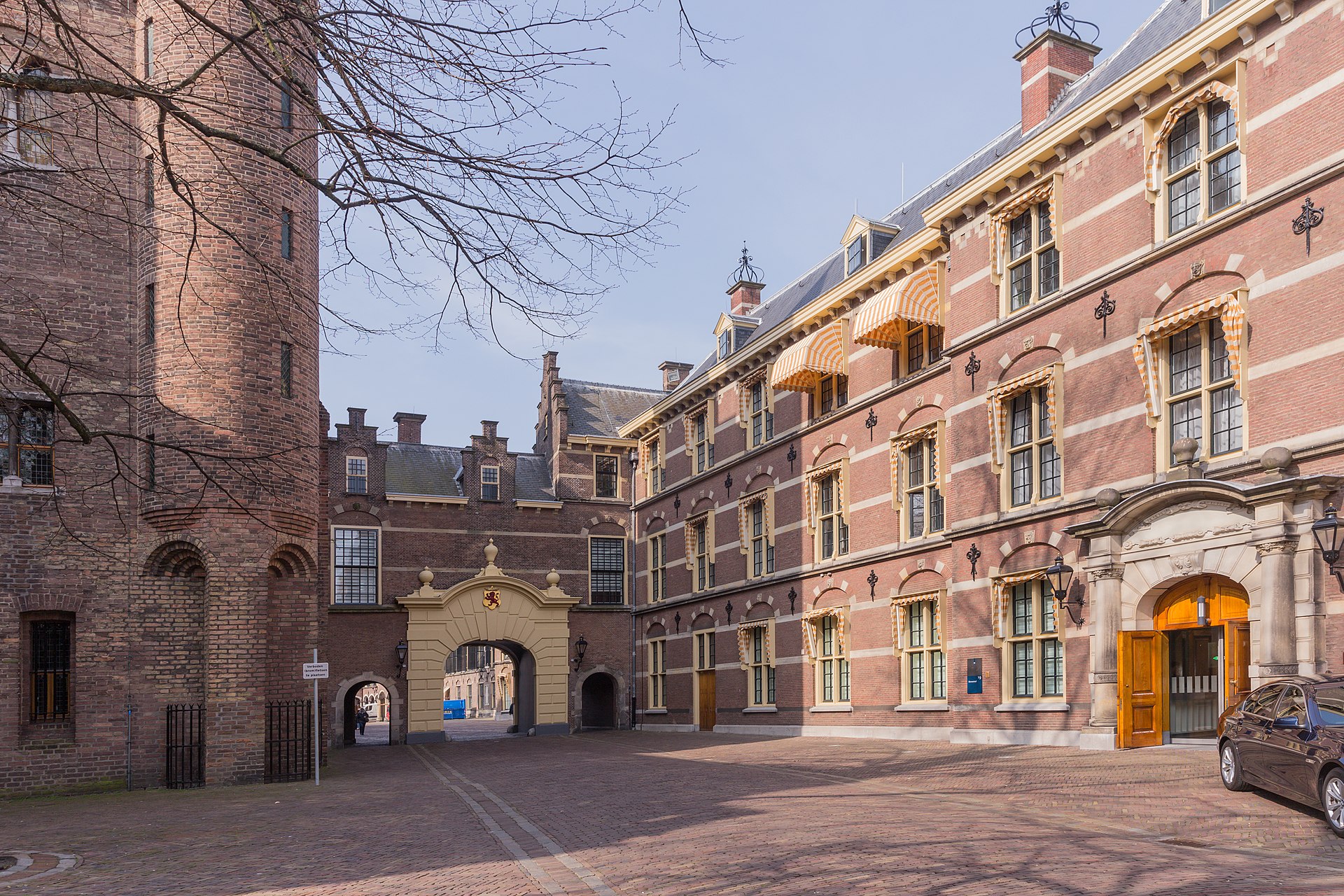
The Binnenhof's setting amplifies its impact: the complex sits on the edge of the Hofvijver, a rectangular pond that reflects the Gothic towers and government buildings in its surface. The view from the Lange Vijverberg — the tree-lined street running along the pond's opposite bank, with the Mauritshuis at one end — ranks among the most recognizable in The Hague. A major renovation has been underway since 2021, temporarily relocating parliamentary functions to other buildings, but the exterior views and courtyard access remain essential to understanding why this complex matters. A guide explains the Dutch political system (coalition governments formed through negotiation, a constitutional monarchy where the king reigns but does not rule) and how this architectural hodgepodge — buildings from every century since the 1200s jumbled together around a single courtyard — physically embodies the Dutch preference for evolution over revolution.
Architecture
Ridderzaal (Hall of Knights): The 13th-century Gothic hall with its dramatic timber ceiling and stained glass windows hosts the annual Prinsjesdag ceremony — the Netherlands' most significant political ritual. Hofvijver Reflection: The rectangular pond reflecting the Binnenhof's towers and the Mauritshuis creates one of the Netherlands' most iconic views — especially atmospheric at dusk. Prinsjesdag: On the third Tuesday of September, the King arrives in a golden coach, reads the government's plans for the coming year in the Ridderzaal, and departs through crowds lining the route — ceremony and democracy intertwined. Architectural Layers: Buildings from eight centuries — 13th-century Gothic, 17th-century Classicism, 19th-century additions — coexist around the courtyard, each layer representing a different era of Dutch governance. Democratic Heritage: The States-General (Dutch parliament) has met here since the 16th century, making the Binnenhof one of the world's oldest continuously used parliamentary complexes.
Historical Significance
The Binnenhof's 800-year continuous use as a seat of governance makes it one of Europe's most historically significant political complexes. The Ridderzaal's annual Prinsjesdag ceremony connects medieval tradition to modern parliamentary democracy in a ritual that has adapted to changing constitutions while maintaining its symbolic core. The complex witnessed the signing of the Act of Abjuration in 1581 — the declaration of independence from Spain that influenced the American Declaration of Independence nearly two centuries later. During the Dutch Golden Age, the States-General directed the affairs of the world's most powerful trading nation from these halls. The Peace Palace nearby extends The Hague's governance story from national to international, while Madurodam offers a miniature perspective on Dutch civic infrastructure including a scale model of the Binnenhof itself.
When to Visit
Courtyard: Generally open during daylight hours (access may vary during renovation). Ridderzaal interior: Limited access during renovation; check ProDemos visitor center for current tour availability. Hofvijver views: Always accessible — the pond and surrounding walkways are public. Best: Early morning or dusk for reflections on the Hofvijver; Prinsjesdag (third Tuesday in September) for the royal procession.
Admission and Costs
Courtyard and exterior: Free. Guided tours (when available): €10-15 through ProDemos, the democracy education center. Prinsjesdag viewing: Free (arrive very early to secure a good position along the route). Political walking tours: €15-30 per person covering the Binnenhof, government district, and royal institutions.
Tips for Visitors
Renovation status: A major restoration began in 2021. Parliamentary functions have relocated temporarily. Check ProDemos for current access status before visiting. Hofvijver walk: The best view is from the Lange Vijverberg on the pond's opposite side — the full Binnenhof complex reflected in the water, with the Mauritshuis at the corner. Combine with Mauritshuis: The Mauritshuis literally borders the Hofvijver — a natural pairing that covers Dutch political and artistic history in a single morning. ProDemos Visitor Center: Located next to the Binnenhof, this free exhibition explains the Dutch political system through interactive displays — useful context before or after seeing the buildings. Prinsjesdag tip: If visiting in September, the third Tuesday draws enormous crowds. Arrive by 10:00 for a viewing spot along the Lange Voorhout, where the golden coach passes beneath a canopy of old trees.