
Hospicio Cabañas timeline
-
Bishop Cabañas takes the diocese
Juan Cruz Ruiz de Cabañas becomes bishop of Guadalajara and resolves to build a single refuge gathering the city's orphans, elderly, and infirm under one roof.
-
Construction begins to Tolsá's design
Architect Manuel Tolsá lays out a vast single-story complex of 23 courtyards ringing a central chapel, raised in stages over the following four decades.
-
The complex completed
Forty years of building work finish the colonnades and courtyards, by which point the hospice has become the largest charitable institution in Latin America.
- 1938–1939
Orozco paints the frescoes
José Clemente Orozco covers the chapel with 57 fresco panels, crowned by The Man of Fire in the dome — his acknowledged masterpiece.
-
Instituto Cultural Cabañas founded
The orphanage relocates after roughly 150 years of care, and the building reopens as a state cultural center with galleries for rotating contemporary art.
-
UNESCO World Heritage listing
UNESCO inscribes the Hospicio Cabañas, citing Tolsá's neoclassical architecture and Orozco's frescoes as an inseparable whole.
Architecture
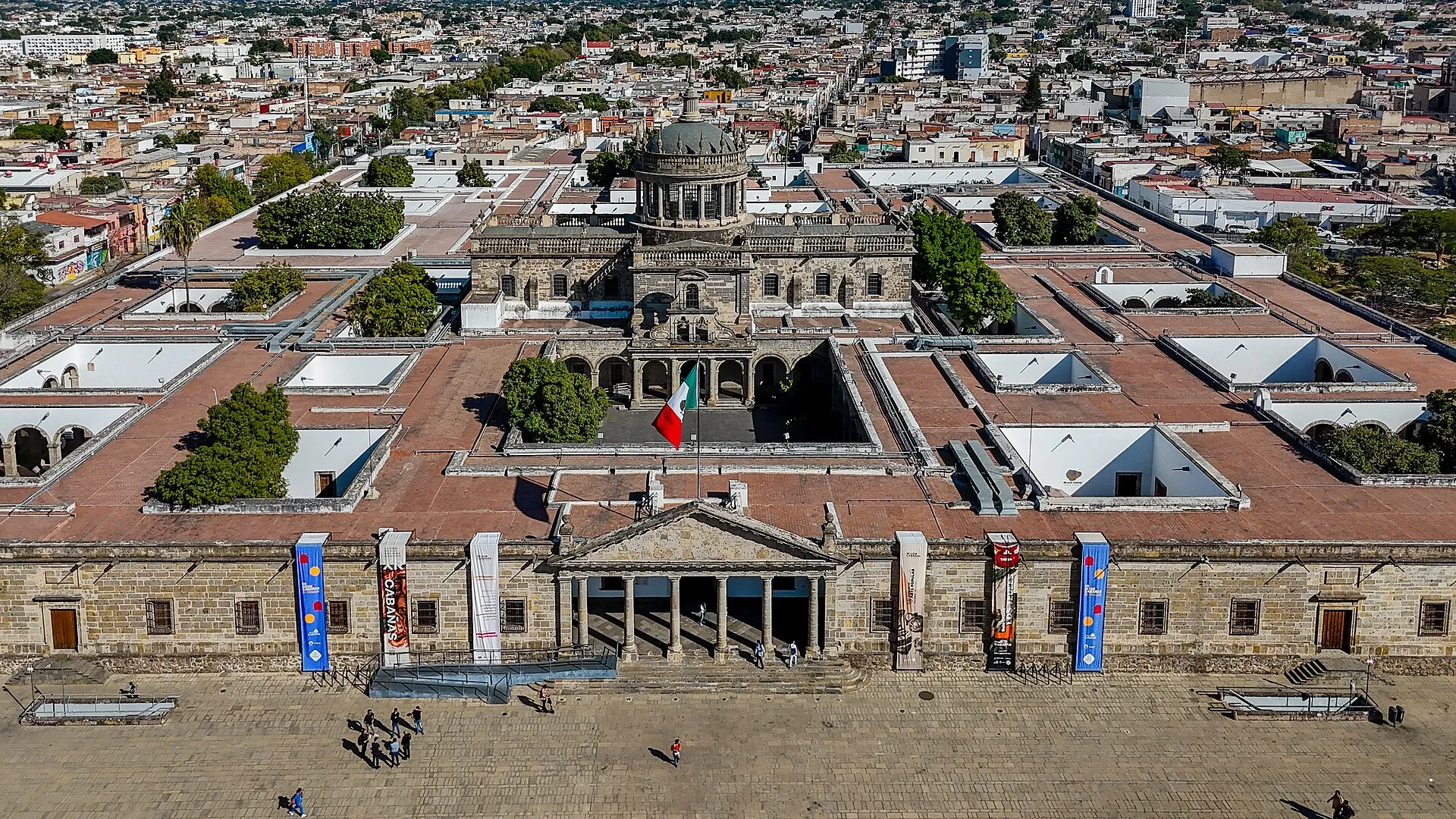
Tolsá's neoclassical plan is a study in calm symmetry: a low, single-story rectangle spread across more than two hectares and organized around 23 courtyards of varying size, linked by arcaded walkways that create a slow rhythm of light and shadow. At its heart stands the Capilla Mayor, a cruciform chapel crowned by a tall drum-and-dome that draws the whole composition upward — the reason the building reads as monumental despite never rising above one floor. The scale and restraint have earned it comparison to the great institutional buildings of Europe, and it remains one of the finest neoclassical ensembles in Latin America.
The chapel is the artistic climax. Between 1938 and 1939, Orozco covered its vaults and walls with 57 fresco panels charting the collision of indigenous and European worlds — the armored Spanish conquest, the machinery of the modern age, and, in the cupola, El Hombre de Fuego consumed and reborn in flame. Critic Luis Cardoza y Aragón judged it the single most powerful image in Mexican art. For photographers, the payoff is the view straight up into the dome from the chapel benches; for a sense of Tolsá's geometry, the repeating arches of the courtyards line up into long, receding perspectives best caught at midday.
Historical Significance
The Hospicio Cabañas embodies two centuries of Mexican social and cultural history. Bishop Juan Cruz Ruiz de Cabañas conceived it as a Casa de la Misericordia — a house of mercy gathering orphans, the elderly, the disabled, and the destitute under one roof — and it operated as a working charity for roughly 150 years, sheltering an estimated 23,000 children before the orphanage relocated in 1980. That continuity of purpose, rare among buildings of its age, is part of what UNESCO recognized.
Orozco chose this chapel deliberately for his most ambitious cycle: its height and curvature let him wrap the viewer inside the drama of conquest and rebirth. As a leading figure of muralismo alongside Rivera and Siqueiros, he used public walls to reclaim Mexican identity in the decades after the Revolution, and the Hospicio frescoes are often called his masterpiece. When UNESCO inscribed the complex on the World Heritage List in 1997, it cited Tolsá's architecture and Orozco's frescoes as inseparable — a single monument in which building and painting complete each other.
When to Visit
Hours: Open Tuesday to Sunday, 10 AM - 6 PM, and closed on Mondays. Allow 60-90 minutes for a proper visit — longer if a temporary exhibition is running in the side galleries. The best light falls at midday, when the sun reaches into the chapel and illuminates the dome frescoes most dramatically; Tuesday and Wednesday mornings are the quietest, while weekends and school-holiday afternoons are busiest.
Accessibility: Because Tolsá designed the entire complex on one level for its infirm and elderly residents, it is unusually easy to move through — the courtyards and colonnades are step-free and navigable by wheelchair, a rarity among Guadalajara's colonial-era monuments.
Getting there: The Hospicio stands at the eastern end of Plaza Tapatía, about a ten-minute walk from Guadalajara Cathedral through the pedestrian plaza past the Teatro Degollado. The nearest light-rail stop is San Juan de Dios on the city's SITEUR Line 2, beside the market of the same name; taxis and ride-hailing drop you at the plaza on the building's western side.
Admission and Costs
General admission is MX$90 ($5), with a reduced MX$30 rate for students, teachers, seniors, and children carrying valid ID; an audio guide adds about MX$50. Temporary exhibitions are sometimes included and sometimes ticketed separately, so check at the box office. A licensed local guide for a small group runs roughly MX$300-500 for the complex alone, and most visitors instead book a wider historic-center walking tour — around MX$500-800 ($28-45) per person — that threads the Hospicio together with the cathedral and the surrounding plazas. Fees are modest by international-museum standards, and the dome alone justifies the ticket.
The Case for a Guide
Orozco's dome is overwhelming on first sight and almost illegible without context — a guide is what turns 57 panels of allegory into a story you can actually follow.
- Decoding "The Man of Fire": A guide walks you through the cycle's argument — conquest, mechanization, and spiritual rebirth — so the cupola reads as a narrative rather than a blur of bodies and flame
- Placing Orozco in muralismo: Understanding how he differs from Rivera and Siqueiros explains why this chapel is considered his masterpiece rather than simply another mural
- Reading Tolsá's plan: Someone pointing out the single-level logic, the 23 courtyards, and the cruciform chapel reveals a design most visitors walk straight past
- Timing the light: A local knows when the sun reaches the dome and which mornings stay quiet, so you see the frescoes at their best
- Threading the historic center: Guides link the Hospicio to the cathedral, Plaza Tapatía, and the Mercado San Juan de Dios into one coherent walk
Tips for Visitors
- Lie down to look up: Wooden benches are set in the center of the chapel precisely so you can lie back and take in the dome. Orozco painted the frescoes to be read from below, and craning your neck will not do the composition justice — this is how the artist intended "The Man of Fire" to be seen.
- Best photographs: The single most striking shot is straight up into the cupola from the benches; for architecture, the long arcaded corridors and the symmetry of the repeating courtyards reward a wide lens, especially in raking midday light. Flash is prohibited in the chapel, but natural-light photography is welcome throughout.
- Get the audio guide: At MX$50 it is the cheapest way to unlock Orozco's dense symbolism panel by panel.
- Leave time for the galleries: The complex hosts rotating contemporary-art exhibitions that are often excellent and far less crowded than the chapel.
- Walk the plaza: Step back onto Plaza Tapatía afterward and continue to the Mercado San Juan de Dios next door, or west toward the cathedral and Teatro Degollado.
Frequently Asked Questions
What time of year is best to see Hospicio Cabañas?
As an indoor attraction, Hospicio Cabañas is rewarding year-round, but Guadalajara's dry season from October through May offers the most comfortable conditions for exploring the 23 courtyards and walking to nearby sites. The rainy season from June through September brings afternoon thunderstorms that can disrupt outdoor plans, though the museum itself remains a cool retreat from summer heat.
When can visitors tour Hospicio Cabañas?
Open: Tuesday-Sunday 10 AM - 6 PM. Closed: Mondays. Best: Midday when natural light illuminates the chapel dome most dramatically. Quiet hours: Tuesday and Wednesday mornings attract fewer visitors than weekends
How much is the entrance fee for Hospicio Cabañas?
General admission: MX$90 ($5). Students and seniors: MX$30 with valid ID. Audio guide: MX$50 additional. Temporary exhibitions: Sometimes included, sometimes separate ticket. Guided tour with local expert: MX$300-500 per group
What should visitors know before visiting Hospicio Cabañas?
Look up properly: Lie on the wooden benches placed in the center of the chapel to properly view the dome frescoes — they were painted to be seen from below, and craning your neck won't do justice to the composition.
How do I get to Hospicio Cabañas, and is it wheelchair accessible?
The complex stands at the eastern end of the pedestrian Plaza Tapatía, about a ten-minute walk from Guadalajara Cathedral past the Teatro Degollado. The nearest light-rail stop is San Juan de Dios on SITEUR Line 2, beside the market of the same name. Because Manuel Tolsá designed the whole hospice on a single level for its infirm residents, the courtyards and colonnades are step-free and easy to navigate by wheelchair — unusually so for a colonial-era monument.
Who was José Clemente Orozco and why do his frescoes matter?
Orozco (1883-1949) was a Jalisco-born painter and one of the three giants of Mexican muralismo, alongside Diego Rivera and David Alfaro Siqueiros. Between 1938 and 1939 he covered the hospice's chapel with 57 fresco panels on the Spanish conquest and the machine age, crowned by The Man of Fire in the dome. Many critics consider this cycle his masterpiece, and it is one of the reasons UNESCO inscribed the complex as a World Heritage Site in 1997.