
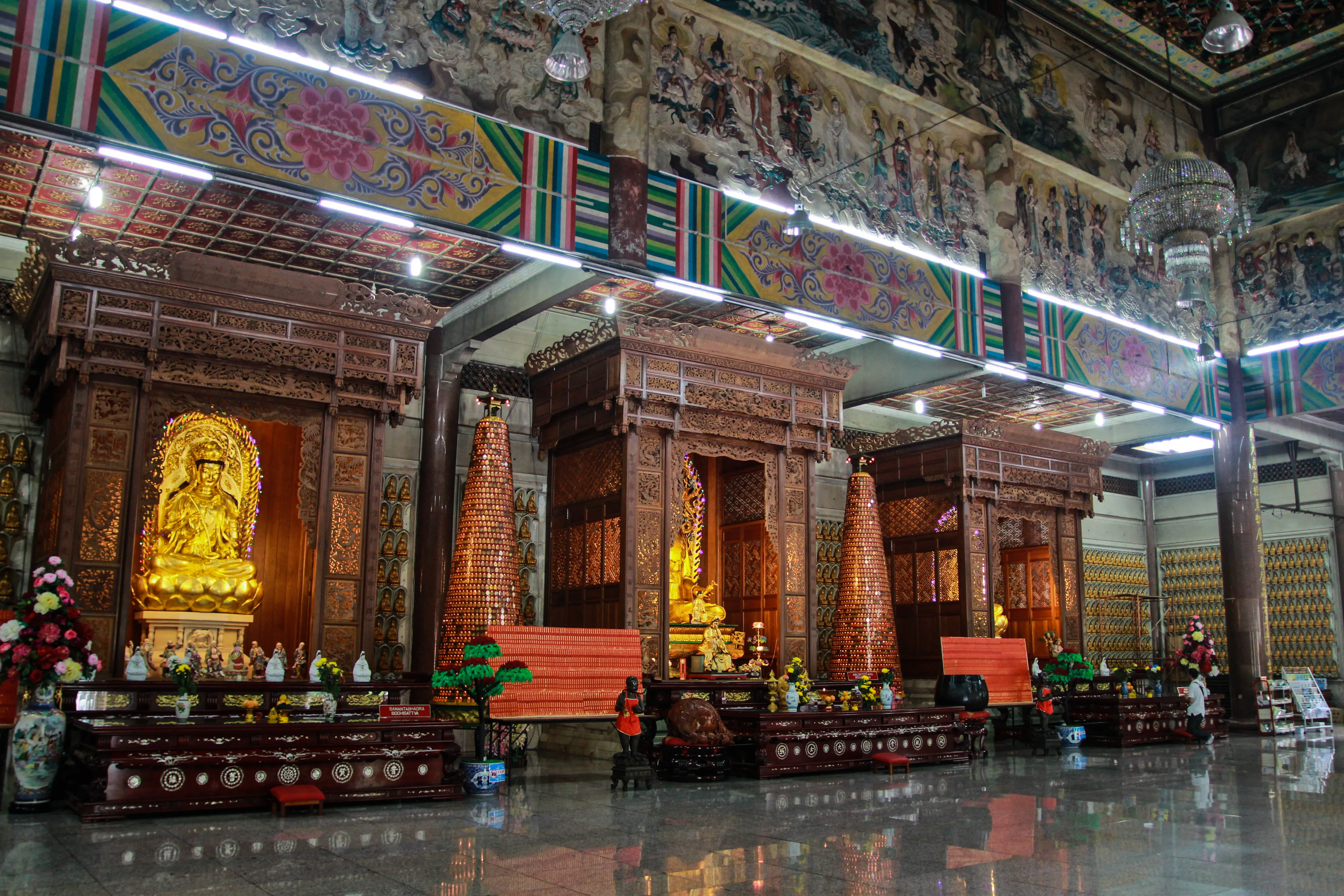
Spiritual Significance
Kek Lok Si belongs to the Mahayana tradition of Chinese Buddhism, which emphasises the role of bodhisattvas — enlightened beings who choose compassion over nirvana — as intermediaries for human devotees. The temple's primary dedicants are Kuan Yin (goddess of mercy), Amitabha Buddha (the Buddha of Infinite Light), and the Laughing Buddha (Maitreya) — a triad that represents compassion, purification, and the promise of future enlightenment.
The temple also functions as a major site for ancestral veneration — a practice central to Chinese Buddhist tradition in which the spirits of deceased family members are honoured, prayed for, and supported through ritual. The temple's extensive memorial halls contain urns and spirit tablets for thousands of families across Penang's Chinese community, and annual rites draw large numbers of worshippers particularly during the Hungry Ghost Festival (July–August) when prayers for wandering spirits are performed.
The Chinese New Year illuminations that have made Kek Lok Si internationally famous are themselves a religious act — the lanterns represent the light of the dharma (Buddhist teaching) and the prayers of devotees for blessings in the coming year. The scale of the illumination — running for 30 evenings — reflects the depth of community devotion and financial support that keeps this ancient institution vital.
Visitor Etiquette
- Dress modestly: Shoulders and knees covered; sarong wraps available at the entrance for a small fee
- Remove footwear before entering the main prayer halls; shoes can remain on in the outer gardens and pagoda walkways
- Photography inside prayer halls: Ask before photographing active worship; the halls are generally open to photography when no service is in progress
- Silence during prayers: Morning and evening prayer sessions (typically 7–8 AM and 6–7 PM) should be observed quietly; do not interrupt or walk in front of worshippers
- Offer incense respectfully: Incense is available for purchase; a guide explains the correct offering sequence and prayers if you wish to participate
- Charitable donations: The temple's social welfare work is funded entirely by donations and visitor contributions; the small entry fees for the pagoda interior and funicular go directly to temple maintenance
Kek Lok Si Temple timeline
-
Beow Lean founds Kek Lok Si
A Hokkien monk from Fujian laid the first hall on the Air Itam hillside, bankrolled by George Town's Chinese merchant clans who wanted a temple "as grand as any in China."
-
Qing imperial patronage
The Qing court granted the temple an imperial tablet and a printed edition of the Buddhist canon, cementing its standing across the overseas Chinese Buddhist world.
-
Pagoda foundation stone laid
King Rama VI of Siam laid the cornerstone of the Pagoda of Ten Thousand Buddhas, which is why the tower is also remembered as the Ban Po Thar or Pagoda of Rama VI.
-
Pagoda of Ten Thousand Buddhas completed
After fifteen years of work the seven-storey, 30-metre tower was consecrated, fusing Chinese, Thai, and Burmese tiers into a single structure.
-
Bronze Kuan Yin statue completed
The 30.2-metre goddess of mercy was finished after nearly a decade of casting and assembly, crowning the hilltop above the pagoda.
-
Kuan Yin pavilion inaugurated
A pillared canopy on sixteen columns was raised over the bronze statue to shelter it from the tropical sun and monsoon rain.
When to Visit
Temple complex hours: Daily 8:30 AM – 5:30 PM (main complex); Chinese New Year illuminations run 6:30 PM – midnight for approximately 30 days after Chinese New Year's Eve.
Best visit timing:
- Weekday mornings (8:30–10:30 AM): Quietest, most atmospheric, morning prayers audible from the main hall
- Golden hour (4:30–6 PM): Warm afternoon light on the pagoda tiers; good for photography before the complex closes
- Chinese New Year evenings (6:30–11 PM): The most spectacular seasonal spectacle in Penang — plan to queue, arrive with a guide who knows the best viewing positions
Visit duration:
- Main complex (lower levels + pagoda exterior): 1.5–2 hours
- Full complex including Kuan Yin hilltop: 2.5–3 hours
- Chinese New Year illuminations visit: 3–4 hours
Admission and Costs
- Main temple complex: Free entry
- Pagoda of Ten Thousand Buddhas (interior): RM 2 ($0.50 USD) donation
- Hilltop funicular to Kuan Yin statue: RM 2 ($0.50 USD) per person each way
- Incense: RM 3–10 at the entrance stalls
- Chinese New Year illumination fee: RM 5–10 ($1.15–2.30 USD) — check locally for the year's rate
- Refreshments: Temple vegetarian café inside the complex; meals RM 8–15 ($1.80–3.40 USD)
- Guided tour from George Town (including transport): RM 150–280 ($34–63 USD) per group for a half-day that combines Kek Lok Si with Penang Hill or George Town heritage
The Case for a Guide
Kek Lok Si's visual drama is apparent to any visitor — the cascading pagoda tiers, the enormous hilltop goddess, the garden of Buddhas. What a guide provides is the theological and historical framework that makes these visual elements coherent: the significance of each deity in the Mahayana pantheon, the meaning of the architectural fusion in the pagoda (why Chinese, Thai, and Burmese styles were deliberately combined), the founding story and the connection to the Qing dynasty empress, and the extraordinary community philanthropy that has sustained the temple across 130 years and multiple generations.
For Chinese New Year visits, a guide is almost indispensable. The illumination queues, the sequence of halls to visit, the best positions for photography, the timing to avoid the worst crowds, and the explanations of each lantern symbol and prayer ritual all require local knowledge that transforms a crowded evening event into a genuinely moving religious and cultural experience. Guides can also arrange visits that combine Kek Lok Si with the nearby Penang Hill funicular and, on the same day, George Town's heritage streets — the three together forming the definitive Penang experience that no single attraction alone can provide.
Tips for Visitors
- Arrive at opening time on weekdays for the quietest experience — tour groups arrive in quantity by 10 AM
- Wear shoes that slip on and off easily — you'll remove them at the main prayer halls and put them back on for the gardens and pagoda exterior walkways
- Bring small denomination notes — the RM 2 funicular and pagoda donations are exact-change preferred; the vegetarian café also prefers cash
- Vertical scale: The complex spans significant elevation change — the climb from the lower entrance to the Kuan Yin hilltop involves substantial steps and slopes; comfortable footwear is essential and the funicular is recommended for visitors with limited mobility
- Chinese New Year planning: Book guided tours for the illumination evenings at minimum two weeks in advance during January–February; transport to and from Air Itam can be difficult during the busiest evenings
- Combine with Penang Hill: The Penang Hill lower funicular station is a 15-minute walk from Kek Lok Si — combining both attractions makes an excellent full-morning itinerary from George Town
- Temple café: The vegetarian food served in the temple's café uses produce from temple gardens; the lunch menu is simple, cheap, and often excellent
Frequently Asked Questions
How much does it cost to visit Kek Lok Si Temple?
The lower temple complex is free to enter, including the main prayer halls, gardens, ponds, and the Pagoda of Ten Thousand Buddhas exterior. The pagoda interior charges a nominal donation of around RM 2 ($0.50 USD). The hilltop funicular to the bronze Kuan Yin statue level costs RM 2 ($0.50 USD) per person each way. The total cost for a thorough visit — including all levels — is typically under RM 10 ($2.30 USD) per person, making this one of the best-value experiences in Penang relative to its scale and visual impact. During Chinese New Year, an additional illumination entry fee of around RM 5–10 may apply for the evening light display.
What is the best time to visit Kek Lok Si Temple?
Early morning (8–10 AM) is the ideal time: the temple is operational before tourist groups arrive, the light is gentle and directional on the pagoda tiers, and the morning prayers at the main hall fill the air with the sound of bells and chanting. Weekday mornings are dramatically quieter than weekends. During Chinese New Year (January–February), the entire complex is illuminated with thousands of lanterns and lights every evening — a spectacle that is widely considered one of the most beautiful annual sights in Malaysia. The illumination typically runs for 30 consecutive evenings following Chinese New Year's Eve, and queues to enter in the evening can be long; a guide who knows the optimal timing and entry sequence makes the difference between a frustrating experience and a magical one.
What is the story behind the Kuan Yin statue at the top of Kek Lok Si?
The 30.2-metre-tall bronze statue of Kuan Yin — the Mahayana Buddhist goddess of mercy and compassion — stands on a hilltop above the main temple complex, accessible via a short funicular ride. It was completed in 2002 after a decade of construction and is one of the largest Kuan Yin statues in Southeast Asia. Kuan Yin (known in Sanskrit as Avalokitesvara) is the most widely worshipped deity in Chinese Buddhism — a bodhisattva who chose to remain in the world to assist all sentient beings before entering nirvana. The statue depicts her in the traditional standing posture, holding a willow branch (symbolising healing) and a vase (containing the waters of compassion). The hilltop position makes the statue visible from across the Air Itam valley and, on clear days, from parts of George Town below.
How do you get to Kek Lok Si Temple from George Town?
Kek Lok Si crowns the hillside above Air Itam, roughly 8 km west of George Town and about 20–25 minutes by road. The cheapest option is Rapid Penang bus 204 from Weld Quay or the Komtar terminal, which stops at Air Itam market a short uphill walk from the temple gate; buses 201 and 203 also serve the area. A Grab ride from the heritage core costs around RM 15–20 ($3–5 USD). Because the Penang Hill lower funicular station sits just 15 minutes' walk away, most visitors pair the two into a single half-day loop from the city rather than making two separate trips.
Why does the Pagoda of Ten Thousand Buddhas mix three architectural styles?
The Pagoda of Ten Thousand Buddhas (Ban Po Thar) deliberately stacks three Buddhist traditions in one seven-storey, 30-metre tower: a Chinese octagonal base, Thai-style middle tiers, and a gilded Burmese stupa crown. The fusion is theological rather than decorative — it expresses Kek Lok Si's ambition to represent the whole Mahayana Buddhist world rather than any single national tradition. King Rama VI of Siam laid the pagoda's foundation stone in 1915 (hence its alternative name, the Pagoda of Rama VI), and it was consecrated in 1930 after fifteen years of construction. Climbing the interior, you can watch the ornament shift tier by tier — a detail a guide will point out that most visitors climb straight past.