
Observation Spots
Formation
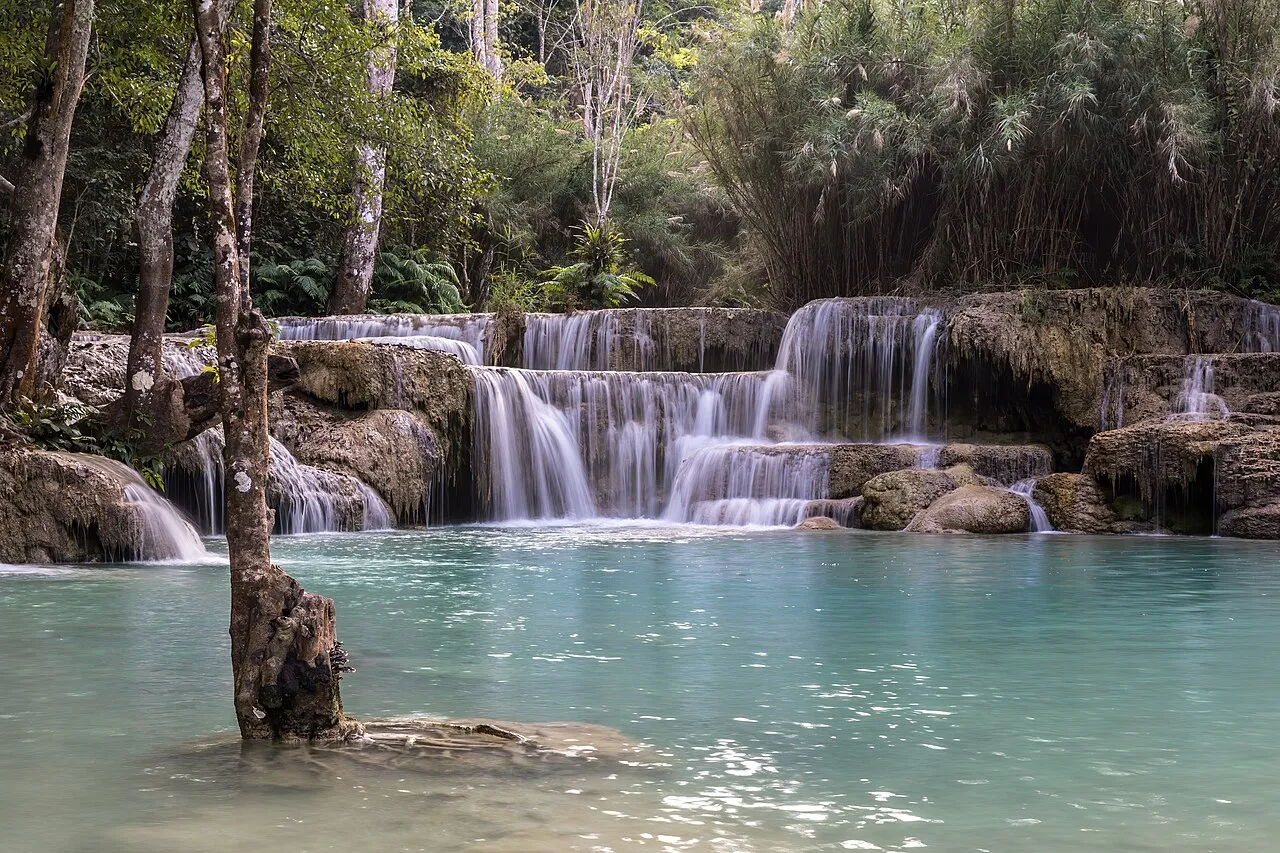
Kuang Si's colour and shape are the work of ordinary chemistry acting over a very long time. The stream that feeds the falls rises from springs in the karst limestone hills south of Luang Prabang, and as it filters through that rock it dissolves large amounts of calcium carbonate. When the water re-emerges into the open air and loses carbon dioxide, that mineral comes back out of solution and hardens into travertine (also called tufa) — a porous, cream-coloured limestone that plates every surface the water touches.
Over centuries this deposition has built the falls' most distinctive feature: a staircase of natural dams. Travertine grows fastest at the lip of each pool, where the water is most aerated, so the rims slowly rise and trap the water behind them into broad shallow basins. The result is the terraced, tiered profile that makes Kuang Si look almost architectural, as though the pools had been carved and stacked on purpose.
The famous turquoise is an optical effect rather than a pigment. Suspended microscopic particles of calcium carbonate scatter sunlight, and the fine white travertine lining the pool floors reflects it back, so the shallow water reads as a luminous blue-green. Because the effect depends on mineral concentration, the colour is at its most saturated in the dry season, when flow is low and calcium-rich; after heavy monsoon rain the pools can run milky or brown as run-off and sediment overwhelm the mineral signal. The same living, water-built limestone means the formations are fragile — standing on the rims or scrubbing the travertine wears away deposits that took generations to accumulate, which is why the upper terraces are roped off.
Wildlife
Kuang Si is as much a wildlife site as a geological one, and two managed attractions at the trailhead make that explicit.
- Tat Kuang Si Bear Rescue Centre — run by Free the Bears, the sanctuary is home to dozens of Asiatic black bears (moon bears, named for the pale crescent on their chest) and a smaller number of sun bears, the world's smallest bear species. Nearly all were confiscated as cubs from poachers or from the bile-farming trade, in which bears are caged for the extraction of bile used in traditional medicine. Raised walkways let visitors watch the bears forage in forested enclosures, and interpretation boards explain why the species are trafficked and how enforcement works across Laos's porous borders.
- Kuang Si Butterfly Park — a small privately run garden near the entrance where native butterfly species, fish ponds, and buffalo ponds sit alongside displays on the ecology of the surrounding hardwood forest and simple wastewater filtration.
Beyond the fences, the forest itself rewards a slow eye. The mixed dipterocarp canopy shelters hornbills, kingfishers, drongos, and barbets, while monitor lizards and butterflies work the damp margins of the trail. Because the falls sit within the forested hinterland of a country that is roughly 60% forest cover, an early or late visit — before the tour groups or after they leave — often turns up more birds along the quiet upper path than anywhere in the town itself. A naturalist guide who can name what is calling from the canopy turns the walk between pools into the richest part of the day.
Trails
The site is a single up-and-down trail that gains height alongside the water, and knowing its stages helps you pace the visit.
- Entrance to the pools (10–15 min, easy): a gravel-and-boardwalk path runs from the ticket gate past the Bear Rescue Centre and butterfly park to the first of the lower terraced pools. This section is gentle enough for most visitors and is where the swimming areas, changing rooms, and footbridges are concentrated.
- Pools to the base of the main fall (5–10 min, easy–moderate): the boardwalk continues up past a chain of increasingly photogenic basins to the wooden bridge facing the 60-metre cascade — the postcard view of Kuang Si.
- The upper climb to the source pool (20–30 min each way, strenuous): an unmarked earth path on the left flank of the main fall switches back steeply to the top of the drop and on to the secluded upper pool where the spring emerges. There are no handrails, the steps are tree roots and packed mud, and the ground is treacherous when wet — this stretch is the least-visited and most rewarding part of the falls, and the part where a guide who knows the route earns their fee.
Accessibility note: stages 1 and 2 suit families, older visitors, and anyone unsteady on their feet; stage 3 does not, and is best skipped in the monsoon when the upper trail is closed or dangerously slick.
When to Visit
Open: Daily 8 AM – 5:30 PM (last entry 5 PM). Bear Rescue Centre and Butterfly Park: Same hours; the bear centre is included in the falls entry fee, the butterfly park charges separately. Swimming: Permitted in the lower pools during the dry season (approximately October–May) only. Best lighting: Mid-morning (9–11 AM), when the sun angles into the pools and the calcium-rich dry-season water shows its deepest turquoise saturation. Quietest windows: the 8:30 AM opening before the first Luang Prabang minivans, and the last hour before 5 PM closing once the day-trippers have left.
Admission and Costs
Entry fee: 20,000 LAK (approximately $1), which also covers the Free the Bears sanctuary. Swimming, changing rooms, and lockers: included or a small additional fee. Kuang Si Butterfly Park: separate admission of roughly 40,000 LAK ($2). Guided transport from Luang Prabang: $5–8 per person by shared tuk-tuk or minivan seat; private tuk-tuk hire $15–20 round trip. Private guided day trip: $50–80 per person including transport, matching the Kuang Si excursion rate quoted on the city guide-cost table. Carry small kip notes — card payment is not available at the gate.
The Case for a Guide
Kuang Si is accessible independently, but a guide adds significant layers to the experience — particularly for understanding the geology, the upper trail, and the Hmong village context.
- Upper trail: The unmarked path behind the main waterfall ascends to the spring source and the most secluded upper pools, inaccessible without someone who knows the trail — this is the most dramatic and least-visited area of the entire falls system
- Travertine geology: The guide explains the calcium carbonate deposition process that creates both the turquoise colour and the slow-building terrace structures, and why human contact with the formations slowly erodes them — context that shapes responsible visiting behaviour
- Bear Rescue Centre: A guide with knowledge of Laos's wildlife-trade history can explain why Asiatic black bears and sun bears are targeted, the specific challenges of enforcement in a country with porous borders, and how the Free the Bears centre fits into a broader regional conservation framework
- Hmong village combination: The Hmong-speaking village of Ban Thapene on the road between Luang Prabang and Kuang Si has a weaving and traditional-textile tradition that a guide introduces with appropriate cultural context — without a guide the village stop is superficial
Tips for Visitors
Arrive early: The first tuk-tuk from Luang Prabang arrives at around 8:30 AM — this is the best window before tour groups from 10 AM onward. Bring swimwear: Even in the cool season the lower pools are swimmable and irresistible; wear it under your clothes, as changing space is limited. Stay for the whole day: The waterfall is most photogenic at different times — pools in morning, main waterfall in midday, upper trail in the afternoon before closing. Dry season only for swimming: The trails behind the main falls become unsafe in the monsoon when water volume triples. Mind the travertine: Stay off the roped terrace rims — the mineral crust is living rock that erodes under foot traffic. Insect repellent: Essential on the forest trail — malaria risk is low in this zone but mosquitoes and insects are prevalent. Combine wisely: Pair Kuang Si with a town day covering Mount Phousi at sunset and Wat Xieng Thong in the morning for a balanced Luang Prabang itinerary.
Frequently Asked Questions
Why is the water at Kuang Si such an intense turquoise colour?
The distinctive powder-blue and turquoise colour comes from calcium carbonate dissolved in the spring water that feeds the falls. As the mineral-rich water flows over the limestone formations, it deposits travertine — the same calcium carbonate mineral that creates terraced hot spring formations at sites like Pamukkale in Turkey. The colour shifts seasonally: deepest turquoise in the dry season (November–April) when water volume is lower and calcium concentration is higher; lighter blue-green in the monsoon season when rain dilutes the mineral content and stirs up sediment that turns the pools milky brown after heavy storms.
Can you swim at Kuang Si Waterfall?
Swimming is permitted in the lower terrace pools during the dry season (approximately October through May). The upper pools and the main waterfall face are restricted to protect both the delicate travertine formations and the safety of visitors. A small changing area and lockers are available near the lower pools, and a wooden footbridge crosses the stream so you can reach the deeper pool beneath the largest cascade, where a rope swing and a shallow ledge make natural entry points. Swimming is not advised during the rainy season when water volume increases significantly and currents become unpredictable.
How do you get from Luang Prabang to Kuang Si Waterfall?
Kuang Si is 30 km south of Luang Prabang, requiring approximately 45–60 minutes by road. Options include shared tuk-tuk transport (arranged through guesthouses for approximately $5–8 per person each way), private tuk-tuk hire ($15–20 round trip), or a guided day trip that combines Kuang Si with the Hmong cultural village at Ban Thapene or an Ock Pop Tok weaving visit along the route. Minivan seats booked through the tour agencies on Sisavangvong Road are the cheapest fixed-price option and usually depart around 8:30 and 11:30 in the morning.
What else is there to see at Kuang Si besides the waterfall?
Two additional attractions sit at the trailhead. The Tat Kuang Si Bear Rescue Centre, run by the conservation charity Free the Bears, cares for dozens of Asiatic black bears (moon bears) and sun bears rescued from the illegal wildlife trade, with viewing platforms over forested enclosures and interpretation boards on the bile-farming trade the animals were saved from. Nearby, the privately run Kuang Si Butterfly Park keeps native butterfly species and explains the ecology of the surrounding hardwood forest. Both take under an hour and turn the falls into a half-day rather than a quick photo stop.
Is Kuang Si Waterfall suitable for visitors with limited mobility?
The lower section is manageable for most visitors: a gravel and boardwalk path leads from the entrance past the Bear Rescue Centre to the first pools and the base of the main cascade in about 10–15 minutes on gentle gradients. Beyond that, the terrain becomes demanding — the climb to the top of the 60-metre fall and the source pool follows steep, root-tangled, and often slippery earth steps with no handrails, which is not advisable for anyone with mobility or balance concerns, and is closed or hazardous after rain. Wheelchair users and families with strollers can still enjoy the lower pools, the footbridges, and the bear sanctuary without attempting the upper trail.