
Spiritual Significance
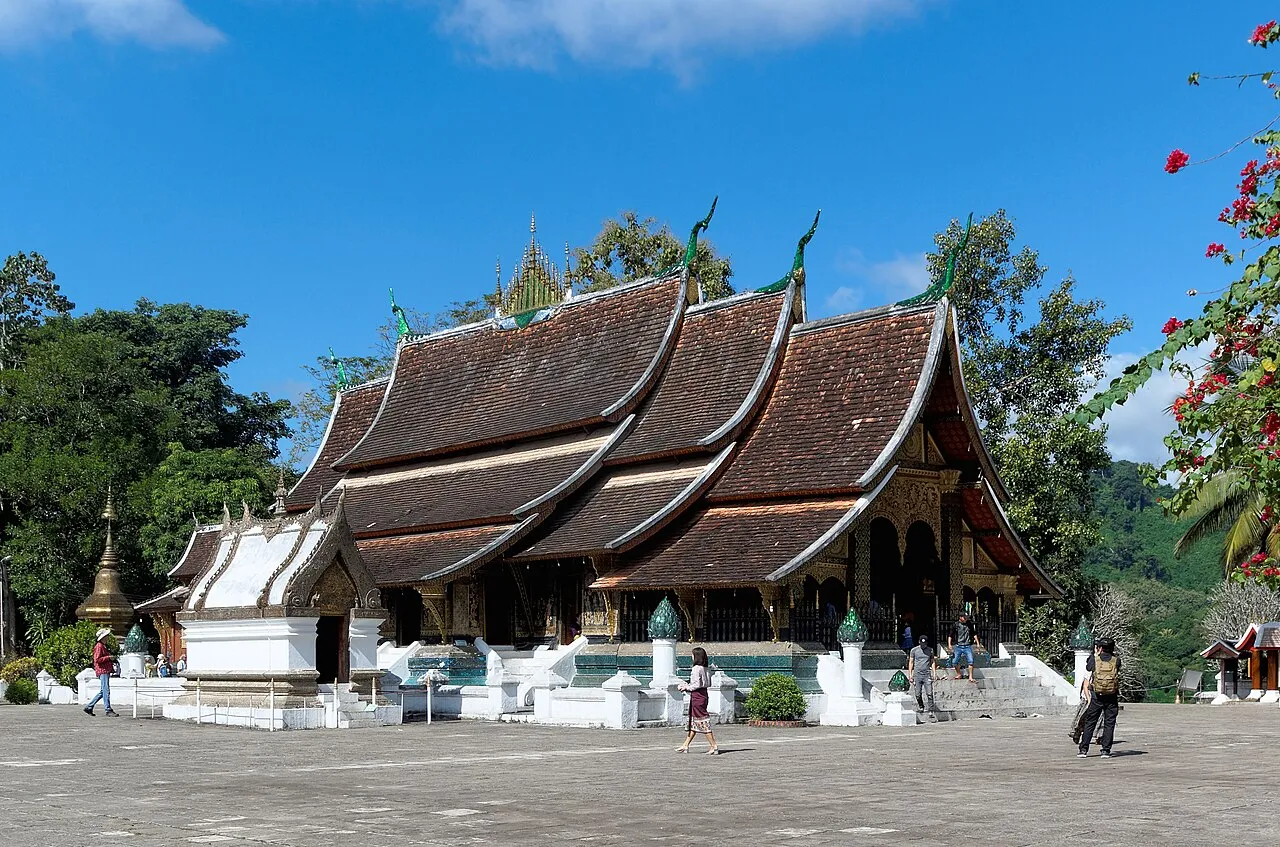
Wat Xieng Thong was never only a monument; it was the ritual heart of Lao kingship. Setthathirath built it where the rivers meet because that confluence marked the spiritual boundary of the royal city, and coronations were consecrated here before a new king could claim the throne. The temple's fortunes were bound to the monarchy's, which is why its survival feels so charged today.
The hall that crowned kings also conducted their funerals. Royal cremation rites began at Wat Xieng Thong, the gilded carriage in the funerary hall carried the urns of the dead through the streets, and the monastery's monks presided over the passage from death toward rebirth — a cycle that gives the compound its layered meaning of enthronement and mourning in one place.
As a living wat, it still orders daily devotion. Lao Buddhists come to make merit, offer incense before the principal Buddha, and join the dawn alms round (tak bat) that threads through the whole peninsula. Reading the temple well means seeing it as Theravada practice first and art second — the mosaics and roofs are acts of devotion, not decoration.
Visitor Etiquette
Wat Xieng Thong is an active monastery, and the etiquette expected of visitors is real, not ceremonial. Cover shoulders and knees: sleeveless tops, shorts, and short skirts are turned away at the sim door, and a light scarf or sarong solves it instantly.
- Remove your shoes before entering the ordination hall, and step over — never on — the raised threshold
- Lower yourself near seated monks or the Buddha image; never point your feet toward either, and don't turn your back on the altar for a photo
- Women should not touch monks or hand objects to them directly; place anything meant for a monk on a cloth or surface instead
- Keep voices low and silence your phone, as services may be underway inside the hall
- Ask before photographing monks, and never use flash near the mosaics or murals
Donations are welcome but never demanded, and the monks' living quarters (kutis) are private. Treating the compound as a place of worship rather than a photo set is the surest way to be welcome in it.
When to Visit
Wat Xieng Thong is open daily, roughly 8 AM to 5 PM, and a single early start covers it comfortably in forty-five minutes to an hour. The compound is small, so timing matters more for light and crowds than for logistics.
- Early morning (8–9 AM) — the gate opens to near-empty courtyards and soft, even light; the best window if you want the sim and mosaics to yourself before the tour groups arrive
- Mid-morning (9–11 AM) — angled eastern sun rakes across the rear wall and makes the Tree of Life mosaic flare; this is the photographer's hour
- Late afternoon (toward the 5 PM close) — warm golden light on the roofs and quiet access to the riverside terrace
Chanting: monks hold morning prayers around 6 AM and evening prayers around 6 PM. Both fall outside public hours but can be heard, and respectfully observed, from beyond the gate without entering during worship.
Admission and Costs
Entry to the temple grounds costs 20,000 LAK (about $1), paid at the gate on Sakkaline Road; the ticket covers the sim, the red chapel, and the funerary carriage hall. Children are generally admitted free, and there is no separate camera charge for still photography.
A licensed guide is the main optional cost and the one that changes the visit most. Typical rates run:
- Temple-only guided visit — roughly $5–10 per person added to a group old-town walk
- Private half-day heritage circuit — $25–40, pairing Wat Xieng Thong with the Royal Palace Museum and Mount Phousi
- Full-day private guide — $40–70, in line with Luang Prabang's wider guide rates
Local currency is the Lao kip (₭); carry small notes, as the gate rarely changes large bills and cards are not accepted. A modest donation in the sim alms box is customary if you light incense, and tipping a private guide $3–5 per person for a half-day is a normal courtesy rather than an obligation.
The Case for a Guide
Wat Xieng Thong's mosaics and rooflines make immediate visual sense; their meaning and craft do not. A guide turns a handsome compound into a readable one.
- Tree of Life mosaic: beyond the glittering surface lies a precise programme of Buddhist cosmology — the cosmic tree, the animals, and the worshippers each carry meaning that a guide decodes panel by panel
- The funerary carriage: the towering gilded chariot in the carriage hall bore the royal urns during cremation processions; a guide explains the ritual and the Phra Lak Phra Lam (Lao Ramayana) scenes carved along its sides
- Architectural grammar: the low triple roof, the naga finials, the orientation of the sim, and the placement of subsidiary shrines follow a deliberate code of Buddhist cosmology and Lao royal symbolism
- Historical context: linking the temple to Luang Prabang's royal past and the Royal Palace Museum across town turns separate sights into one story of Lan Xang kingship
Tips for Visitors
Mosaic photography: the Tree of Life wall reads best between 9 and 11 AM, shot square-on from about ten metres as the eastern sun lifts the colours. For the roofs, the hour before the 5 PM close gives the warmest light and the thinnest crowds.
Dress for entry: shoulder and knee coverage is enforced at the sim door — carry a scarf if you are temple-hopping in the heat. Quiet hours: arrive at opening or in the last hour to dodge the mid-morning tour pulse.
Combine nearby: the Royal Palace Museum and Mount Phousi sit within 800 metres, making a complete half-day of Luang Prabang's finest heritage — best paired with a separate full-day trip to Kuang Si Waterfall. River finish: the landing stage below the temple gives longboat views back to its river facade, a fitting end before you walk back down Sakkaline Road.
Frequently Asked Questions
When was Wat Xieng Thong built and why is it significant?
Wat Xieng Thong (Monastery of the Golden City) was founded around 1560 CE by King Setthathirath of the Lan Xang Kingdom — one of the last great royal temples raised before the kingdom fractured. It served as the royal coronation chapel and funerary temple for Luang Prabang's kings until the monarchy's abolition in 1975. Unlike most Lao temples lost to war or revolution, Wat Xieng Thong survived intact and is the finest surviving example of pre-colonial Luang Prabang temple architecture.
What are the glass mosaics at Wat Xieng Thong?
The rear wall of the sim (ordination hall) carries the famous Tree of Life mosaic — a full-wall cosmic tree flanked by animals and worshippers, composed of thousands of individually set coloured glass tiles against a dark ground. The red chapel opposite wears equally intricate mosaics of Lao mythology and village life. These glass-tile mosaics, added during the mid-20th-century restoration, are among the finest surviving examples of traditional Lao decorative art.
Is Wat Xieng Thong still an active temple?
Yes — Wat Xieng Thong remains an actively functioning Buddhist monastery with resident monks. Morning chanting (suad mon) begins at approximately 6 AM and evening prayers at around 6 PM. Visitors are welcome to observe these services respectfully from the outer areas of the sim without entering during active worship. The monks' living quarters (kutis) are off-limits, and temple etiquette — shoes off, shoulders covered, quiet voices — is strictly expected.
How do you get to Wat Xieng Thong and where is it?
Wat Xieng Thong sits at the far northern tip of the Luang Prabang peninsula, at the end of Sakkaline Road where it meets the Mekong. From the night market or the Royal Palace Museum it is a flat 10–15 minute walk north through the old town; a bicycle or short tuk-tuk ride works too. Most visitors fold it into a walking circuit of the historic quarter rather than arriving separately.
What is the gilded funeral carriage at Wat Xieng Thong?
Inside the funerary carriage hall stands the temple's gilded royal funeral chariot — a tall, wheeled vehicle fronted by multi-headed naga serpents, built in the early 1960s to carry the cremation urns of King Sisavang Vong. It is a land carriage drawn in procession, not a river barge, and its wooden panels are carved with episodes from the Phra Lak Phra Lam, the Lao Ramayana. It is one of the finest pieces of 20th-century Lao royal craftsmanship.