
Spiritual Significance
In Balinese Hindu cosmology, water (tirtha) is not merely physically purifying but spiritually transformative — a medium through which the divine realm makes contact with human existence. Tirta Empul's spring is classified as tirtha kamandalu, the most sacred grade of holy water in Balinese classification, reserved for major purification and for ritual use by high priests (pedanda) in temple ceremonies across the island.
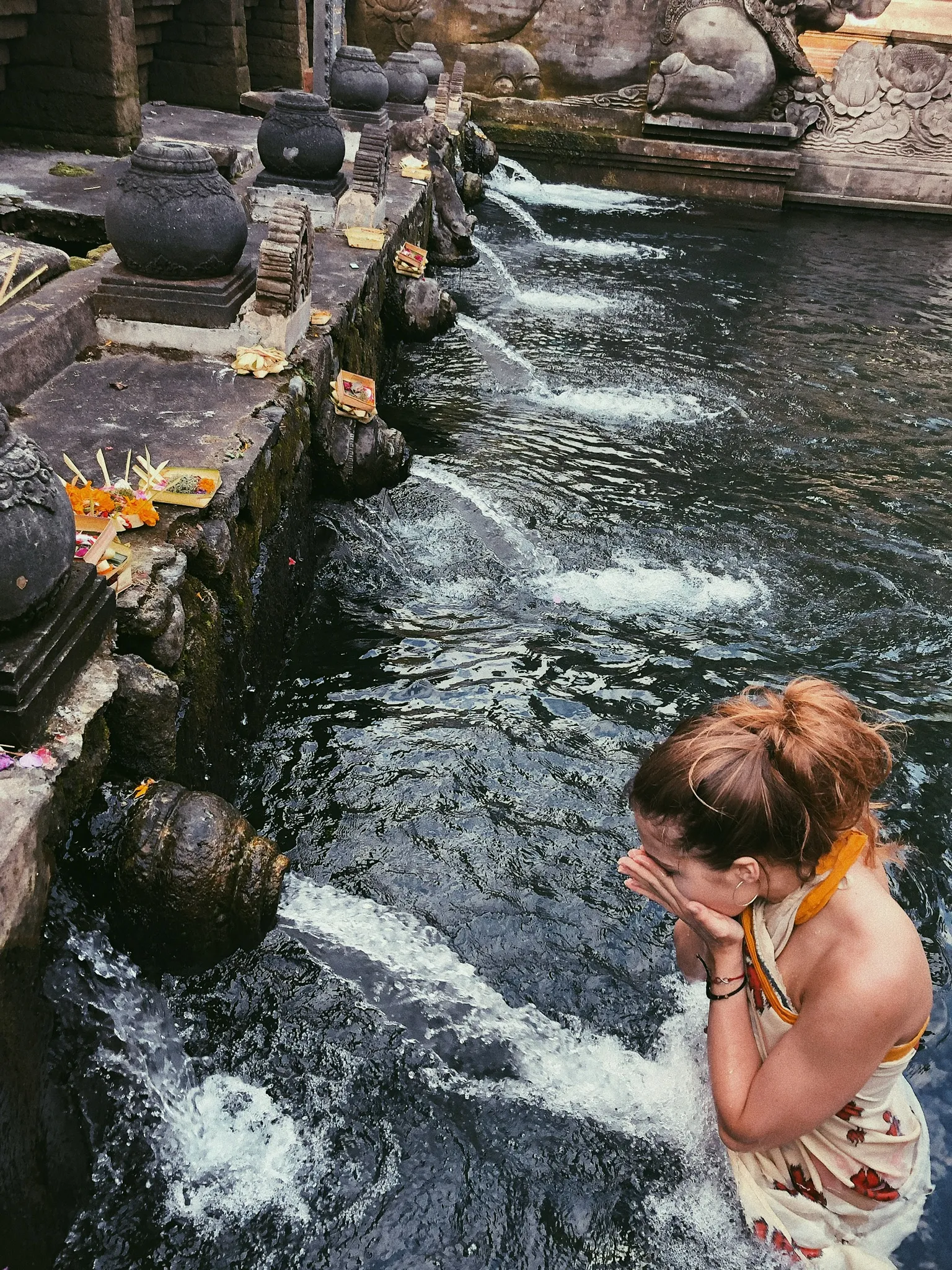
The melukat ritual performed at the bathing pool is a personalised sequence of immersions under specific spouts, each targeting different aspects of spiritual contamination (sebel): illness, grief, bad fortune, ancestral obligations, or general impurity accumulated through contact with death or emotional distress. The sequence is traditionally determined by a Balinese priest (pemangku) who reads the individual's spiritual condition and prescribes the appropriate spout order — making each melukat unique to the participant.
Visitor Etiquette
Dress code: Sarong and sash are mandatory throughout the complex — available at the entrance for IDR 15,000–20,000 rental. Shoulders must be covered; dedicated changing rooms are provided for visitors wishing to enter the bathing pools. Pool behaviour: If entering the pools, move from east to west in the main pool; avoid the two westernmost spouts which are reserved for purification of the deceased. Do not touch or obstruct the spring spout openings. Photography: Permitted throughout the outer and middle courtyards; do not photograph Balinese worshippers performing ritual without asking; the inner courtyard (jeroan) is closed to non-Hindu visitors and photography there is not permitted. Timing: Arrive before 9 AM for the most peaceful experience and the highest likelihood of observing genuine devotional activity before tourist groups arrive; midday is the most crowded window.
When to Visit
Open: Daily 9 AM – 5 PM (temple ceremonies may temporarily close specific areas). Best time: 7–9 AM — worshippers present before tourist groups arrive; quieter atmosphere for respectful observation and pool participation. Visit duration: 1–1.5 hours for independent visit; 1.5–2 hours with a guide including explanation of ritual sequence and temple history. Busy periods: Galungan and Kuningan festival days see several hundred additional devotees; extraordinary atmosphere but crowded pools.
Admission and Costs
- Entrance fee: IDR 50,000 (adults) / IDR 30,000 (children) — approximately USD 3 / USD 2
- Sarong rental: IDR 15,000–20,000 if not bringing your own
- Pool participation: Included in entrance fee; a small donation to the temple (dana punia) box is customary — IDR 10,000–25,000
- Temple guide: Available on-site for approximately IDR 100,000–200,000 per group for a 60-minute tour
- Guide from Ubud (half-day including Tirta Empul and Tegallalang): IDR 500,000–800,000 with transport
The Case for a Guide
Tirta Empul is arguably the site in Bali where a guide makes the greatest difference between a meaningful visit and a superficial one:
- Ritual explanation: The 30 spring spouts each have distinct functions in the melukat sequence; without knowing which spout addresses which spiritual concern, the entire ritual becomes an arbitrary washing exercise; a guide translates the sequence into comprehensible theological logic
- Active ceremony observation: On ceremonial days, a guide identifies the specific ritual stage being performed, explains the offerings' symbolism, and positions you respectfully near the action without intruding on devotees
- Historical context: The Warmadewa dynasty, the Pakerisan Valley's UNESCO significance, and the spring's mythology connect Tirta Empul to a wider arc of Balinese Hindu history that gives the site genuine depth
- Pool protocol: The spout sequence, the avoidance zones, and the appropriate behaviour in the bathing pools require local knowledge; a guide ensures visitors participate correctly and receive the experience as intended rather than as an awkward tourist intrusion
Tips for Visitors
Combine with: Tirta Empul is 15 minutes east of Tegallalang Rice Terraces and 25 minutes east of Ubud — both sites are natural combinations for a single morning circuit with a guide. Presidential Palace viewpoint: From the northeastern corner of the temple courtyard, the Tampaksiring Presidential Retreat (built by Sukarno in 1954) is visible on the hillside above — a guide explains its history and its relationship to the temple. Water shoes: Optional but useful if you plan to enter the bathing pools — the pool floor is smooth stone, manageable barefoot but slippery. Ceremony calendar: Ask your guide or hotel whether a major ceremony falls during your visit — attending Tirta Empul on a Galungan day is an extraordinary cultural experience but requires flexible timing.
Frequently Asked Questions
Can visitors join the melukat purification ritual at Tirta Empul?
Yes, and this is one of the most meaningful experiences available to visitors in Bali — but it requires respectful preparation. To enter the bathing pools, visitors must wear a sarong and sash (available for rent at the temple entrance for IDR 15,000–20,000) and leave an offering at the altar beside the pool before entering. Balinese etiquette requires entering the pools from the eastern end and moving west through the spouts in sequence; the final two spouts in the main pool are designated for the purification of the dead and should be avoided by visitors without specific guidance. A guide who explains the ritual's purpose, the correct sequence of spouts, and the appropriate prayers to observe makes the difference between an awkward tourist participation and a genuinely respectful spiritual engagement.
What is the history of Tirta Empul?
Tirta Empul was founded in 962 CE during the reign of the Warmadewa dynasty, the first recorded Hindu kingdom in Bali. The temple's founding myth connects it to a battle between the god Indra and the demon King Mayadenawa — Indra is said to have struck the ground to release a spring of holy water (amerta, the elixir of immortality) to revive his fallen soldiers. The spring has produced water continuously since at least the 10th century; hydrological studies show it draws from volcanic aquifers in Bali's central highlands, with a constant temperature of around 22°C regardless of season. The temple complex was expanded and restored by successive Balinese kingdoms over a thousand years; the current stone structures date primarily to the 17th–19th centuries, though the pool configuration reflects the original 10th-century layout.
What are the different areas inside Tirta Empul?
Tirta Empul is divided into three main courtyard zones following the Balinese three-zone (tri mandala) layout. The outer courtyard (jaba) holds the entrance, ticket booth, and changing facilities. The middle courtyard (jaba tengah) contains the two main bathing pools: the larger Petirtaan Pembersihan with 30 spring spouts arranged in two rows, and the smaller Petirtaan Pengelukatan used for specific purification purposes. The inner courtyard (jeroan) is the most sacred zone and contains the main shrines and the spring's source — this area is only accessible to Balinese Hindus participating in formal ceremony. The former Indonesian presidential retreat, built by Sukarno in the 1950s and still used by the presidential administration, overlooks the temple from the adjacent hillside.