

Overview
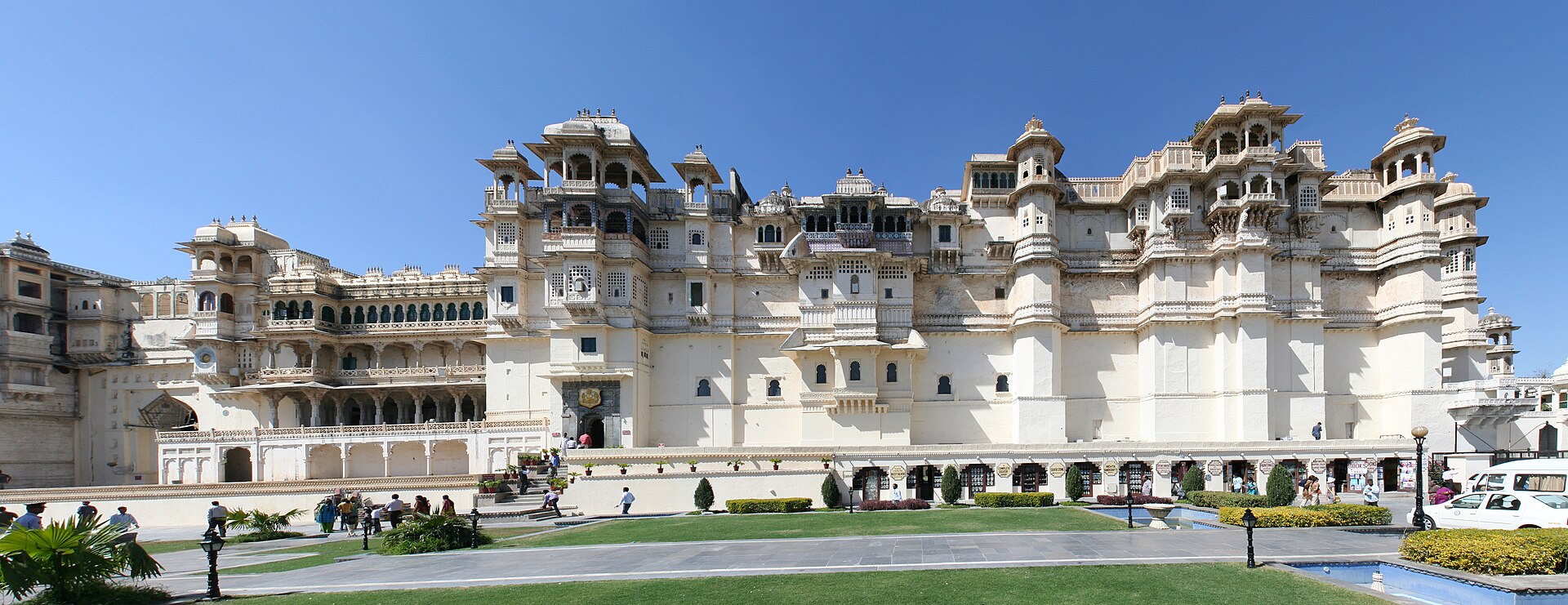
City Palace Udaipur is the largest palace complex in Rajasthan, stretching 244 meters along the east bank of Lake Pichola in a continuous sweep of sandstone, marble, and granite. Built over 400 years by successive Mewar rulers beginning with Maharana Udai Singh II in 1553, the palace blends Rajasthani fortification with Mughal decorative elegance across a maze of courtyards, towers, balconies, and gardens. The Mewar dynasty famously never submitted to Mughal authority -- the only Rajput dynasty to maintain this defiance -- and the palace reflects that independent spirit in every stone. The complex also served as a filming location for the James Bond film Octopussy (1983), adding a layer of pop-culture fame to its centuries of royal history. Jagdish Temple stands steps from the palace entrance, and Lake Pichola stretches below.
Architecture
The palace is a labyrinthine complex of courtyards, pavilions, terraces, and corridors built across four centuries in a blend of Rajasthani, Mughal, and European styles. The Mor Chowk (Peacock Courtyard) features three exquisite glass-mosaic peacocks adorning the walls, each representing a different monsoon season. The Sheesh Mahal (Mirror Palace) rivals Amber Fort's version, with mirrors arranged to create infinite reflections of a single flame. The Tripolia Gate is the triple-arched main entrance where maharanas were weighed in gold, which was then distributed to the poor. The palace's terraces offer panoramic views of Lake Pichola, the Jag Mandir and Lake Palace islands, and the Aravalli Hills beyond. Museum galleries house Mewar miniature paintings -- a distinct artistic tradition characterized by vivid color and detailed courtly scenes -- and weapons including the sword of Maharana Pratap.
Historical Significance
Construction began in 1559 under Maharana Udai Singh II, who founded Udaipur after the Mughal Emperor Akbar sacked the previous Mewar capital at Chittorgarh. Over 22 successive rulers expanded the palace across four centuries, each adding courtyards, towers, and gardens that reflected their era while maintaining the complex's architectural unity. The Mewar dynasty's defining characteristic was its refusal to accept Mughal suzerainty -- uniquely among the Rajput kingdoms -- and the palace embodies that fierce independence in its military architecture combined with artistic refinement. Maharana Pratap, the legendary warrior who fought the Mughal army at the Battle of Haldighati in 1576, remains the dynasty's most celebrated figure; his sword and armor are displayed in the palace museum. The arms gallery houses weapons spanning four centuries of Mewar resistance.
When to Visit
Museum: daily, 9:30 AM - 5:30 PM. Last entry: 4:30 PM. Best time: morning (10-11 AM) for softer light in the courtyards and smaller crowds.
Admission and Costs
Foreigners: ₹300 ($3.60). Indian nationals: ₹100. Camera fee: ₹200. Guide: ₹500-1,000 for a 1.5-2 hour tour.
Tips for Visitors
Allow 2-3 hours: the palace is vast, and a guide prevents you from missing the best rooms in the maze of corridors. Sunset from the terrace: the upper terraces catch golden light on Lake Pichola -- time your visit to end there. Combine with the lake: exit through the palace to the jetty for a sunset boat ride. Part of the palace is a hotel: the Fateh Prakash Palace wing operates as a luxury hotel -- you can dine there without staying. Sound-and-light show: evening performances in the Manek Chowk courtyard bring Mewar history to life. Visit Jagdish Temple on the way in or out -- it is just steps from the palace entrance.