

Overview
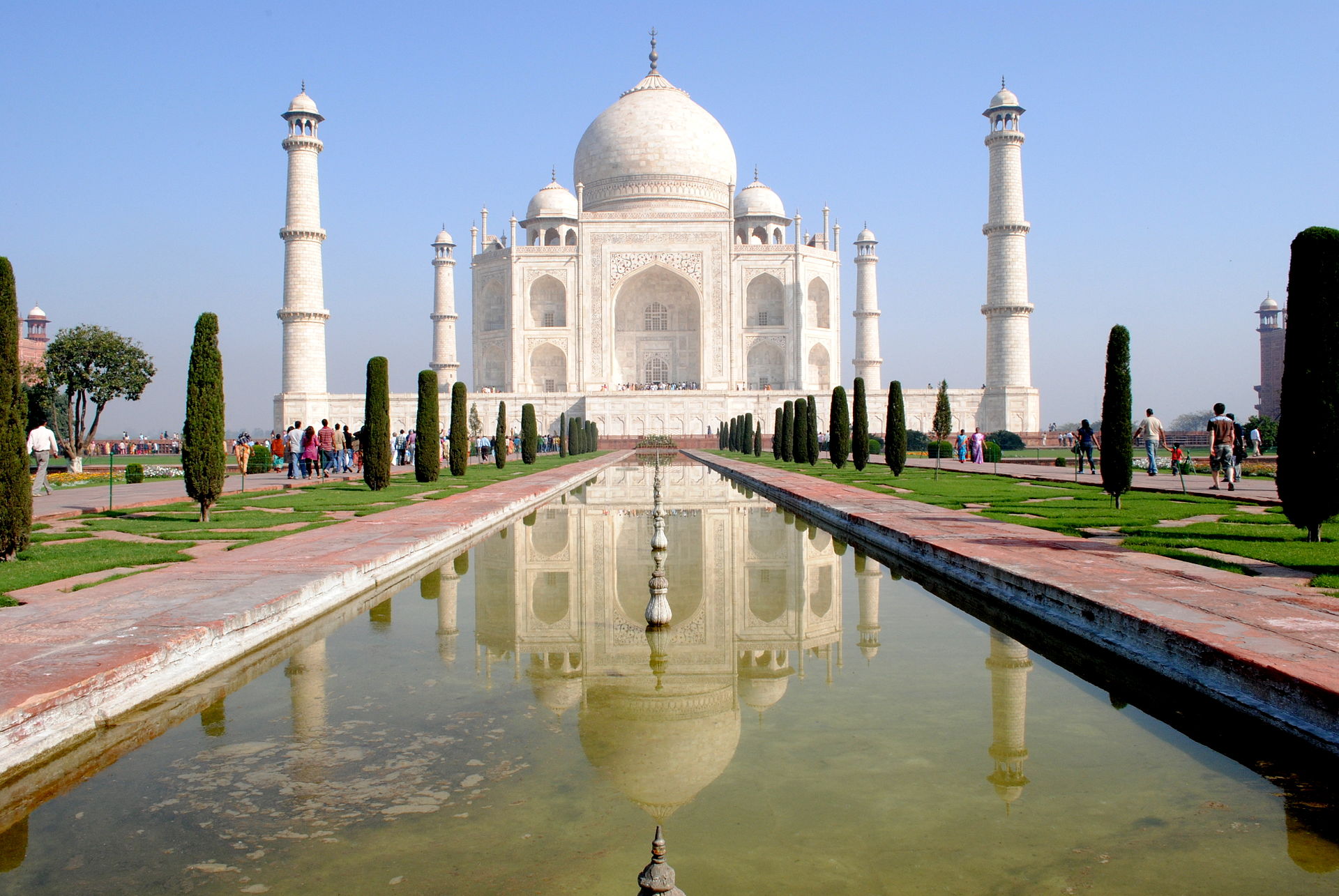
The Taj Mahal is a white marble mausoleum commissioned in 1632 by Mughal Emperor Shah Jahan in memory of his wife Mumtaz Mahal, who died during the birth of their fourteenth child. Completed in 1653 after twenty-two years of labor by some 20,000 artisans, it is widely regarded as the finest example of Mughal architecture and holds UNESCO World Heritage status. The structure draws on Persian, Islamic, and Indian design traditions, its symmetry broken only by Shah Jahan's own cenotaph, added after his death. 28 types of semi-precious stones sourced from across Asia are inlaid into the marble in intricate floral patterns. A guide explains the optical illusion of the minarets, which lean outward as an earthquake safeguard, identifies each of the inlaid stones by origin, and points out how the Quranic calligraphy increases in size as it rises so that every letter appears uniform when read from the ground. After visiting the Taj, continue to Agra Fort to see where Shah Jahan spent his final eight years imprisoned, gazing at this monument through a window, and consider a half-day trip to Fatehpur Sikri.
Architecture
The white Makrana marble was quarried 400 kilometers away in Rajasthan; the 28 varieties of semi-precious stones inlaid into its surface — lapis lazuli from Afghanistan, jade from China, turquoise from Tibet, carnelian from Arabia — traveled trade routes spanning half the known world. A guide reveals what photographs cannot. The four minarets lean imperceptibly outward — an earthquake-proof design ensuring they would fall away from the main dome rather than onto it. The calligraphy on the entrance arch is subtly scaled larger as it ascends so that every letter appears the same size when read from the ground. The marble changes color throughout the day: pinkish at dawn, brilliant white at noon, golden at sunset, and translucent blue under moonlight. These are not accidental effects but deliberate engineering by master builders whose names a guide can recite. The Charbagh gardens divide into four quadrants with raised pathways and water channels reflecting the structure.
Historical Significance
The pietra dura inlay technique uses 28 types of gemstones set into marble in floral patterns — a craft brought by artisans from as far as Samarkand and Baghdad. Every element mirrors exactly across the central axis, except for one thing: Shah Jahan's own cenotaph, added after his death, which breaks the symmetry his architects had so carefully maintained. Complete Quranic surahs are inscribed along the arched portals, scaled for visual uniformity. The Taj holds UNESCO World Heritage status and remains the head shrine of Mughal funerary architecture. Visit Agra Fort to see the Musamman Burj, the octagonal marble tower where Shah Jahan spent his final eight years imprisoned, gazing across the Yamuna at the monument he had built.
When to Visit
Open: Saturday-Thursday, 6:00 AM - 6:30 PM. Closed every Friday for mosque prayers. Night visits: available on full moon nights and two days either side (8:30 PM - 12:30 AM, limited to 400 visitors). Best time: sunrise (6-7 AM) for the famous pink-to-white color shift and the smallest crowds.
Admission and Costs
Foreigners: ₹1,100 ($13.20) including water and shoe covers. Indian nationals: ₹50. Children under 15: free. Night viewing: ₹750 foreigners, ₹510 Indians (advance booking required). ASI-approved guide: ₹1,000-1,500 for a 2-hour tour. A composite ticket with Agra Fort saves money.
Tips for Visitors
Enter from the East Gate: Shorter queues than the West Gate, and you approach through gardens for the classic reveal. Bag restrictions: Only small bags allowed. Lockers available at gates (free). Electronics, food, and tripods are restricted. Shoe covers provided: Included in the foreigner ticket price. You can also go barefoot on the marble platform. Mehtab Bagh alternative: For sunset views without entering (and without paying), cross the Yamuna to Mehtab Bagh for the Taj reflected in the river. Combine with Agra Fort: The composite ticket saves money and the fort provides the view Shah Jahan had of his creation. Book night visits early: Only 400 spots per night. Book through the ASI website or your hotel.