
Walking Route
Landmarks Along
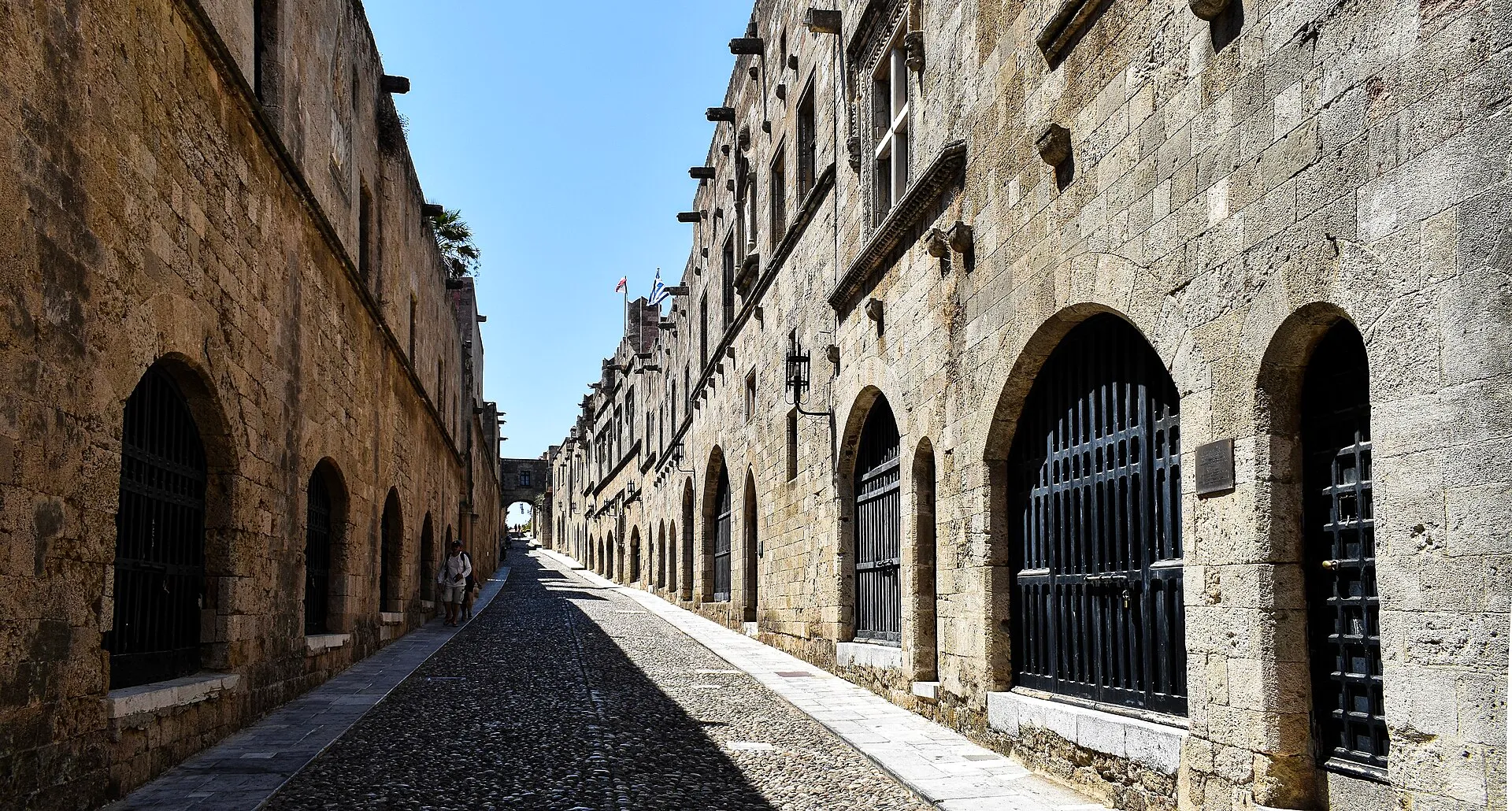
Walking uphill from Museum Square, the street unfolds as a sequence of set-piece landmarks; the interactive walking route above maps each one in order. Roughly midway on the right stands the Auberge of France, the largest and most ornate of the inns, its facade crowded with carved coats of arms, fleur-de-lys, gargoyles, and the arms of Grand Masters Pierre d'Aubusson and Emery d'Amboise. Beside it the small French Chapel and the Chapel of the Virgin (Our Lady of France) carry a fifteenth-century relief of the Madonna and Child.
Opposite rise the more restrained Auberge of Italy, bearing the arms of Grand Master Fabrizio del Carretto, and the Auberge of Provence with its four heraldic shields set in the arms of a cross. Lower down sits the Inn of the Order of the Tongue of Auvergne with its distinctive Aragonese horseshoe doorway, while the long, sober Auberge of Spain (housing the tongues of Aragon and Castile-León-Portugal) occupies much of the western side. At the very top the lane opens onto the Palace of the Grand Master, and at its foot the arched Gothic loggia of the fifteenth-century Hospital of the Knights — now the Archaeological Museum of Rhodes — anchors the lower end. Read together, these facades are effectively a heraldic index of the Order's leadership across the fifteenth century.
Photo Spots
The single best vantage point is the bottom of the street looking uphill toward the Palace of the Grand Master, where the gentle incline compresses the auberges into a continuous corridor of Gothic stone and the crenellated palace towers close the frame at the top — shoot this in early morning (7–9 AM) before crowds fill the lane. The connecting stone flying arches that span the street between buildings make natural frames; stand beneath one and shoot through it to layer arch upon arch into the distance.
For facade detail, the Auberge of France rewards a tight shot of its carved escutcheons, best in morning light when the east-facing reliefs catch direct sun and the shadows deepen the carving. Looking downhill from near the palace gives the reverse composition, with the rooftops of the Old Town and, on clear days, a sliver of sea beyond. In late afternoon in spring or autumn, raking golden light skims the cobbles and stone textures, and the near-empty street after 6 PM in summer allows clean, people-free frames the daytime crowds make impossible. A wide 24–35mm lens captures the corridor effect; a short telephoto isolates single doorways and the crocodile-like gargoyles of the French auberge.
When to Visit
The street is a public lane, open at all hours and free to enter — there is no gate, ticket, or closing time. Timing matters only for atmosphere and light:
- 7–9 AM — the most atmospheric window: soft raking light, cool stone, and the lane almost to yourself before the day's cruise passengers arrive.
- 10 AM – 2 PM (summer) — by far the busiest stretch, when tour groups and cruise-ship crowds fill the narrow corridor; pleasant but hard to photograph cleanly.
- After 6 PM (summer) — the second sweet spot, when day-trippers have left and low sun rakes across the west-facing carvings.
The walk from Museum Square to the Palace takes about 10 minutes at a strolling pace; most guided visits linger 30–45 minutes. Walk it in both directions — the perspective, the shadows, and the visible facades change completely depending on whether you are heading up toward the Palace or back down toward the sea.
Admission and Costs
Walking the street is free, and it is included in virtually every Old Town walking itinerary. Costs arise only at the monuments that bookend it:
- Palace of the Grand Master (top of the street): €10 entry.
- Archaeological Museum of Rhodes (the Hospital, at the lower end): €6; a combined Palace + Museum ticket costs €12.
- Guided group tour of the Old Town that includes the street: €20–35 per person (about $22–38).
- Private guide for the Street of the Knights and Palace combined: €40–80 (about $44–88) for up to six people, typically 1.5–2 hours.
Because the street's value is almost entirely interpretive rather than physical, the private-guide option delivers the greatest uplift here of any monument in the northern Old Town.
The Case for a Guide
The Street of the Knights is visually spectacular, but its significance is almost entirely a matter of historical knowledge — the stones say little without interpretation:
- Identifying the auberges — Each building belonged to a different tongue; a guide can name each one, explain its original function, and trace what became of it after 1522.
- Decoding the heraldry — The carved shields and escutcheons are readable documents; a guide versed in medieval heraldry can pin specific Grand Masters and noble houses to particular facades.
- The military order's structure — Understanding the Hospitallers as both a nursing order and a naval fighting force explains why a palace, a great hospital, and residential auberges stand side by side in a single quarter.
- Transition to Ottoman and Italian use — The afterlife of each building — mosque, dwelling, consulate, or restored showpiece — is a story in itself, and the Italian re-fronting of the 1930s repays a critical eye.
Pairing the street with the Palace of the Grand Master and the museum at its foot turns a ten-minute walk into a coherent narrative of the Order's rise, siege, and departure to Malta.
Tips for Visitors
Walk the street from bottom to top (from Museum Square toward the Palace) on your first pass, then return down the opposite pavement to see the facades you were facing the other way. The carved coats of arms above the doorways read best in the morning, when the east-facing reliefs catch direct light. Look for the small plaque near the middle of the lane marking the boundary of the Collachium — the Knights' reserved inner quarter — from the Burgus, the mixed commercial and residential town below; it is an invisible line today but a defining social division in the medieval city.
Wear flat, grippy shoes: the original cobbles (hokhlakia-style paving in places) are uneven and slick after rain. There is no shade and no water fountain on the lane itself, so carry water in the warm season and fill up beforehand. Combine the walk with the Palace of the Grand Master at the top and the Archaeological Museum at the foot for a natural half-day heritage circuit, and if you are extending the trip beyond the Old Town, the clifftop Acropolis of Lindos an hour down the coast pairs well on a second day. The lane looks its absolute finest in late-afternoon light in spring or autumn, when the low sun rakes the stone textures of the carved facades.
Frequently Asked Questions
What are the buildings along the Street of the Knights?
The buildings are the auberges — the residential and administrative inns — of the Knights Hospitaller's eight national 'tongues' or language groups. Each tongue (France, England, Germany, Italy, Provence, Auvergne, Castile-Leon-Portugal, and Aragon) had its own auberge where knights of that nationality lived and dined together. The most completely preserved are the Auberge of France (the largest), the Auberge of Italy, and the Inn of the Order of the Tongue of Auvergne. Most are now used as offices and consulates and cannot be entered, but their facades are fully visible from the street.
How old is the Street of the Knights?
The street follows a route that existed in the ancient and Byzantine city, but the surviving buildings were constructed in the late fourteenth and fifteenth centuries, with several rebuilt after earthquake damage. The cobblestones visible today are original medieval paving. The Italian restoration of the early twentieth century straightened and repaved the street to some extent, but the building facades date primarily from the 1400s and represent genuine late Gothic architecture.
Is the Street of the Knights open to visitors?
The street itself is a public lane open at all hours, free to walk. The building interiors are not open to the public — they function as offices, consulates, and institutional premises. The exception is the Auberge of France, which occasionally opens for special events. The best experience of the street is to walk it early in the morning before the tourist crowds arrive, or after 6 PM in summer when the angle of light rakes across the stone facades and the cruise ship visitors have departed.
How do I get to the Street of the Knights?
The street sits in the northern part of the walled Old Town and is entirely pedestrian, so every approach is on foot. From the cruise and ferry berths at Kolona and the commercial harbour, enter through the Marine Gate (Pyli Thalassini) and walk about seven minutes up through Ippocratous Square. From Mandraki, the main town harbour, enter via the Liberty Gate (Eleftherias) or the Gate of Saint Paul near the fortifications; both bring you within a few minutes of the street's lower end at Museum Square, in front of the Archaeological Museum. There is no vehicle access inside the medieval walls, and the nearest paid car parks lie outside the Gate of Saint Athanasios and along the New Town waterfront.
Are there shops or restaurants on the Street of the Knights itself?
No — this is the deliberate character of the lane. Because the auberges are offices, consulates, and institutional premises, the street has no shops, cafes, or tavernas along it, which is exactly why it retains such an undiluted medieval atmosphere. For food and browsing you step off it at either end — Museum Square and the surrounding lanes at the bottom, and the Agiou Fanouriou and Sokratous streets a short walk into the commercial quarter, where tavernas, bakeries, and craft shops cluster. Eating on the street itself is not possible, so plan a meal before or after your walk rather than during it.