
Excavation History
The systematic archaeology of Lindos began with the Danish expedition of 1902–1914, led by Christian Blinkenberg and Karl Frederik Kinch under the Carlsberg Foundation. Their meticulous excavation of the sanctuary uncovered thousands of votive offerings and, most famously, the Lindos Chronicle — a marble stele inscribed in 99 BCE that catalogues the temple's legendary treasures and the dignitaries who dedicated them, from Pharaoh Amasis to Alexander the Great. The Danish finds, published across monumental volumes, remain the foundation of scholarship on the site and are largely held by the National Museum of Denmark. During the Italian occupation of the Dodecanese (1912–1943), archaeologists undertook extensive anastylosis — the re-erection of fallen columns using original stone — that gave the Doric Stoa and the Temple of Athena Lindia their present partly-standing form, though some early reconstructions used concrete now considered intrusive. Post-war Greek restoration campaigns, including a major EU-funded programme from the 1990s onward, have corrected earlier work and stabilised the medieval and ancient masonry that share the clifftop.
Key Artifacts
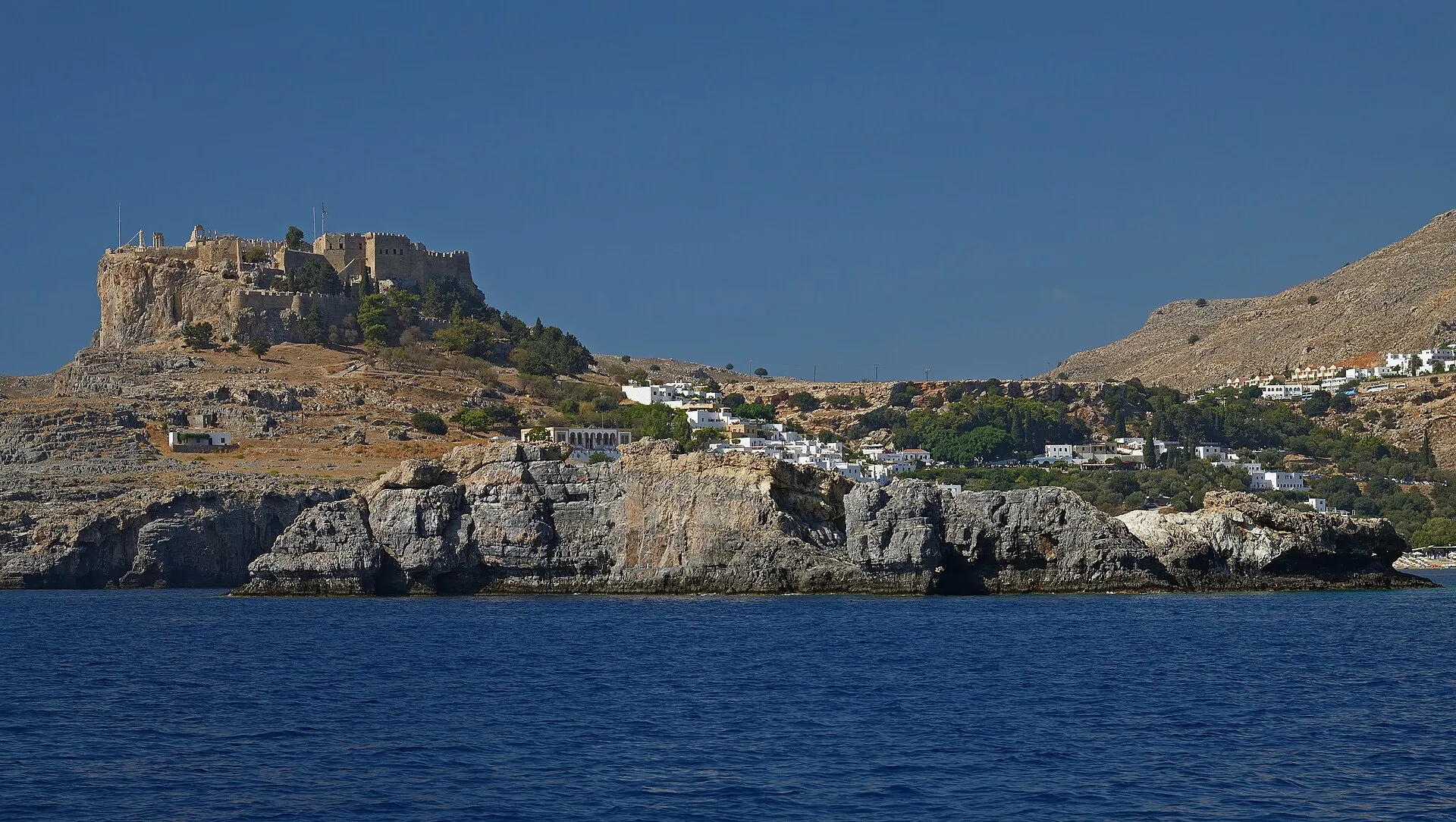
The site's centrepiece is the Temple of Athena Lindia, of which four columns and part of the cella walls survive from the fourth-century BCE rebuild on the highest point of the promontory. Below it stretches the vast Doric Stoa, a third-century BCE portico whose forty-two re-erected columns frame the monumental staircase leading up to the Propylaea, the ceremonial gateway to the sanctuary. Carved into the living rock at the foot of the ascent is the famous trireme relief — the prow of an ancient warship, attributed to the sculptor Pythokritos of Rhodes (also credited with the Nike of Samothrace) — which once served as the base for a statue honouring a naval commander. Layered over the Greek ruins are the fortifications and Governor's palace of the Knights Hospitaller, and within the walls stands the small thirteenth-century Byzantine church of St John, decorated with later frescoes. Visitors also encounter a Hellenistic rock-cut cistern, the foundations of a Roman temple dedicated to the emperor, and stretches of ancient terracing — a compressed record of Greek, Roman, Byzantine and Crusader building on a single cliff.
When to Visit
November–March: Tuesday–Sunday 8 AM–3 PM. April–October: Tuesday–Sunday 8 AM–7:40 PM. Closed Monday year-round. The best time to visit is early morning (8–10 AM) or late afternoon (after 4 PM) to avoid the intense midday heat and cruise-ship crowds. The ascent path begins at the entrance to Lindos village and takes 15–20 minutes. Allow 2–3 hours total for the climb, the site, the descent, and time in the whitewashed village below. The village itself — with its late-medieval merchant houses decorated with black-and-white pebble mosaics (chochlakia) — deserves at least an hour.
Admission and Costs
Acropolis entry: €12 (adults, April–October). Reduced rates for students with ID and EU citizens under 25. The acropolis is free to enter on certain Greek national holidays (March 25, October 28). Donkey rides up the hill: approximately €10 one way, negotiated with the operators at the foot of the hill. Combined guided tours from Rhodes Town that include Lindos transportation, the village, and the acropolis with a licensed guide: €40–60 per person including transport. Private day tour from Rhodes Town to Lindos: €150–250 for up to 6 people.
The Case for a Guide
The Acropolis of Lindos rewards visitors who arrive with preparatory knowledge, and a licensed guide with expertise in ancient Greek religion, military architecture, or Byzantine art can add substantial depth:
- Temple reconstruction — Only four columns remain of the original sanctuary; a guide who can describe the full building from archaeological evidence gives visitors a mental picture of the original scale
- The trireme relief — The carved warship relief at the base of the stairway is easy to miss and requires explanation to appreciate fully
- Knight's castle — The medieval fortifications built over and around the ancient site tell a distinct story that runs parallel to the archaeological layers
- The village below — The whitewashed Lindos village contains late-medieval merchant houses with distinctive interior decoration; a guide who can gain access to one of the private houses on the tour provides an unforgettable addition
Tips for Visitors
Carry substantial water — the path and the site are exposed, and the summer heat is intense. Start the ascent before 9 AM in July and August; by 10 AM, the queue for donkeys can be long and the path is busy. The view from the top looking south over Lindos Bay, where a small beach sits directly below the cliffs, is one of the finest compositions in the Aegean. Saint Paul's Bay to the north of the promontory is where the Apostle Paul is traditionally believed to have sheltered during a storm on his journey to Rome — a small chapel marks the site at beach level. The cobblestone paths of the village are original; some are steep and wet stones are slippery in morning dew.
Frequently Asked Questions
How do you get to the Acropolis of Lindos?
The acropolis is above the village of Lindos, approximately 50 km south of Rhodes Town. Buses from Rhodes Town run roughly hourly in summer (journey about 1 hour) and stop at the entrance to the village. From the village centre, the acropolis is reached either on foot (a steep 15–20 minute climb on cobbled paths) or by donkey — the traditional alternative still operating today. The path is exposed and rocky; good shoes and water are essential. Taxis and private transfers from Rhodes Town are also available.
What is at the top of the Acropolis of Lindos?
The acropolis contains the Propylaea (monumental gateway) and the Doric Stoa (covered walkway) from the third century BCE, and the principal Temple of Athena Lindia — four columns of which remain standing from the original fourth-century BCE structure. The Knights Hospitaller built their castle walls around and over the ancient remains in the fourteenth century, and a Byzantine church of St John (thirteenth century) survives within the walls. The views from the top across both sides of the promontory — Lindos Bay to the south and the Saint Paul's Bay to the north — are magnificent.
Is the climb to the Acropolis of Lindos difficult?
The cobbled path up the hill takes 15–20 minutes at a moderate pace. It is uneven in places and involves some steps. The path is exposed to the sun; midday in summer (July–August) is extremely hot. Morning visits (before 10 AM) or late afternoon visits (after 4 PM) avoid the worst heat and the crowds. People with limited mobility should consider the donkey option. The acropolis itself is also uneven, with ancient masonry and rough ground; flat, stable shoes are required.