
Palace of Versailles timeline
-
Louis XIII's hunting lodge
A modest brick-and-stone lodge in the woods became the seed of the future palace.
-
The Sun King's great works begin
Louis XIV launched the enlargement, drawing in Le Vau, Le Brun, and the gardener André Le Nôtre.
-
Court and government move in
Versailles became the seat of French power, binding the nobility to the king's daily orbit.
-
Hall of Mirrors completed
Jules Hardouin-Mansart's 73-metre gallery of 357 mirrors set the standard for royal grandeur in Europe.
-
Royal Opera inaugurated
The gilded opera house opened for the wedding of the future Louis XVI and Marie Antoinette.
-
The court leaves for Paris
The women's march on Versailles forced the royal family back to the capital, ending the palace's reign.
-
Museum of the History of France
Louis-Philippe reopened Versailles as a national museum dedicated to all the glories of France.
-
Treaty of Versailles signed
The treaty ending the First World War was signed in the Hall of Mirrors on 28 June.
-
UNESCO World Heritage listing
The palace, gardens, and Trianon estates were inscribed together as a World Heritage Site.
Historical Significance
Louis XIV built Versailles not merely as a home but as a political instrument. By compelling the great nobles of France to live at court and compete for his favour, he drained the aristocracy of the independence that had fuelled a century of civil wars, binding their status to his person. UNESCO frames the achievement in European terms:
The Palace of Versailles was the principal residence of the French kings from the time of Louis XIV to Louis XVI. Embellished by several generations of architects, sculptors, decorators and landscape architects, it provided Europe with a model of the ideal royal residence for over a century.
The palace has since witnessed pivotal moments far beyond the Ancien Régime. The Treaty of Versailles that ended the First World War was signed in the Hall of Mirrors on 28 June 1919 — deliberately, in the same room where the German Empire had been proclaimed after France's defeat in 1871. Nearby, the intimate world Marie Antoinette created at the Petit Trianon and her rustic Hameau de la Reine still captures the widening gulf between royal fantasy and a struggling nation. When the women of Paris marched on Versailles in October 1789 and forced the royal family back to the capital, the palace's century as the seat of power ended almost overnight. It became the Museum of the History of France under Louis-Philippe in 1837, and a UNESCO World Heritage Site in 1979.
Architecture
Versailles grew over more than a century under a succession of France's finest talents. Louis Le Vau began the great enlargement in 1661; Jules Hardouin-Mansart then more than doubled the palace, adding the north and south wings, the Royal Chapel, and the masterpiece that defines it. Charles Le Brun oversaw the interiors, and Le Nôtre composed the gardens as a single vast optical composition.
- Hall of Mirrors — the 73-metre Galerie des Glaces lines 357 mirrors across 17 arches to face 17 windows, so the garden light and the chandeliers multiply toward infinity; Le Brun's painted ceiling glorifies the reign of Louis XIV.
- The King's and Queen's State Apartments — enfilades of gilded salons named for planetary gods, where the king's semi-public lever and coucher rituals turned daily life into political theatre.
- The Royal Chapel and Royal Opera — Hardouin-Mansart's soaring chapel (completed 1710) and the gilded wooden opera house inaugurated in 1770 for the wedding of the future Louis XVI and Marie Antoinette.
- The Gardens — Le Nôtre's geometry of parterres, bosquets, and fountains marches down to the 1.5-kilometre Grand Canal, the whole axis engineered to draw the eye toward the horizon as a statement of dominion over nature.
- The Trianon estates — the pink-marble Grand Trianon (1687) and the neoclassical Petit Trianon with Marie Antoinette's English garden and faux-rustic hamlet, a separate world most day-trippers never reach.
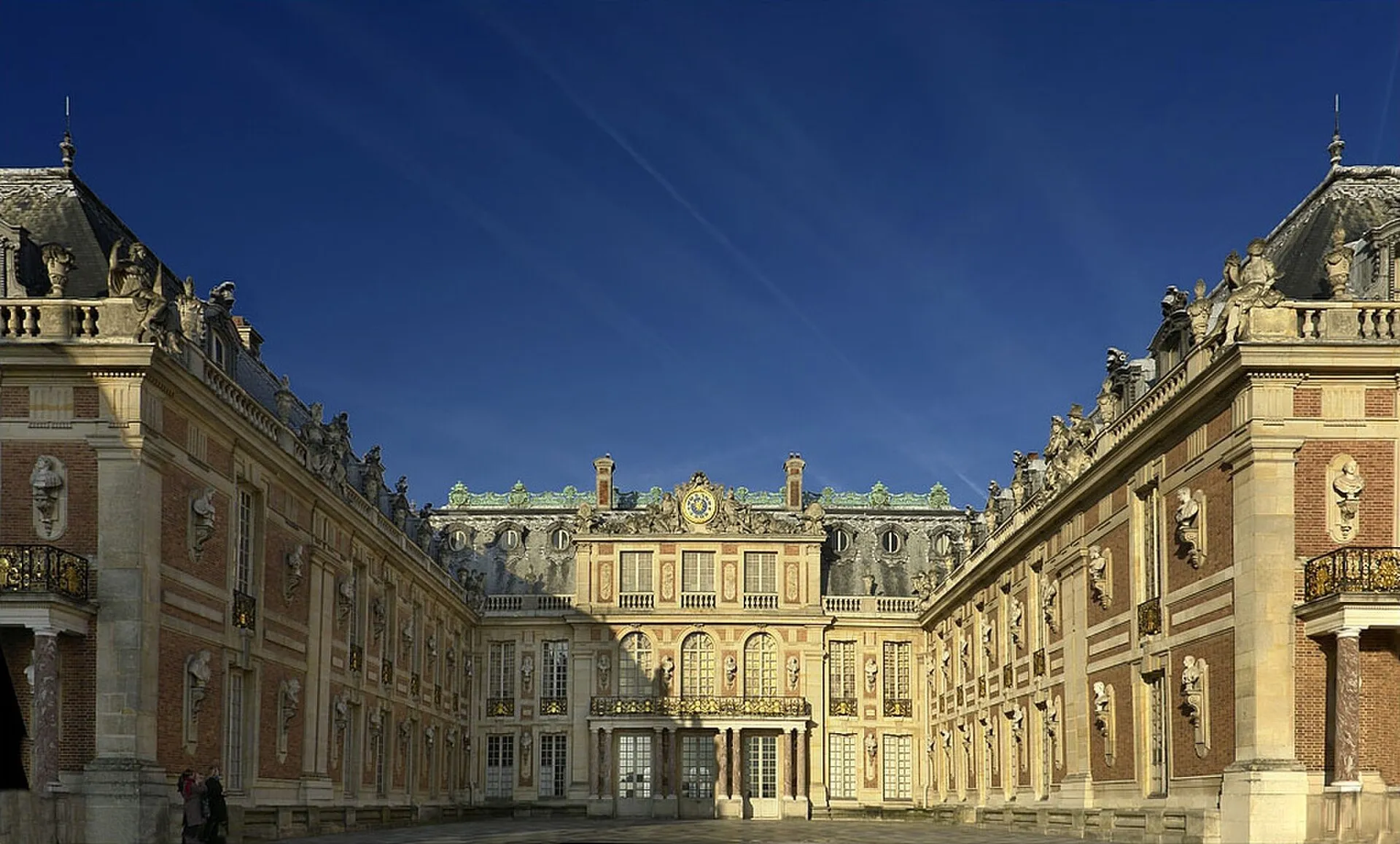
For photographers, the finest compositions are the mirrored perspective of the Galerie des Glaces in early-morning light, the gilded Grille Royale and the Cour de Marbre from the forecourt, and — best of all — the rear terrace looking down the central axis, where the Latona and Apollo fountains align with the Grand Canal. Golden hour turns the palace facade and the parterre pools into a single mirror.
When to Visit
Palace: Tuesday–Sunday, 9:00 AM – 6:30 PM (until 5:30 PM in winter); the Trianon estates open from midday. Gardens: daily, 8:00 AM – 6:00 PM, closing earlier in winter. Closed Mondays, and on 1 January, 1 May, and 25 December. The quietest slots are Tuesday and Wednesday mornings right at opening, before the Paris coach tours arrive; late afternoons after 3 PM also thin out as day-trippers leave. The Grandes Eaux Musicales — when Le Nôtre's fountains run to Baroque music — play on weekends and some weekdays from April to October, magnificent but the busiest days to visit.
Admission and Costs
Palace + Gardens: €21 (~$23), rising to €28 (~$30) on Musical Fountain (Grandes Eaux) days when the gardens carry a separate charge. The Passport covering the whole estate — palace, Trianon, and shows — is €32 (~$35). Entry is free for under-18s and, on the first Sunday from November to March, free for everyone. Timed entry is mandatory and books out days ahead in high season. A group guided tour from Paris runs €80–150 ($86–162) per person including transport; a private guide is €400–600 ($430–650) for a half-day.
The Case for a Guide
Versailles without a guide is a gold room followed by another gold room followed by an 800-hectare garden — a sequence that numbs rather than enlightens. A guide restores the human drama of absolute monarchy by explaining exactly who used each room, for what purpose, and what political theater was staged within it daily.
- Hall of Mirrors diplomatic symbolism: The 357 mirrors were positioned to reflect the garden view back at foreign ambassadors during audiences — a deliberate power display asserting French dominance; guides explain the 1919 Treaty of Versailles signing here and why Bismarck chose this room to proclaim the German Empire in 1871.
- Louis XIV's daily lever and coucher rituals: The king's morning rising (lever) and evening retiring (coucher) were semi-public court ceremonies where nobles competed for the privilege of handing Louis his shirt — guides explain how this ritualization of the monarch's body was a calculated tool for controlling the aristocracy by making them dependent on royal favor.
- Hidden service passages: Behind the gilded state apartments, a network of narrow service corridors allowed servants, doctors, and mistresses to move invisibly through the palace — guides explain which passages connect where and how the hidden infrastructure of absolute monarchy differed completely from its public face.
- The Trianon estates that most tourists skip: The Grand Trianon (Louis XIV's pink marble retreat) and the Petit Trianon with Marie Antoinette's English garden and Hameau de la Reine (her faux-rustic hamlet) occupy a separate ticket zone that most day-trippers never reach — guides prioritize access and explain why these buildings matter more for understanding royal psychology than the main palace.
- Garden fountain schedule and Le Nôtre's geometry: The 50 fountains only run during scheduled Grandes Eaux Musicales weekends — guides explain the gravitational engineering (no pumps in the 17th century) that made the system possible, and how André Le Nôtre's geometry forced visitors' eyes toward infinity as a statement of royal dominion over nature itself.
Tips for Visitors
Book a timed entry ticket at chateauversailles.fr well in advance — even ticket-holders queue at security, so aim for the 9:00 AM opening slot. Reach Versailles by RER C to Versailles Château–Rive Gauche (about 40 minutes from central Paris, then a short walk), or by Transilien from Saint-Lazare and Montparnasse. Wear comfortable shoes: the palace, gardens, and Trianon together involve kilometres of walking, and a rented golf cart, bike, or the little train helps cover the estate. Bring water and a picnic — the gardens invite it and on-site cafés are pricey. For the best light and the smallest crowds, do the Hall of Mirrors first, then walk out to the gardens; save the Trianon and the Hameau for the afternoon, when the main palace is at its most crowded. Photographers should time the Apollo Fountain and Grand Canal axis for late afternoon.
Frequently Asked Questions
When is the best season to visit the Palace of Versailles?
May, June, and September are the golden months: the nearly 800-hectare gardens are in full colour, the Grandes Eaux Musicales fountain shows run on weekends, and the mild weather suits the long outdoor walking Versailles demands. The first Sunday from November through March grants free palace admission with far thinner crowds, though the fountains are switched off. July and August bring the longest garden hours but overwhelming visitor volumes, with waits that can top two hours even with a timed ticket.
How should visitors plan a day trip to Versailles from Paris?
Allow a full day. The palace alone needs three to four hours, and the gardens and Trianon estates can fill the rest. Book a timed entry ticket weeks ahead, arrive for the 9:00 AM opening to beat the coach tours, and take the RER C to Versailles Château–Rive Gauche, about 40 minutes from central Paris. Tour the Hall of Mirrors and State Apartments first, break for a picnic in the gardens, and keep Marie Antoinette's Petit Trianon and Hameau de la Reine for the afternoon.
How much is the entrance fee for the Palace of Versailles?
Palace and Gardens admission is €21 (~$23), rising to €28 (~$30) on Musical Fountain days when the gardens are ticketed. The Passport covering the whole estate and the shows is €32 (~$35). Under-18s enter free, and admission is free for everyone on the first Sunday from November to March. A guided day tour from Paris with transport runs €80–150 ($86–162) per person; a private guide is €400–600 ($430–650) for a half-day.
Is it worth hiring a guide for Versailles?
For most visitors, yes. Versailles has roughly 2,300 rooms and an estate of nearly 800 hectares, and without context the gilded salons blur into one another. A licensed guide has priority entrance past the security queue, prioritises the highlights across the palace and Trianon, and brings alive the court intrigue of Louis XIV, Marie Antoinette, and the Revolution that ended it all. Many guided tours also bundle round-trip transport from Paris.
How do you get to Versailles from Paris?
The simplest route is the RER C line to Versailles Château–Rive Gauche, about 40 minutes from stations such as Saint-Michel or the Gare d'Austerlitz, followed by a 10-minute walk to the palace gates. Two Transilien trains also serve the town: Line L from Paris Saint-Lazare to Versailles–Rive Droite, and Line N from Montparnasse to Versailles–Chantiers. By road, Versailles is about 20 kilometres southwest of central Paris, though parking is limited and the train is far quicker than driving.