
Walking Route
Walking Routes
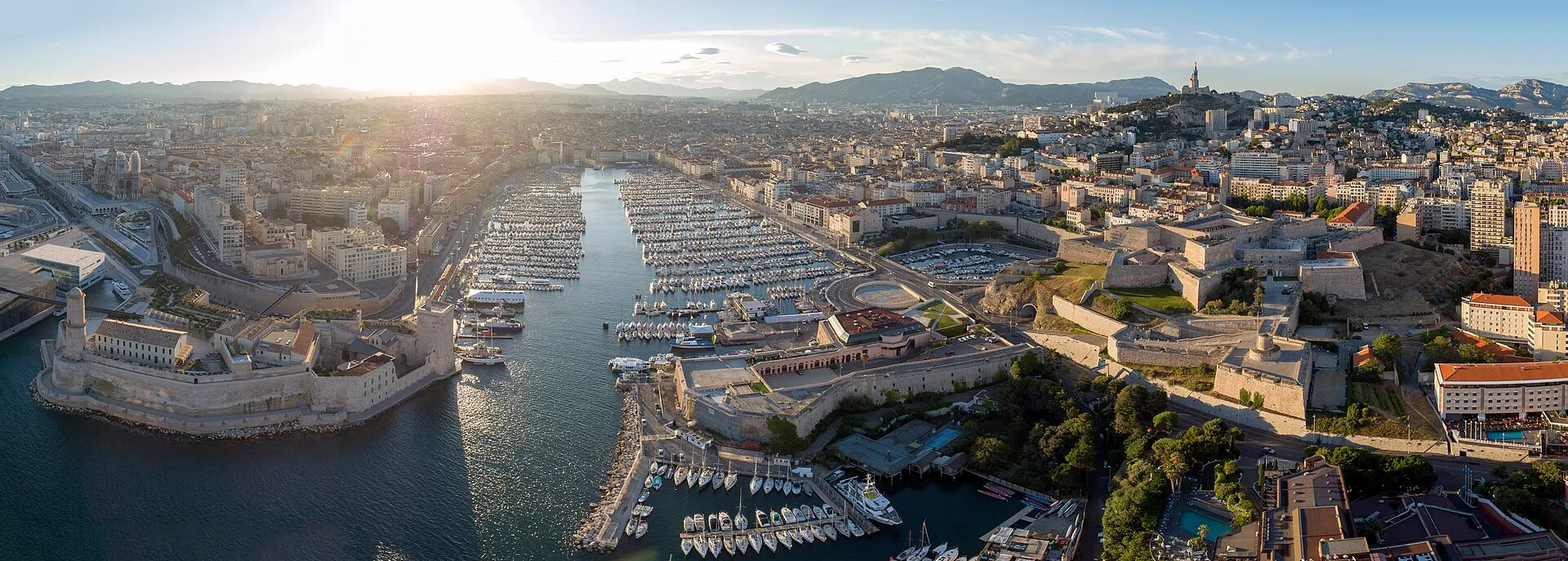
The most rewarding way to read the Vieux-Port is to walk its full horseshoe, starting from the head of the harbour where the Vieux-Port metro (M1) surfaces beside the water. An unhurried loop with photo and café stops runs about 60 to 90 minutes:
- Quai des Belges - the head of the port, where the daily fish market sells the dawn catch and the excursion boats to the Château d'If and the Calanques cast off.
- L'Ombrière - Foster's mirrored canopy, the waterfront's best photograph; shoot upward into the reflection, or crouch low to catch the boats hanging overhead.
- Quai du Port - the north quay and its 17th-century Hôtel de Ville, one of the few buildings to survive the 1943 demolition of this bank.
- The Ferry Boat - hop the little César across the water for €0.50; the two-minute crossing is the cheapest and most charming boat ride in the city.
- Fort Saint-Jean - climb its ramparts, now linked to the MuCEM, for the classic view straight down the port toward the golden Madonna.
- Fort Saint-Nicolas - cross to the south bank for the harbour-entrance panorama, then stroll back east along the terrace-lined Quai de Rive Neuve.
From the north quay it is a ten-minute walk uphill into Le Panier, Marseille's oldest quarter, and about twenty minutes - or a short ride on the tourist train from the Quai des Belges - up to Notre-Dame de la Garde. Together they make an easy, memorable full day of Marseille on foot.
Local Life
What keeps the Vieux-Port from becoming a mere postcard is that Marseille still uses it. The daily fish market on the Quai des Belges, where fisherwomen gut and sell straight from the boats, keeps alive a trade older than France itself, and it remains the place locals come for the rascasse, weever, and conger that make a genuine bouillabaisse - the dish protected since 1980 by a local charte that spells out which fish and which method count as the real thing. For the definitive version, Marseillais send you west of the port to the tiny fishing cove of the Vallon des Auffes rather than to the tourist-facing quays.
The port is also the stage for the city's unhurried aperitif culture: at sunset the terraces fill with glasses of cloudy pastis, the anise spirit that Paul Ricard began bottling in Marseille in 1932. Just off the water on the Quai de Rive Neuve, the Bar de la Marine is forever tied to Marcel Pagnol, whose Marius trilogy set its famous card game on this very quay, while the César ferry he immortalised has been shuttling foot passengers across the harbour since 1880. On match days you will hear the whole port roar for Olympique de Marseille - proof that the Vieux-Port is still, first and last, the city's living room. Continue uphill to Le Panier or along the water to the MuCEM to round out the day.
When to Visit
The harbour is open and free at any hour, but it changes character through the day. The fish market on the Quai des Belges runs roughly 8 AM to 1 PM daily, busiest and best-stocked in the early morning. Come between 7 and 9 AM for a near-empty waterfront and the softest light, or at sunset for golden reflections in Foster's mirrored canopy and the aperitif rush on the terraces. May through September is peak season for boat excursions and outdoor dining; the winter months are quiet but eminently walkable in Marseille's mild climate. Weekday mornings are the least crowded overall. Check the official Marseille tourist office for seasonal market and event times before you go.
Admission and Costs
Walking the port and standing beneath L'Ombrière are both free. The historic ferry boat across the harbour is a token €0.50 ($0.55). Guided walking tours run €15-25 ($16-27) per person, while a private guide for two to three hours is €150-250 ($160-270). The passenger boat out to the Château d'If costs about €12 ($13) round trip. Fish-market prices vary with the day's catch - a guide helps you judge freshness and identify the right fish for bouillabaisse - and a full charter bouillabaisse, served over two courses at the harbour's serious fish restaurants, runs €55-75 ($60-80) per person.
The Case for a Guide
- Reading the fish market - a local guide decodes the Quai des Belges catch, naming the rascasse, weever, and conger that belong in a real bouillabaisse and steering you clear of the tourist versions
- Layered history - from the Phocaean Greek founding around 600 BC to the two royal forts, the lost 1905 transporter bridge, and the wartime demolition of the north bank in 1943, a guide unpacks 2,600 years in a single walk
- Architecture and design - the story behind Norman Foster's 2013 mirrored Ombrière, the surviving 17th-century Hôtel de Ville, and the engineering of Fort Saint-Jean and Fort Saint-Nicolas
- Food and aperitif culture - the bouillabaisse charte, the pastis ritual, and the difference between the tourist quays and the authentic fish restaurants of the Vallon des Auffes
- Connecting the city - guides thread the port into the wider picture, linking it to Le Panier uphill, the MuCEM at the harbour mouth, and Notre-Dame de la Garde on the skyline
Tips for Visitors
Parking is difficult around the port - use the Vieux-Port metro (M1) or park outside the centre. Be alert to pickpockets in the crowded market and terrace areas, especially in summer. Boat tours to the Calanques and the Château d'If depart from the Quai des Belges; book ahead in high season. Don't miss the €0.50 ferry boat across the harbour - it is the best-value experience on the water. For photographs, shoot L'Ombrière at sunset and climb to Fort Saint-Jean for the long view down the port toward Notre-Dame de la Garde. For an authentic bouillabaisse, head to the Vallon des Auffes rather than the tourist quays, and pair the port with Le Panier just uphill for a complete Marseille day.
Frequently Asked Questions
Which months are best for the atmosphere at Marseille's Old Port?
May through September transforms the waterfront into an open-air living room, with terrace dining, boat excursions to the Château d'If, and the morning fish market at its most abundant with fresh Mediterranean catch. The daily fish sale on the Quai des Belges runs year-round, but summer brings the widest variety, including sea urchins and rascasse for authentic bouillabaisse. Winter months are quieter, with some waterfront restaurants scaling back outdoor seating, though the mild Provençal climate keeps the port walkable even in January, when the low sun rakes the quays with the clear light that first drew painters here.
What are the opening hours of the Old Port?
The harbour itself is a public space, open and free to walk around the clock. The fish market on the Quai des Belges runs every morning, roughly 8 AM to 1 PM, with fishermen selling straight from their boats. For the calmest atmosphere, come between 7 and 9 AM before the crowds arrive; for the golden-hour reflections in Norman Foster's mirrored canopy, come at sunset. Weekday mornings and the winter months are consistently the least crowded times to visit.
How much does it cost to visit the Old Port?
Walking the port is completely free, and standing beneath Norman Foster's L'Ombrière canopy costs nothing. The historic ferry boat across the harbour is a token €0.50 ($0.55). Guided walking tours run €15-25 ($16-27) per person, while a private guide for two to three hours is €150-250 ($160-270). The passenger boat out to the Château d'If costs about €12 ($13) round trip. A true charter bouillabaisse, served over two courses, runs €55-75 ($60-80) per person at the harbour's serious fish restaurants.
What does a guide add to an Old Port visit?
A guide turns a pretty harbour into 2,600 years of layered history. On the Quai des Belges they help you read the fish market, pointing out the rascasse, weever, and conger that make a real bouillabaisse and steering you away from the tourist versions. They explain Norman Foster's 2013 mirrored canopy, the two royal forts that once trained their cannon on a rebellious city, and the Italian and North African families who built Marseille's seafood trade. Good guides also link the port to Le Panier uphill and Notre-Dame de la Garde on the skyline.
Why is the Vieux-Port so important to Marseille's history?
The Vieux-Port is quite literally where Marseille began: Greek sailors from Phocaea in Asia Minor landed in this sheltered inlet, the ancient Lacydon, around 600 BC, making it the oldest city in France. For twenty-five centuries the basin was the commercial heart of the western Mediterranean, until the far larger La Joliette docks opened just to the north in the 1840s to handle steamships and colonial cargo, leaving the old harbour to fishing boats and pleasure craft. Guarded by Fort Saint-Jean and Fort Saint-Nicolas and scarred by the wartime destruction of its north bank in 1943, the port carries the whole story of the city in a single, walkable horseshoe of water.