
Walking Route
Walking Routes
The Panier is a maze of near-identical stepped lanes where getting pleasantly lost is half the point, but a loop of roughly 60 to 90 minutes links its landmarks without backtracking. Start from the Old Port and climb:
- Montée des Accoules - the steep stepped climb up from the harbour, past the surviving bell tower of the Accoules, one of the city's oldest churches, that carries you out of the bustle and into the quiet quarter.
- Place de Lenche - the sloping, café-lined square on the site of the ancient Greek agora; take a terrace table for the framed view back down over the masts of the port.
- Rue du Panier and its side lanes - the namesake street and the alleys around it, an ever-changing open-air gallery of murals, painted doors, and stencils.
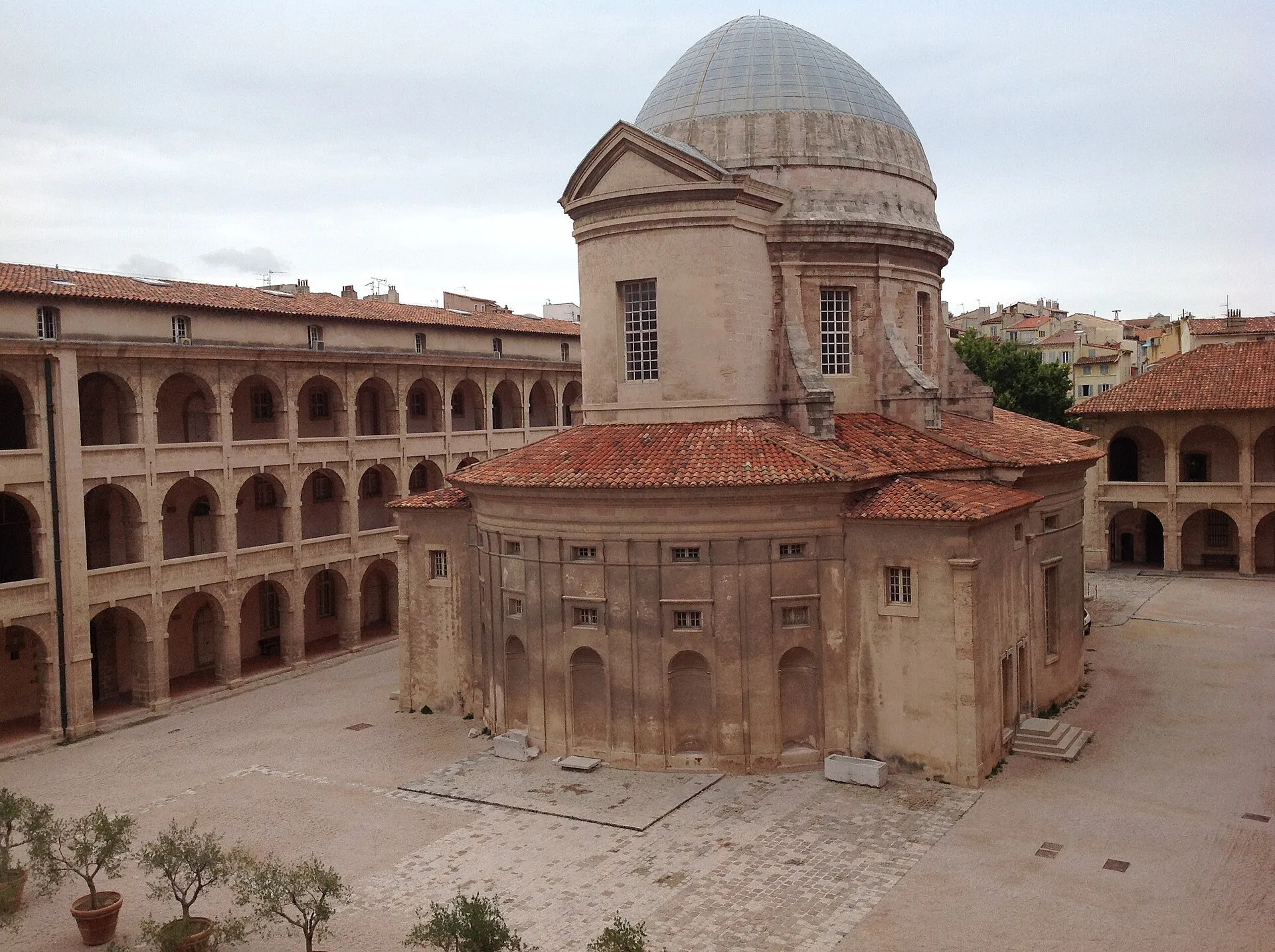
- La Vieille Charité - Pierre Puget's arcaded 17th-century almshouse and its domed chapel, now a museum complex and the architectural high point of the walk.
- Place des Moulins - the leafy, tourist-free summit where fifteen windmills once ground the city's grain; the calmest corner of the quarter.
- Cathédrale de la Major - the huge striped Neo-Byzantine cathedral on the seaward edge, where the old Panier meets the modern Joliette waterfront and the sea opens up.
For food and rest stops, the terraces of Place de Lenche are the obvious lunch anchor, while the lanes hide artisan bakeries, ice-cream makers, and small Provençal kitchens. There is no true park in the Panier, but Place des Moulins offers shade and benches, and a short walk downhill the Jardin des Vestiges preserves the excavated Greek harbour and ramparts beside the Centre Bourse. From the cathedral it is minutes back down to the Old Port and the footbridge across to the MuCEM.
Local Life
What sets the Panier apart is that it is still a living neighborhood, not an open-air museum. Laundry strings between the shuttered windows overhead, children play on the steps, and elderly residents trade news from doorways while, one street over, a ceramicist glazes bowls and a printmaker inks a press. The quarter's craft revival is genuine: independent ateliers sell hand-thrown pottery, textiles, jewellery, and small-batch design, and several traditional savonneries still cut and stamp cubes of savon de Marseille, the olive-oil soap whose 72%-oil formula was fixed by a royal edict under Colbert in 1688 and which remains one of the city's signature souvenirs (see the background on Marseille soap).
The Panier is also woven into popular French culture. For nearly two decades the France 3 soap opera Plus belle la vie set its fictional quartier du Mistral here, and its exterior scenes and postcard-perfect stepped lanes drew a steady stream of fans up from the port. Yet the deeper identity is older and rougher-edged - a port-of-immigrants quarter where Italian, Corsican, Armenian, North African, and Comorian communities have layered their languages, cooking, and shops over the same 2,600-year-old streets. A good local guide is the difference between snapping a pretty mural and understanding who painted it and why, which courtyard hides a Greek foundation stone, and which family has run the same workshop for three generations. Round out the day downhill on the Old Port or along the water at the MuCEM.
Le Panier timeline
- 600 BC
Greeks found Massalia
Phocaean sailors settled this hillside above the natural harbour, building their agora on today's Place de Lenche and founding what became France's oldest city.
- 1660s
A working immigrant quarter
As the port grew, the Panier filled with dockers, fishermen, and successive waves of Italian, Corsican, and later North African and Comorian families.
- 1671-1749
La Vieille Charité is built
Marseille-born architect Pierre Puget designed the arcaded almshouse and its domed chapel at the heart of the quarter to shelter the city's poor.
- 1852-1893
Cathédrale de la Major rises
The vast striped Neo-Byzantine cathedral was raised on the quarter's northern edge, replacing the old medieval Major beside it.
-
The lower Panier is dynamited
The Nazi occupiers razed some 1,500 buildings between the quarter and the Old Port in the rafle du Vieux-Port; the upper hill survived.
-
La Vieille Charité reopens
Restored as a cultural centre, the former hospice signalled the quarter's shift from neglected slum to artistic and museum district.
-
Capital of Culture renewal
Marseille's culture-capital year accelerated the Panier's rebirth as a quarter of ateliers, galleries, and street art without erasing its working-class soul.
When to Visit
The quarter is open and free at every hour, but it changes character through the day. Come between 9 and 11 AM, when the ateliers raise their shutters but the tour groups have not yet climbed up from the Old Port, for the quietest lanes. Weekdays are calmer than weekends, and it is worth avoiding Monday mornings, when many independent shops stay shut. Save the late afternoon for photography: low sun rakes across the ochre and pastel facades and lights up the murals far better than the flat glare of midday. May through September brings the workshops out onto the streets and the brightest colour, while April and October trade a little warmth for far thinner crowds; winter is mild and atmospheric but sees some ateliers cut their hours. Check the Marseille tourist office for current exhibition times at La Vieille Charité before you go.
Admission and Costs
Wandering the Panier is free - it is a living quarter, not a ticketed site. Guided options add the context that makes the maze legible:
- Shared walking tour — about €15-25 ($16-27) per person for two hours.
- Street-art tour — €20-30 ($22-33) per person, decoding the murals and their artists.
- Private guide — €120-200 ($130-216) for two to three hours.
- La Vieille Charité — temporary exhibitions €5-10 ($5.50-11); its Mediterranean-archaeology and African-arts museums a few euros more, and often free on the first Sunday of the month.
A cube of genuine savon de Marseille from an atelier runs €4-8 ($4.40-8.70), and a café terrace or an artisan lunch on Place de Lenche is easy to fold into the walk.
The Case for a Guide
The Panier looks like a simple photo stroll, but almost all of its meaning is invisible without someone to unlock it. A guide turns the maze into 2,600 years of layered story and threads it into the rest of Marseille:
- Reading the layers — where the Greek agora stood beneath Place de Lenche, which walls hide Roman and medieval stone, and how the same streets have been lived in since 600 BC.
- The 1943 wound — walking the line where the Nazi rafle du Vieux-Port dynamited the lower quarter, and understanding why the upper hill survived intact.
- Decoding the street art — naming the artists behind the murals, explaining what they mean, and finding the pieces that change from month to month.
- Meeting the makers — introductions to soap makers, ceramicists, and shopkeepers, and the difference between a real savon de Marseille and a tourist copy.
- Not getting lost — the lanes are a near-identical maze, and a guide keeps you oriented while connecting the quarter to the Old Port, the MuCEM, and Notre-Dame de la Garde.
Tips for Visitors
Wear comfortable shoes: the Panier is built on a hill of steep lanes, worn cobbles, and long flights of steps, with almost no flat ground. Many independent shops close 12:30-2:30 PM for lunch and often all day Monday, so plan your visit around it. Keep valuables secure and stay aware of petty theft in the busier squares and on the crowded climb up from the Old Port. Remember this is a residential quarter - laundry hangs overhead and families live behind the painted doors, so keep noise down, ask before photographing people, and respect the quiet. Combine the walk with the neighbouring MuCEM, reached via the footbridge from Fort Saint-Jean, and the Old Port just downhill for a complete Marseille day on foot.
Frequently Asked Questions
When is the best time of year to wander Le Panier?
May through September delivers the full Mediterranean experience with outdoor artisan workshops spilling onto the narrow streets, colorful facades glowing under long sunny days, and street art that pops against bright blue skies. The shoulder months of April and October offer pleasant weather with far fewer tourists in this compact hillside quarter. Winter visits are mild by northern European standards, but some smaller boutiques and soap-making ateliers reduce their hours.
What time of day is best for exploring Le Panier?
Come between 9 and 11 AM, when the ateliers and boutiques lift their shutters but the tour groups climbing up from the Old Port have not yet arrived, and the stepped lanes are still quiet enough to hear your own footsteps on the cobbles. Weekdays are noticeably calmer than weekends, and Monday mornings are the deadest of all because many independent shops stay closed. Save the middle of the day for a long lunch on Place de Lenche, then return in the late afternoon, when low sun rakes across the ochre, pink, and pistachio facades and lights up the murals - by far the best window for photography.
How much should visitors budget for Le Panier?
Wandering the quarter itself costs nothing - it is a living neighborhood, not a ticketed site. A shared walking tour runs about €15-25 ($16-27) per person for two hours, a dedicated street-art tour €20-30 ($22-33), and a private guide €120-200 ($130-216) for two to three hours. Temporary exhibitions inside La Vieille Charité are €5-10 ($5.50-11), and its Mediterranean-archaeology and African-arts museums a few euros more, while a cube of genuine olive-oil savon de Marseille from an atelier is €4-8 ($4.40-8.70). Budget a little extra for a café terrace on Place de Lenche and an artisan lunch.
What should visitors know before exploring Le Panier?
Wear comfortable shoes: Le Panier is built on a hill of steep lanes, worn cobbles, and long flights of steps, with almost no flat ground. Many independent shops close from roughly 12:30 to 2:30 PM for lunch and often all day Monday, so plan around it. Keep valuables secure and stay aware of petty theft in the busier squares and on the crowded approach from the Old Port. Above all, remember that this is a real residential quarter: laundry hangs overhead and families live behind the painted doors, so keep noise down, ask before photographing people, and respect the quiet.
Why is Le Panier considered Marseille's oldest neighborhood?
Le Panier sits directly on the hillside where Greek sailors from Phocaea founded Massalia around 600 BC, making it the birthplace not just of Marseille but arguably of urban France - the settlement predates Paris by roughly three centuries. The ancient Greeks built their agora on what is now Place de Lenche, and the streets have been continuously inhabited ever since, layering Greek, Roman, medieval, and modern city on the same ground. That unbroken occupation, rather than any single monument, is what earns the quarter its title as the oldest neighborhood in France.
What was destroyed in Le Panier during World War II?
In January 1943, during the Nazi occupation, German forces backed by Vichy police evacuated tens of thousands of residents and dynamited the dense web of old streets on the Panier's lower flank, between the quarter and the Old Port - roughly 1,500 buildings across some fourteen hectares - in the operation remembered as the rafle du Vieux-Port. Hundreds of the displaced, including many of the district's Jewish and immigrant families, were deported. The upper Panier on the hill survived, which is why its tangle of pre-war lanes still stands today while the waterfront below was rebuilt from scratch after the war.