
Historical Significance
Before Place de la Bourse, Bordeaux turned its back on the river behind medieval walls. Under Louis XV, the royal intendants Claude Boucher and, above all, the Marquis de Tourny drove to open the city to the Garonne, and the crown's premier architecte Jacques Gabriel drew up a grand Place Royale framing an equestrian statue of the king. After Gabriel's death in 1742, his son Ange-Jacques Gabriel — later architect of the Petit Trianon and the Place de la Concorde in Paris — carried the work to completion in 1775.
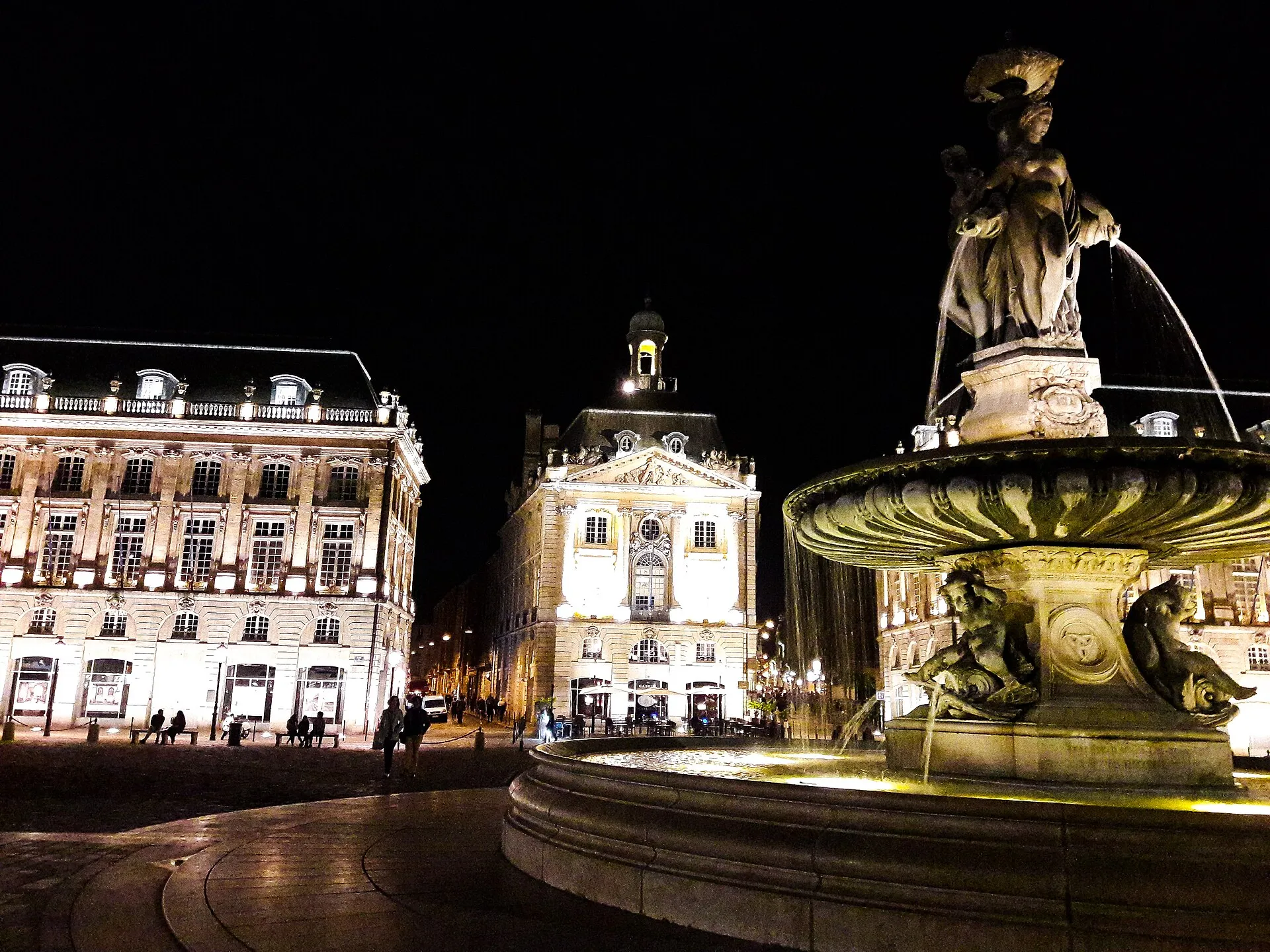
The square was conceived as a stage for royal power. Jean-Baptiste Lemoyne's bronze equestrian statue of Louis XV stood at its centre from 1743 until revolutionaries melted it down in 1792; the empty middle was finally filled in 1869 by the Fontaine des Trois Grâces, whose three intertwined figures are the Graces of classical mythology.
"Prenez Versailles, mêlez-y Anvers, et vous avez Bordeaux" — take Versailles, mix in Antwerp, and you have Bordeaux, wrote Victor Hugo, capturing exactly the blend of courtly grandeur and mercantile wealth the square was built to project.
That wealth had a darker source: much of the 18th-century fortune that paid for these façades flowed from Atlantic commerce, including the transatlantic slave trade — a history the city today acknowledges rather than hides. The two great pavilions still speak to the trading age: the northern Palais de la Bourse housed the stock exchange and now the chamber of commerce, while the southern Hôtel des Fermes holds the Musée national des Douanes, France's national customs museum. In 2007 UNESCO inscribed the whole ensemble as the "Port of the Moon," recognising it as an outstanding example of Enlightenment-era urban design in Bordeaux.
Architecture
Ange-Jacques Gabriel and his father conceived Place de la Bourse as a controlled exercise in neoclassical symmetry: a broad semicircle opening onto the river, framed by two matching pavilions and unified by a continuous rhythm of arcades, Corinthian pilasters, balustrades and steep slate roofs. The composition is deliberately theatrical — every line pulls the eye across the quay to the Garonne, reversing centuries of the city hiding behind its walls.
Look up and the stone comes alive with mascarons, the carved keystone masks of river gods, sea nymphs and grimacing faces for which Bordeaux is famous. The twin wings carry their own identities — the Palais de la Bourse to the north and the Hôtel des Fermes to the south, the latter now home to the Musée national des Douanes — while at the centre the 1869 Fontaine des Trois Grâces supplies the square's romantic focal point.
The modern counterpoint is the Miroir d'eau (2006), designed by landscape architect Michel Corajoud with fountain engineer Jean-Max Llorca. At 3,450 m² it is the largest reflecting pool in the world, yet it holds only about 2 cm of water over a granite slab. On a roughly quarter-hour cycle it fills to a glassy mirror that doubles the façades, drains, then erupts in a knee-high fog — the brouillard — that drifts across the plaza. The still-water phase, shot low from the river side at dusk, is arguably the best photograph in all of Bordeaux; the misting phase, backlit by the floodlit stone, is the most atmospheric.
When to Visit
The square and its Miroir d'eau are open-air and free, accessible day and night all year; only the water mirror is seasonal, running roughly March to mid-November and draining for the coldest months (it is also emptied periodically for cleaning even in season).
- Blue hour and after dark — the façades are floodlit and reflected in the still water, and the ~15-minute mirror-and-mist cycle is at its most dramatic against the lit stone.
- Sunset in June–July — the low western sun catches both the limestone and the water film, producing the golden reflections the square is known for.
- Early morning — the calmest window for a clean, crowd-free mirror shot before families and tour groups arrive.
- The mirror cycle — wait for the still-water phase for symmetrical reflections, then stay for the brouillard mist, which children love and which softens the whole plaza.
Pair a visit with the nearby Grand Théâtre, a few minutes' walk up toward the Rue Sainte-Catherine shopping street.
Admission and Costs
There is no admission charge: access to the square and the Miroir d'eau is free, and even the Musée national des Douanes in the Hôtel des Fermes asks only a modest entry. Costs arise only if you add a guide or arrive by tram.
- Square & water mirror — free.
- Guided walking tour (shared) — €15–25 (about $16–27) per person, usually two hours taking in the quays and old town.
- Private guide — €120–180 (about $130–195) for a two-hour tour.
- Tram — a single Bordeaux TBM ticket is €1.70 (about $1.85); line C stops right at "Place de la Bourse."
The square pairs naturally with Cathédrale Saint-André and the Cité du Vin, both a short walk or tram ride away in Bordeaux.
The Case for a Guide
Place de la Bourse looks simple — a curved façade and a sheet of water — yet almost nothing about it is accidental, and a good local guide unlocks the layers a photograph can't show.
- Two centuries in one view — a guide threads together Gabriel's royal Place Royale, the vanished statue of Louis XV, and Corajoud's 21st-century Miroir d'eau into a single story of a city reinventing itself.
- Reading the stone — guides point out the mascarons and decorative symbolism most visitors walk straight past, and explain how the Atlantic trade that built these façades shaped Bordeaux.
- Perfect photo timing — locals know the water-mirror cycle and the light, and will position you for the still-water reflection at exactly the right moment.
- A wider walk — most tours fold the square into a route past the Grand Théâtre and Cathédrale Saint-André, turning a quick photo stop into a proper introduction to the UNESCO old town.
Tips for Visitors
- Bring flip-flops — wading in the Miroir d'eau is encouraged in summer, but the granite turns slippery during the misting phase, so tread carefully.
- Pack a tripod — night reflections and the blue-hour cycle reward a long exposure; the low quayside wall makes a handy brace if you travel light.
- Shoot from the river side — stand between the water mirror and the Garonne and frame the façades across the still film for the classic symmetrical shot.
- Take tram line C — it runs along the quays to the "Place de la Bourse" stop, and the square is flat and step-free, so it is fully wheelchair- and stroller-accessible.
- Combine with the quays — around 5 km of renovated riverfront run either side, ideal for a stroll to the Grand Théâtre or a riverside apéritif at dusk.
- Watch your belongings — like any crowded photo hotspot, the plaza attracts pickpockets on busy summer evenings.
Frequently Asked Questions
When is the best time to see the Miroir d'eau at Place de la Bourse?
May through September is when the Water Mirror operates at full effect, with warm evenings perfect for watching children splash through the misting cycles and the neoclassical facades shimmer in the still-water reflections. The mirror is typically drained during the coldest winter months from December through February. Late afternoon in June or July produces the most spectacular golden reflections as the setting sun catches both the stone facades and the water surface simultaneously.
Is Place de la Bourse free to visit, and what are the opening hours?
The square itself is an open public space with no gates and no admission — it is free to visit day and night, all year round, and the floodlit facades are spectacular after dark. The Miroir d'eau (Water Mirror) is also free but seasonal, running roughly from March to mid-November and drained in the coldest months. Only the Musée national des Douanes (National Customs Museum), housed in the Hôtel des Fermes on the south side of the square, charges a modest entry fee.
How do you get to Place de la Bourse?
Take tram line C, which runs along the riverside quays and stops directly at the 'Place de la Bourse' stop; a single TBM ticket costs about €1.70 ($1.85). The square is a flat, roughly ten-minute walk from the Grand Théâtre and the pedestrian shopping street Rue Sainte-Catherine, and it sits right on the Garonne quays, so it slots easily into any riverside walk through central Bordeaux.
What are the highlights of Place de la Bourse?
The still-water reflections of the Miroir d'eau — arrive during the mirror phase for perfect symmetrical photos of the facades. The misting phase — fun for children and wonderfully atmospheric at night. The Fontaine des Trois Grâces — the central 1869 fountain of the three Graces of classical mythology. The carved mascaron masks on the facades, and the two 18th-century pavilions, the Palais de la Bourse and the Hôtel des Fermes.
Is Place de la Bourse accessible for wheelchairs and strollers?
Yes. The square and the Miroir d'eau sit on a flat, paved, step-free plaza directly beside the quays, making them fully accessible to wheelchair users and to families with strollers. Tram line C stops at street level right at the square, and the renovated riverfront on either side is smooth and level for an easy stroll toward the Grand Théâtre.
How does a guide enhance a visit to Place de la Bourse?
A guide turns a quick photo stop into two centuries of history — connecting Ange-Jacques Gabriel's royal design and the vanished statue of Louis XV to Michel Corajoud's modern Water Mirror. Guides decode the mascarons and trade symbolism woven into the stone, explain Bordeaux's transformation under Louis XV, and know exactly when the mirror cycle and the light line up for the best reflection shot.