

Overview
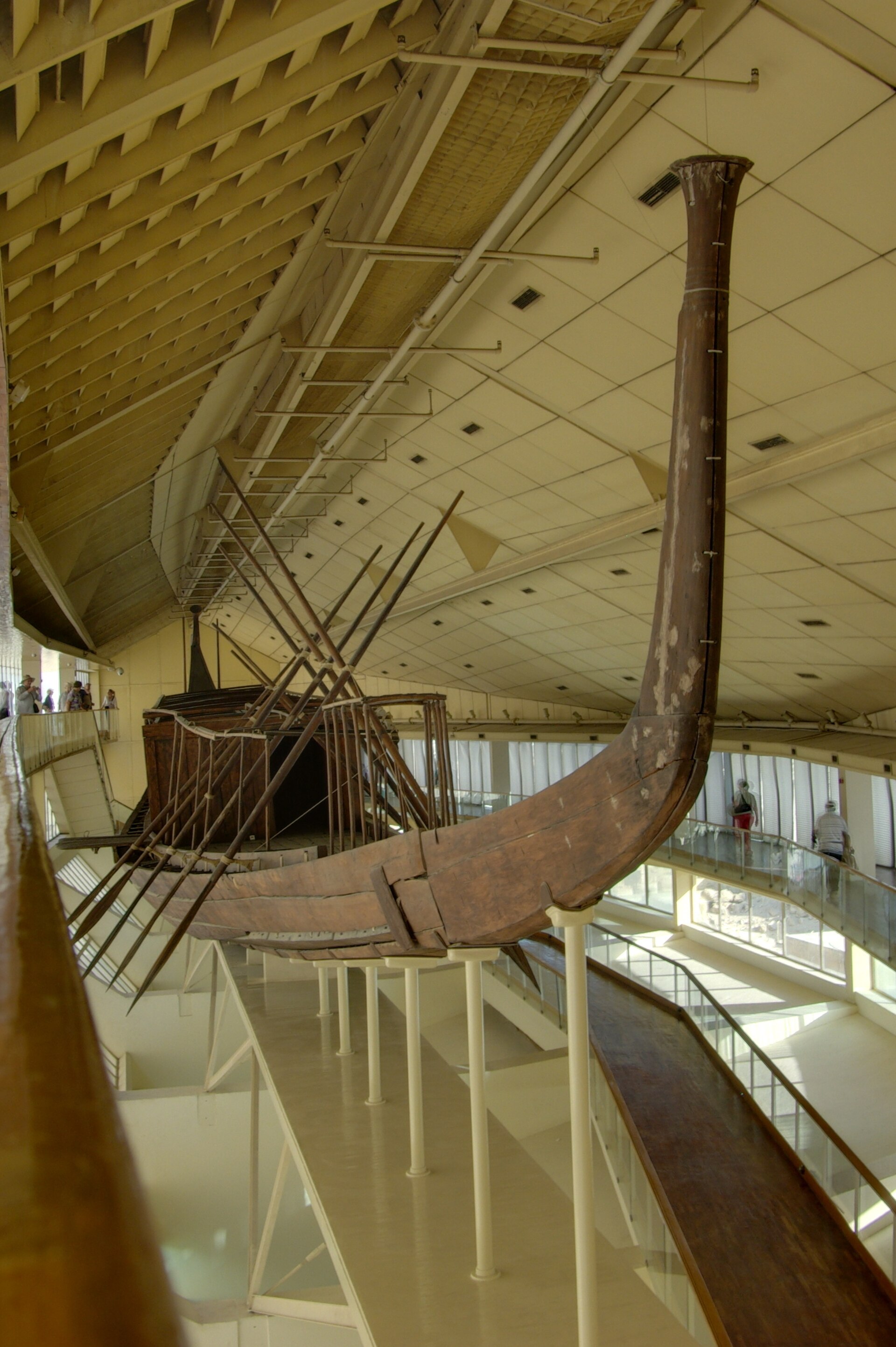
Beside the Great Pyramid stands a purpose-built museum housing one of the most extraordinary artifacts from the ancient world: a 43.6-meter wooden barge, sealed in a pit since roughly 2560 BC and painstakingly reassembled from 1,224 individual cedar pieces. This vessel, known as Khufu's solar boat or funerary barge, offers an unparalleled window into ancient Egyptian craftsmanship, religious belief, and maritime tradition.
Collections Highlights
The vessel of stunning sophistication stretches 43.6 meters long. The hull consists of cedar planks sewn together with rope made from halfa grass, a technique that predates nail construction by millennia. Rather than using metal fasteners, the ancient shipwrights drilled channels through adjoining planks and laced them together, allowing the hull to flex slightly on water. This "stitched" construction method made the boat both strong and resilient, absorbing the stresses of waves rather than cracking under rigid resistance. Mortise-and-tenon joints lock the planks in alignment. The curved prow and stern, rising gracefully in the classic papyriform shape, were achieved by steaming and bending massive timbers. Oars with blades wider than a man's torso served both for propulsion and steering. The central cabin, with its columns topped by papyrus-bud capitals, echoes the architecture of temples and palaces, suggesting that this vessel was meant to carry a king. The sun god Ra crossed the sky each day in a boat, sinking into the underworld at sunset and sailing through the realm of the dead before rising reborn at dawn. The pharaoh, upon death, was expected to join Ra on this eternal voyage. A "solar barque" would carry the royal soul across the celestial waters. Unlike a purely symbolic vessel, Khufu's barge shows evidence of actual use: rope wear at the attachment points, minor repairs to the hull, and water staining on certain timbers. Some scholars believe it served as the pharaoh's funeral barge, transporting his mummified body from Memphis across the Nile to the Giza necropolis.
Guided Tours
In May 1954, Egyptian archaeologist Kamal el-Mallakh was clearing rubble from the south side of the Great Pyramid when he noticed a row of limestone blocks sealed with gypsum mortar. Removing one block, he peered into the darkness and caught the unmistakable scent of cedar wood -- a fragrance locked away for forty-six centuries. The excavation of the first pit took two years, with each piece of wood photographed, catalogued, and carefully lifted by hand. The reconstruction fell to Ahmed Youssef Moustafa, a master restorer who worked without blueprints, surviving depictions, or previous experience with vessels of this scale. He studied each timber's shape, grain, and assembly marks, gradually intuiting how they fit together. The process took 14 years, from 1957 to 1971, and required extraordinary patience. Youssef Moustafa once spent eight months on a single problem: how the cabin structure attached to the deck. A second pit, parallel to the first, was confirmed by probing but left unopened until 2011, when Japanese researchers used remote sensing and eventually extracted another disassembled boat in far more fragile condition. Expert guides at the museum recount this extraordinary discovery story, explain the stitched-hull construction technique visible from the elevated walkway, and decode the theological significance of solar boats in Egyptian afterlife beliefs. Without context, the boat is impressive but opaque; with explanation, it becomes a window into ancient technology, theology, and the personality of the pharaoh who commissioned it.
When to Visit
Why did Khufu need a boat buried beside his pyramid? The answer lies in Egyptian beliefs about the afterlife. The sun god Ra crossed the sky each day in a boat, sinking into the underworld at sunset and sailing through the realm of the dead before rising reborn at dawn. The pharaoh, upon death, was expected to join Ra on this eternal voyage. A "solar barque" would carry the royal soul across the celestial waters, ensuring the pharaoh's perpetual renewal alongside the sun. This theological explanation accounts for the boat's placement but not its condition. Unlike a purely symbolic vessel, Khufu's barge shows evidence of actual use: rope wear at the attachment points, minor repairs to the hull, and water staining on certain timbers. Some scholars believe it served as the pharaoh's funeral barge, transporting his mummified body from the capital at Memphis across the Nile to the Giza necropolis. After completing this final voyage, it was disassembled with ceremonial care and sealed in the pit to serve the pharaoh in eternity. The presence of a second boat -- discovered in the adjacent pit -- supports the idea that paired vessels were standard for royal burials. One boat might carry the pharaoh by day, another by night, mirroring Ra's twin barques. The theological system was elaborate, the craftsmanship extravagant, and the result is an artifact that speaks across millennia about how one civilization imagined the journey beyond death. Hours have typically been 9 AM to 5 PM daily, though the GEM may offer extended evening access. The museum interior is climate-controlled -- a welcome respite from the plateau's unforgiving sun. Allocate 45 minutes to an hour for the boat itself, longer if you explore the related maritime exhibits. Morning visits tend to be quietest before tour groups arrive.
Admission and Costs
The vessel has been relocated from its original museum beside the pyramid to the Grand Egyptian Museum (GEM), the massive new facility near the Giza plateau entrance. This move was driven by conservation concerns: the original museum building, designed in the 1980s, struggled to maintain stable temperature and humidity levels despite its climate-control systems. Rising groundwater at Giza and increased visitor traffic worsened conditions. At the GEM, Khufu's boat now occupies a custom-designed gallery with state-of-the-art environmental controls. The new display allows visitors to view the vessel from multiple levels and angles impossible in the cramped original structure. Surrounding exhibits contextualize the boat within ancient Egyptian maritime traditions, funerary practices, and the broader archaeology of Giza. The second boat, too fragile to display when first excavated, is undergoing conservation treatment and may eventually join its companion. For visitors, the relocation means checking current information before planning. The original museum site beside the pyramid may be repurposed, closed, or offer historical exhibits about the excavation. The GEM itself, when fully operational, promises to be the definitive destination for Egyptian antiquities, housing treasures previously scattered across Cairo's older museums. The original Solar Boat Museum charged EGP 200 (roughly $4) in addition to the Giza Plateau admission of EGP 540. At the Grand Egyptian Museum, pricing and ticketing are integrated into the broader GEM admission structure. Group tours typically bundle the boat with broader Giza coverage for $20-35 per person, while private Egyptologist guides charge $80-150 for up to five people. A comprehensive plateau tour including the boat, Great Pyramid, and Sphinx runs $150-300 for 5-6 hours.
Tips for Visitors
The original Solar Boat Museum charged EGP 200 (roughly $4) in addition to the Giza Plateau admission of EGP 540. At the Grand Egyptian Museum, pricing and ticketing are integrated into the broader GEM admission structure. Hours have typically been 9 AM to 5 PM, though the GEM may offer extended evening access. Either way, allocate 45 minutes to an hour for the boat itself, longer if you explore the related maritime exhibits. The museum interior is climate-controlled -- a welcome respite from the plateau's unforgiving sun. Photography is permitted but flash is prohibited to protect the ancient wood. The elevated walkway circles the vessel, allowing close examination of the hull's stitched seams, the cabin's columned structure, and the graceful curves of prow and stern. Guides add considerable value here: without context, the boat is impressive but opaque; with explanation, it becomes a window into ancient technology, theology, and the personality of the pharaoh who commissioned it. Group tours typically bundle the boat with broader Giza coverage for $20-35 per person, while private Egyptologist guides charge $80-150 for up to five people and can devote focused attention to the vessel's details. A comprehensive plateau tour including the boat, Great Pyramid, and Sphinx runs $150-300 for 5-6 hours.