
Architecture
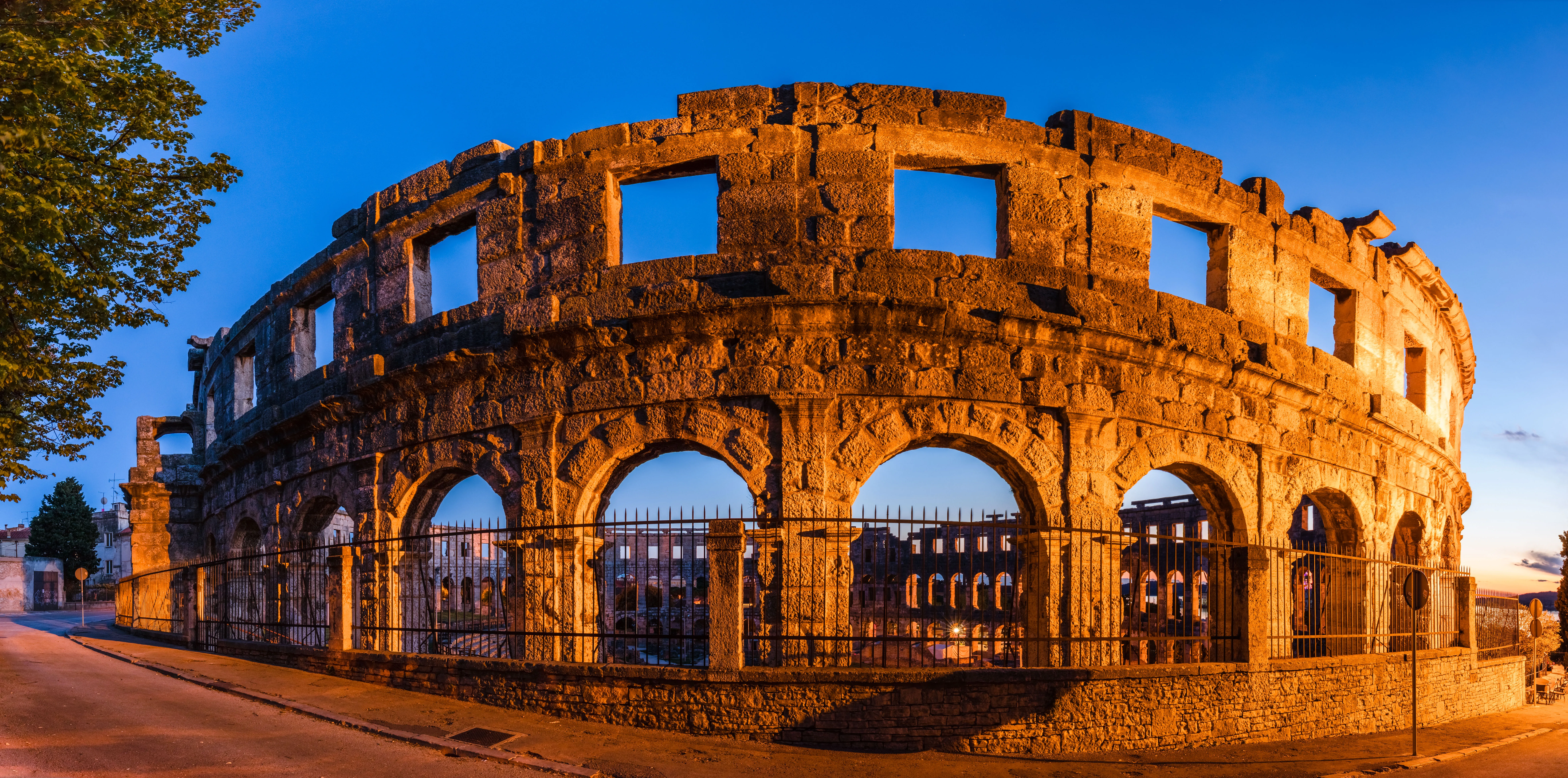
Outer arcade: The four-storey exterior wall of 72 arches arranged in three tiers, constructed in opus quadratum (large dressed limestone blocks without mortar) of Istrian lapis histricus. The structural logic is identical to the Colosseum — the arcade provides both visual grandeur and the structural support for the seating banks within. Four hollow towers: Positioned at the cardinal points of the oval, each tower contained an internal staircase giving access to the upper seating levels; the hollows also collected rainwater, channelled via pipes to cisterns beneath the arena floor. Cavea (seating banks): Original stone seating has almost entirely gone (used as building material in the medieval period), but the vomitoria (exit passages) and seating substructure remain visible. Underground chambers: The subterranean service level beneath the arena floor — where animals, gladiators, and equipment were held before spectacles — now houses the permanent museum of the gladiatorial games.
Historical Significance
The Pula Arena's historical significance operates on two levels: as a monument to Roman engineering and imperial ambition, and as a document of survival through fifteen centuries of post-Roman history. The arena survived Venetian quarrying plans, multiple changes of political control (Ostrogothic, Byzantine, Frankish, Venetian, Habsburg, Italian, Yugoslav, Croatian), two world wars in the 20th century, and the disintegration of Yugoslavia — each era leaving the limestone somewhat worn but structurally intact. That a structure built to entertain Roman crowds in the first century CE now entertains Sting fans in the 21st is either the strangest or the most logical continuity in European cultural history, depending on your perspective on the endurance of the desire for spectacle.
When to Visit
Daytime visits: Open daily from 8 AM (closing times vary: typically 8–9 PM in summer, 5 PM in winter). Best time for photography: Golden hour (1 hour before sunset) when the Istrian limestone turns warm amber and the shadow geometry of the arches becomes most dramatic. Concert season: Typically June through September; programme available from the Pula tourist board. Film Festival: One week in July — check the annual programme. Duration: 60–90 minutes for the arena and underground museum at a comfortable pace.
Admission and Costs
Adult daytime entry: ~€10–13. Children (6–14): ~€5–7. Under 6: Free. Combined Pula Roman sites ticket: Available at reduced rate from the tourist office. Concert tickets: €30–120+ depending on artist. Pula Film Festival: €7–15 per screening. Guided tours of the arena: €80–140 for private groups up to six, or €12–18 per person in small groups with a licensed guide.
The Case for a Guide
The arena speaks powerfully for itself — its scale and completeness are immediately impressive without interpretation. A licensed guide adds the layers of history and context that transform the visual impact into genuine understanding.
- Roman arena programmes decoded: A guide explains the social and political function of gladiatorial games — not merely entertainment but a tool of imperial control, where emperors demonstrated their generosity through spectacle and crowds performed their loyalty through participation
- Construction engineering: The four external towers (each hollow, each containing staircases) were the arena's circulation system — 23,000 people entered and exited through these towers in an orderly flow; a guide explains the logistics of Roman crowd management at this scale
- Istrian limestone's role in Roman architecture: The same lapis histricus quarried for this arena also built Diocletian's Palace in Split and the city walls of Dubrovnik — a guide who can trace this material connection creates a coherent picture of Roman building practice across the entire eastern Adriatic
- The Venetian near-miss: The story of the 15th-century Senate proposal to dismantle the arena for Venetian building stone — and why it didn't happen — is one of the most dramatic counterfactuals in architectural conservation; a guide makes the stakes of that debate vivid
- Gladiatorial reality vs cinematic myth: The actual evidence for gladiatorial combat (mortality rates, equipment, social status, training) differs substantially from the Hollywood version; a guide who can cite the archaeological evidence from the underground museum corrects decades of cinematic distortion
Tips for Visitors
Visit at sunset: The amber light on Istrian limestone at golden hour is the defining visual experience of the arena — schedule accordingly. Underground museum first: Start with the subterranean chambers to get the historical context before climbing to the arena floor. Book concert tickets early: The most popular summer performers sell out weeks in advance; check the programme before arriving in Pula. Film Festival screenings: The experience of watching a film on the arena floor under an Istrian summer sky is worth the effort of planning around the July schedule. Combine with the Forum: The Temple of Augustus is a 10-minute walk from the arena — combine both in a half-day Roman Pula circuit.
Frequently Asked Questions
Is the Pula Arena one of the best-preserved Roman amphitheatres?
Yes — and the comparison is straightforward. The Colosseum in Rome is more famous but substantially ruined: its exterior wall is partly collapsed, the interior seating has gone, and the arena floor is modern reconstruction. The Verona Arena is better preserved inside but lacks a complete exterior wall. The Pula Arena retains its complete four-storey outer wall on all sides — all 72 arches of the exterior arcade standing intact after two millennia — making it the most structurally complete large Roman amphitheatre in existence. The other entries on the "six most intact" list — El Jem in Tunisia, Capua and Arles in France — are all smaller than Pula. Of the truly large Roman arenas built for tens of thousands of spectators, Pula's is the most complete.
What events take place inside the Pula Arena today?
The arena hosts a full summer season of concerts, the Pula Film Festival (Croatia's premier film event, held each July), theatrical performances, and cultural events. International musicians who have performed here include Sting, Elton John, Luciano Pavarotti, Tom Petty, and the Foo Fighters — artists who specifically requested the arena for its acoustic and visual drama. The Pula Film Festival occupies the arena for one week in July, screening Croatian and international premieres on a screen erected within the oval; attending an open-air screening on Roman stone under an Istrian summer sky is one of the most memorable cultural experiences in the Mediterranean.
How much does it cost to visit the Pula Arena?
Daytime entry to the arena and its underground museum costs approximately €10–13 for adults, €5–7 for children (6–14), free under 6. Combined tickets with other Pula Roman sites (Temple of Augustus, Arch of the Sergii museum) are available at a small discount. Concert tickets vary dramatically by performer — from €30 for local acts to €120+ for international headliners. Pula Film Festival screenings cost approximately €7–15 per film. The arena is most atmospheric at golden hour, around an hour before sunset.