

Overview
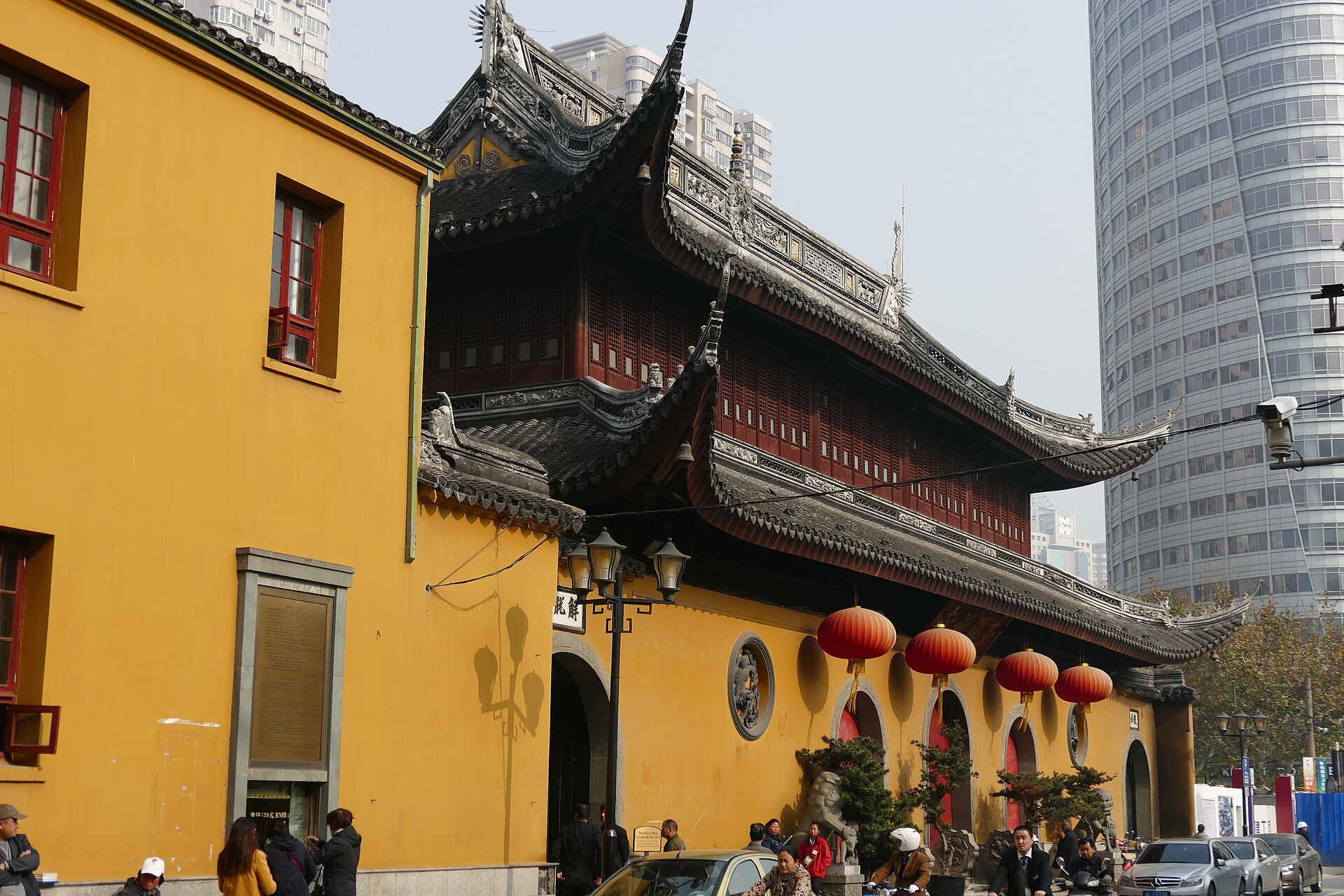
Jade Buddha Temple (Yùfó Sì, 玉佛寺) owes its existence to a single monk's extraordinary journey. In 1882, the Zen Buddhist monk Huigen traveled overland from China to Burma, where he acquired five exquisite Buddha statues carved from whole blocks of translucent white jade. He shipped two of them back to Shanghai, and a modest temple was erected to house the figures in 1882. War destroyed that original structure, but the statues survived, and the present temple was rebuilt in 1928 on Anyuan Road, where it stands today as one of the few active Buddhist monasteries inside the Shanghai urban core. Unlike many Chinese temples that function primarily as museums, Jade Buddha Temple pulses with daily religious life: saffron-robed monks chant sutras at dawn, devotees light spiraling coils of sandalwood incense, and the scent of burning joss paper drifts through courtyards shaded by ancient ginkgo trees. The temple complex spans three main halls arranged along a traditional south-to-north axis, each building escalating in spiritual significance until visitors reach the sealed upper chamber where the seated Jade Buddha resides. After exploring the temple grounds, a stroll south along Jiangning Road leads toward The Bund, while the lanes around Yu Garden offer a complementary glimpse into Shanghai's layered spiritual and mercantile heritage.
Spiritual Significance
Seated Jade Buddha: A 1.95-meter figure carved from a single block of milky Burmese jade, encrusted with agate and emerald ornaments donated by devotees over a century. Reclining Buddha: A serene 96-centimeter jade sculpture depicting the Buddha's entry into nirvana, displayed in a ground-floor hall where visitors can observe at close range. Grand Hall of Magnificence: The central worship space housing three gilded Buddhas of the past, present, and future, flanked by the eighteen golden arhats. Temple Vegetarian Restaurant: A canteen-style eatery within the complex serving inventive Buddhist cuisine where wheat gluten and tofu masquerade convincingly as pork, chicken, and fish. Sutra Library: An upstairs collection of over 7,000 volumes of Buddhist scriptures, some hand-copied by monks during the Qing dynasty. Courtyard Ginkgo Trees: Several towering ginkgo specimens that turn brilliant gold each November, framing the Song-dynasty-style architecture in seasonal splendor
When to Visit
Temple grounds: Daily 8:00 AM - 4:30 PM (last entry 4:00 PM). Morning chanting: Begins around 4:30 AM for ordained practitioners; visitors may observe from approximately 7:30 AM. Best: Early morning on weekdays, when incense smoke hangs low and the courtyards are nearly empty. Busiest: Lunar New Year and the birthday of Guanyin (19th of the 2nd lunar month) draw enormous crowds of worshippers
Admission and Costs
General admission: ¥50 per person (includes access to all halls). Incense bundle: Complimentary basic sticks included with ticket; premium sandalwood coils ¥20-80. Vegetarian restaurant: ¥30-60 per person for a full meal of mock-meat dishes and Buddhist temple cuisine. Photography: Allowed in courtyards but strictly prohibited in the Jade Buddha chamber
Tips for Visitors
Dress modestly: Shoulders and knees should be covered as a sign of respect; the temple occasionally turns away visitors in very casual attire. Step over thresholds: Traditional etiquette dictates stepping over, not on, the raised wooden thresholds at each hall entrance - monks consider treading on them disrespectful. Eat at the temple canteen: The vegetarian restaurant is genuinely good and far cheaper than nearby restaurants - arrive before 11:30 AM to beat the lunch rush. Combine visits wisely: Pair Jade Buddha Temple with the nearby M50 Art District, a converted textile mill complex just a 15-minute walk east along Suzhou Creek. Engage a guide for symbolism: The iconography across the halls encodes centuries of Chan Buddhist philosophy that's invisible without explanation - a guide transforms a quick visit into a meaningful experience