
Formation
Geologically, West Lake is a lagoon that lost its sea. Two thousand years ago the site was a shallow bay opening onto the estuary of the Qiantang River, the same river whose spectacular tidal bore still surges past Hangzhou each autumn. Silt carried by the river and sediment pushed back by the tides slowly built a bar across the bay's mouth, sealing off a pocket of water that freshened over time into today's lake. Because it was born from silt, the lake is remarkably shallow, averaging little more than two metres deep and reaching a maximum of around five; sunlight therefore penetrates almost the entire water column, which is part of why lotus and reed beds colonise the margins so readily. That same shallowness is the lake's great vulnerability. Left alone, West Lake would have choked itself with sediment and vegetation and reverted to marshland within a few centuries. Its survival is a story of hydraulic engineering: governor Bai Juyi dredged and dyked it in the 820s, and two and a half centuries later the poet-governor Su Shi cleared it again in 1090, using the excavated mud to build the Su Causeway. The causeways you stroll are, quite literally, the spoil heaps of these clean-outs, reshaped into the most elegant infrastructure imaginable. The forested hills on the west and south, meanwhile, are the eroded remnants of older bedrock ridges, and their springs feed the lake with the clear water that keeps it from stagnating.
Trails
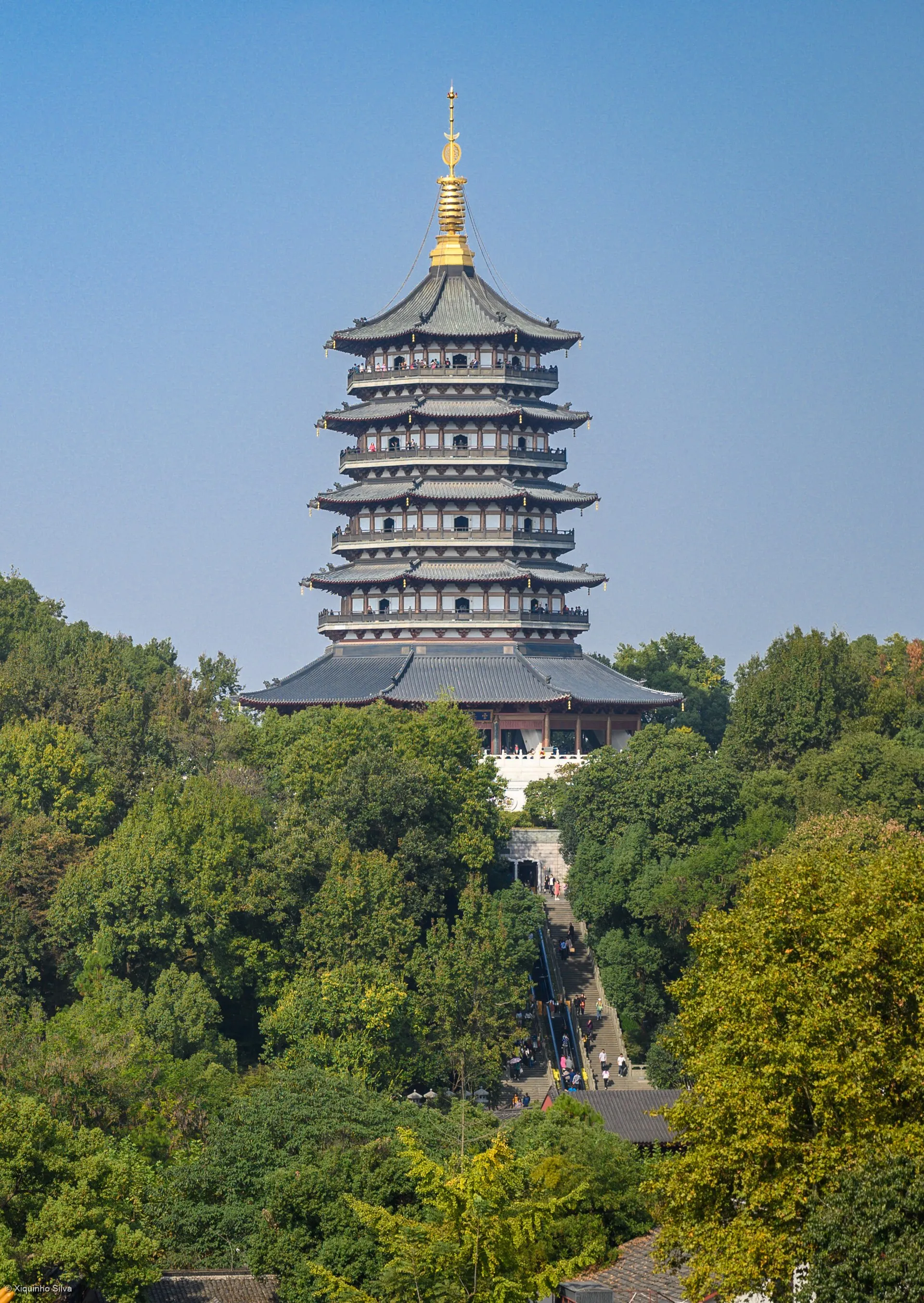
Broken Bridge in snow: One of the classic Ten Scenes, the bridge appears to "break" where snow melts first, creating a gap of dark stone against white, and it anchors the legend of the White Snake. Three Pools Mirroring the Moon: Three small stone pagodas on the lake surface create the illusion of multiple moons floating on the water during the Mid-Autumn Festival. Leifeng Pagoda at sunset: First raised by a Wuyue king in 975, the tower collapsed in 1924 after treasure-hunters weakened its brick core, and the steel-and-copper reconstruction that opened over the original foundations in 2002 once again glows amber on the south shore as the sun drops behind the western hills. Quyuan Garden lotus ponds: Wooden boardwalks wind through thick stands of lotus rising above head height in midsummer. Su Causeway morning walk: A 2.8-kilometre tree-lined path crossing six arched stone bridges, best experienced at first light. Orioles Singing in the Willows: A lakeside park where birdsong mingles with rustling willow branches, exactly as poets described it centuries ago.
Wildlife
West Lake's willow-fringed shores and lotus-choked inlets provide habitat for a rich population of waterbirds. Little grebes and mandarin ducks paddle among the lotus stems in the Quyuan Garden section, while grey herons stand sentinel on the rocks near the Su Causeway. The lake's resident black-crowned night herons are so abundant that their nesting colonies in the island trees are visible from passing boats. Seasonally, flocks of cormorants winter on the lake, and the forested hills along the western shore shelter Eurasian jays, spotted doves, and occasional Reeves's pheasants in the undergrowth.
When to Visit
Lake access: Open 24 hours, 365 days a year with no entrance fee. Boat cruises: Electric boats run from roughly 7:30 AM to 5:00 PM (extended to 9 PM in summer). Hangzhou has a humid subtropical monsoon climate, which shapes when the lake is at its best. Best moment: Dawn on the Bai Causeway, when mist hangs low over the Broken Bridge and the water is glass-still. Spring (March–May) brings peach and willow blossom along the causeways and is the finest all-round window; October rivals it with clear autumn skies. Lotus season: July through August fills the Quyuan Garden section with pink and white blooms, though the midsummer heat and humidity are punishing by midday. Winter is quiet and often grey, but a rare snowfall on the Broken Bridge recreates the most celebrated of the Ten Scenes.
Admission and Costs
Lakeside walking and cycling: Completely free. Electric boat to the Three Pools Mirroring the Moon island: ¥55 (about $8) per person, includes island entry. Hand-rowed wooden boat: ¥150 (about $21) per hour for up to six people, a more intimate experience. Public bike-share: First hour free at most docks; bikes are plentiful around the entire shoreline. Lakeside tea houses along the south shore serve local Longjing green tea with a view for around ¥30–50 ($4–7) a pot, an easy way to rest mid-loop.
The Case for a Guide
West Lake is free to walk and easy to enjoy on your own, but its meaning is almost entirely invisible without context, and that is exactly what a knowledgeable local guide supplies. The lake is a landscape of allusion, where every bridge, pagoda, and stand of willows quotes a poem or a painting most visitors have never read.
- The Ten Scenes decoded: A guide explains why a plain stone bridge is called "Lingering Snow on the Broken Bridge" and points you to the exact spot and season each scene was meant to be viewed from
- The engineering behind the beauty: Hear how Bai Juyi and Su Shi turned dredged mud into the causeways you are standing on, and why the lake needs constant human care to exist at all
- The legends made legible: The tale of the White Snake at the Broken Bridge, the buried scriptures of Leifeng Pagoda, and the meaning of the Three Pools stone lanterns come alive when someone can tell them in place
- Efficient routing: A guide sequences the causeways, islands, and viewpoints so you catch the best light and skip the crowds, then hands you off to Lingyin Temple or the Longjing Tea Plantations for the afternoon
- Tea-house etiquette and fair prices: Local guides steer you to honest Longjing tea houses on the south shore and away from the tourist-priced traps near the busiest gates
Tips for Visitors
Cycle the full loop: The 15-kilometre shoreline path is flat and well-paved; grab a free bike-share and circle the entire lake in about 90 minutes. Avoid Golden Week: The first week of October draws over a million visitors daily and the causeways become shoulder-to-shoulder. Rainy days have charm: Misty rain is one of the classic West Lake moods; bring an umbrella and photograph the atmospheric conditions the poets loved. Evening boat rides: Summer evening cruises pass illuminated pagodas and the Impression West Lake water-stage show, directed by Zhang Yimou. Lakeside tea stops: Small tea houses along the south shore serve Longjing green tea with a view; budget ¥30–50 ($4–7) for a pot. Combine wisely: Lingyin Temple and the Longjing Tea Plantations sit just west of the lake and pair neatly into a single day.
Frequently Asked Questions
What are the access hours for West Lake and when do boat cruises run?
Lake access: Open 24 hours, 365 days a year with no entrance fee. Boat cruises: Electric boats run from roughly 7:30 AM to 5:00 PM (extended to 9 PM in summer), and hand-rowed wooden boats work the same daylight window, weather permitting. The best light falls before 8 AM and in the last hour before sunset, so aim your boat trip for either end of the day rather than the harsh midday glare.
How much does it cost to access West Lake?
Lakeside walking and cycling: Completely free. Electric boat to the Three Pools Mirroring the Moon island: ¥55 (about $8) per person, which includes island entry. Hand-rowed wooden boat: ¥150 (about $21) per hour for up to six people, a slower and more intimate experience. Public bike-share is free for the first hour at most docks, so the entire shoreline can be seen for almost nothing.
What is the most efficient way to explore West Lake's full shoreline?
Cycle the full loop. The 15-kilometre shoreline path is flat and well-paved; grab a free bike-share and circle the entire lake in about 90 minutes, crossing the Bai and Su causeways in the process. Walkers short on time should prioritise the Bai Causeway from the Broken Bridge to Solitary Hill, the single most scenic kilometre on the water.
How was West Lake formed, and why is it so shallow?
West Lake began as a shallow marine lagoon at the mouth of the Qiantang River. A silt bar gradually sealed it off from the sea roughly two thousand years ago, leaving a freshwater basin that averages barely two metres deep. Without repeated dredging it would have silted into marshland long ago, which is exactly why governors from Bai Juyi to Su Shi kept clearing it across the centuries.
Which of the Ten Scenes should first-time visitors prioritise?
For a single day, chain together four: dawn at the Broken Bridge on the Bai Causeway, mid-morning along the Su Causeway's six bridges, the lotus ponds of Quyuan Garden in summer, and Leifeng Pagoda catching the last light at sunset. Together they cover the lake's north, west, and south shores and the classic viewpoints that Southern Song painters fixed eight centuries ago.