
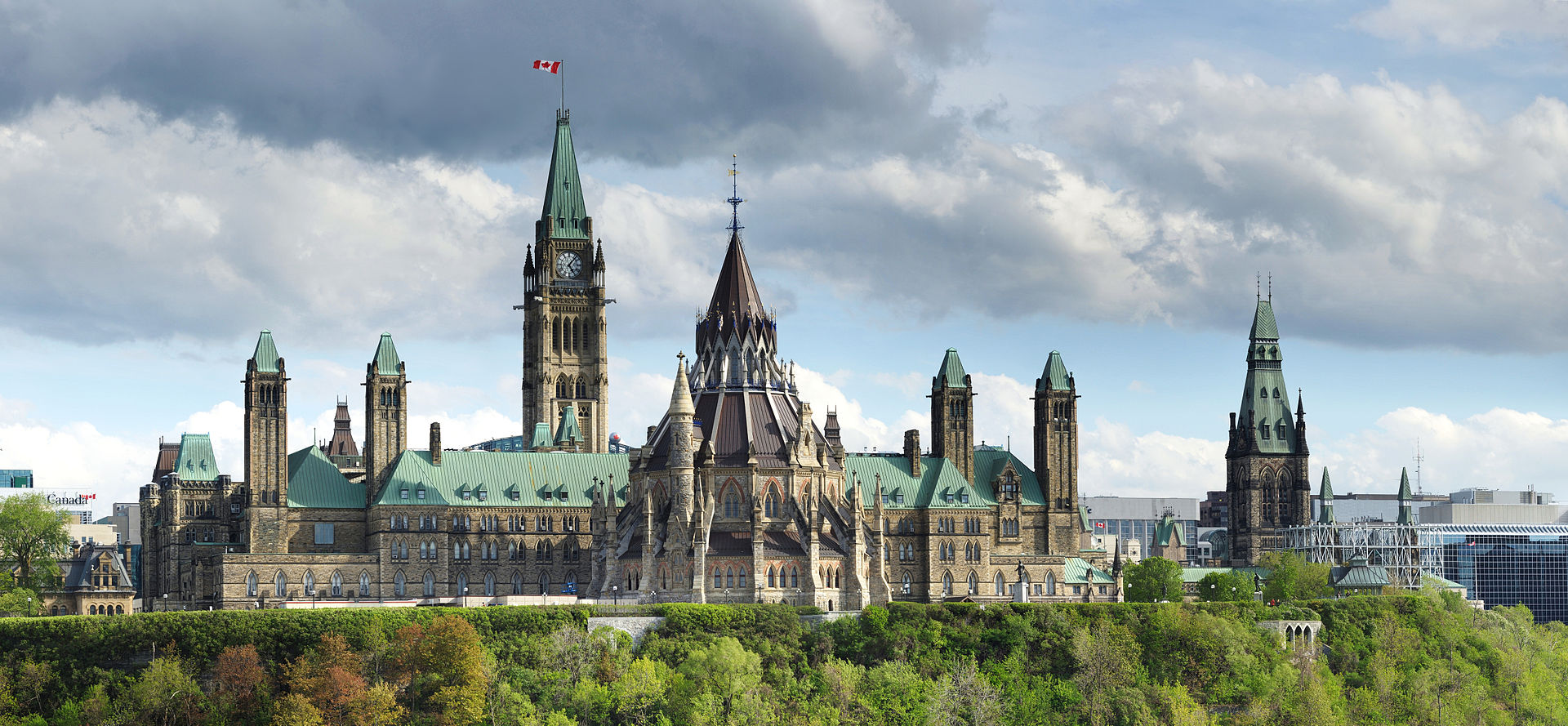

Overview
Perched on a limestone promontory above the Ottawa River, Parliament Hill has served as the seat of Canadian federal government since Confederation in 1867. The original buildings were designed in the High Victorian Gothic style that Thomas Fuller and Chilion Jones championed — a deliberate departure from the Neoclassical vocabulary of Washington, intended to signal that this northern democracy drew its institutional identity from British parliamentary tradition rather than American republicanism. The Centre Block, gutted by fire in 1916 and rebuilt with the soaring Peace Tower at its heart, is currently undergoing a massive restoration projected to last into the 2030s, making the West Block the temporary home of the House of Commons while work proceeds behind vast scaffolding. What remains fully accessible is still extraordinary: the copper-roofed Library of Parliament, a polygonal reading room that survived the 1916 fire because an alert clerk slammed its iron doors shut; the Centennial Flame, burning at the main gate since 1967 with water flowing over shields representing every province and territory; and the sweeping lawn where Canadians gather for everything from Canada Day fireworks to impromptu yoga sessions. During summer evenings, the facades become a canvas for a free sound-and-light show that projects the nation's history across the Gothic stonework in vivid colour.
Historical Significance
Parliament Hill has anchored Canadian democracy since 1867, when the Dominion of Canada confederated four provinces under a parliamentary system modelled on Westminster. The original High Victorian Gothic buildings represented a deliberate architectural statement: choosing Gothic over Neoclassical signalled allegiance to British parliamentary tradition rather than the American republican model visible in Washington's columned Capitol. The catastrophic fire of February 3, 1916 — which destroyed the Centre Block but spared the Library thanks to clerk Conolly's quick action in slamming its iron fire doors — led to the reconstruction that produced today's 92-metre Peace Tower, dedicated in 1927 as a memorial to Canadians who served in the First World War. The tower houses a 53-bell carillon, a memorial chamber with Books of Remembrance listing every Canadian who died in military service, and an observation deck offering panoramic views of the Ottawa River valley. The Centennial Flame, lit at the stroke of midnight on January 1, 1967, to mark Canada's hundredth birthday, burns continuously from the centre of a fountain ringed by bronze shields of every province and territory — coins tossed in by visitors are donated to disability research. The Hill has witnessed landmark moments in Canadian political life: Pierre Trudeau's defiant stance during the 1970 October Crisis, the patriation of the Constitution in 1982, and annual Canada Day celebrations that draw hundreds of thousands to the lawn.
Architecture
Peace Tower: Rising 92 metres above the Hill, the memorial tower houses a 53-bell carillon, a memorial chamber honouring Canada's war dead, and an observation deck offering panoramic views of the Ottawa River valley and the Gatineau Hills. Library of Parliament: The only interior space to survive the 1916 fire, this stunning polygonal chamber is lined with hand-carved white pine galleries, a marble statue of Queen Victoria at its centre, and shelving for over 600,000 volumes — widely regarded as one of the most beautiful library interiors in the world. Changing of the Guard: Soldiers in scarlet tunics and bearskin caps march from Cartier Square Drill Hall to the Hill, executing precise drill movements accompanied by a regimental band — a spectacle that draws thousands of spectators each summer morning. Centennial Flame: Lit on the stroke of midnight on January 1, 1967, to mark Canada's hundredth birthday, this eternal flame burns from the centre of a fountain ringed by the bronze shields of every province and territory, with coins tossed in by visitors donated to disability research. Sound-and-light show: On summer evenings the entire Centre Block facade transforms into a projection screen, telling Canada's story through light, music, and narration — a spectacle that draws families, couples, and backpackers to the lawn with blankets and takeaway from nearby ByWard Market.
When to Visit
General grounds: Daily 9 AM - 5 PM for building access, though the lawns and exterior pathways are open around the clock. Changing of the Guard: Late June through late August, daily at 10 AM on the front lawn (weather permitting). Sound-and-light show: Nightly in July and August, starting at dusk (approximately 9:30 PM), projected onto the Parliament buildings. Best time: Arrive by 9 AM on a summer weekday to secure free tour tickets, then stay through the morning to catch the Changing of the Guard ceremony. Least crowded: Weekday afternoons in late September and October, when the fall foliage across the river in Gatineau adds a stunning backdrop.
Admission and Costs
Guided tours of Parliament: Free — tickets must be booked online in advance through the official parliamentary website; walk-up availability is extremely limited. Changing of the Guard: Free — the ceremony takes place on the open lawn and requires no ticket. Sound-and-light show: Free — blankets and lawn chairs are welcome on the grass; no reservation needed. Library of Parliament: Free to visit as part of a guided tour; the reading room interior is viewable from a roped gallery.
Tips for Visitors
Book tours early: Free guided tour slots are released online and fill up quickly during peak season; check the parliamentary website first thing in the morning for same-day availability. Security screening: All visitors entering buildings pass through airport-style security — leave large bags, sharp objects, and liquids at your hotel to speed the process. Riverside walk: After touring the buildings, follow the path along the bluff behind Centre Block for unobstructed views of the Ottawa River, the Alexandra Bridge, and the Canadian Museum of History on the Gatineau shore. Combine with the canal: The Ottawa Locks at the eastern edge of the Hill connect Parliament directly to the Rideau Canal — watch boats descend the eight-lock staircase to the river, one of the most photographed engineering features in the capital. Winter visits: Parliament Hill is quieter in winter but no less striking, with snow blanketing the Gothic spires and the Centennial Flame melting a circle of bare ground around its base.