

Overview
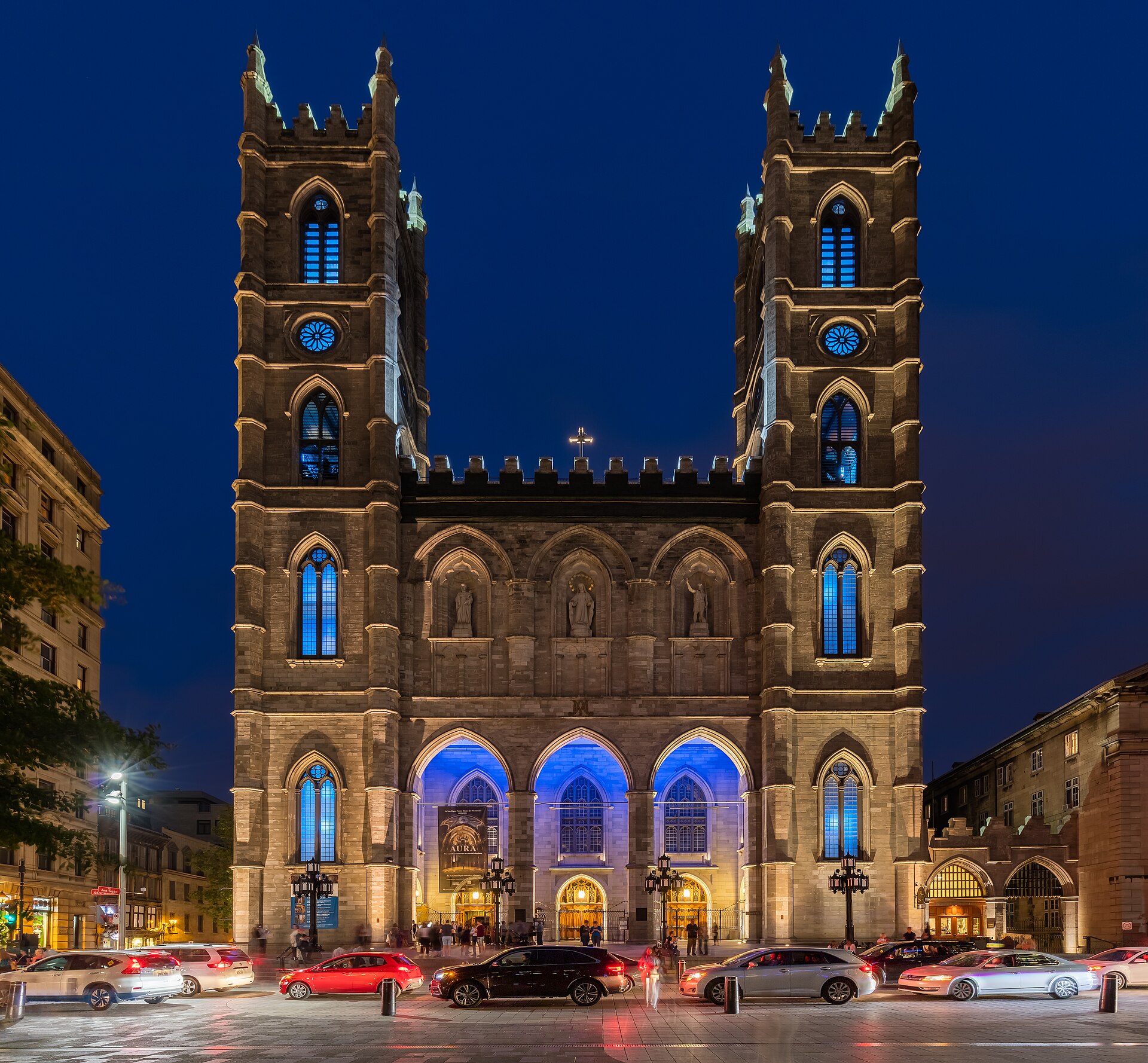
When Irish-American architect James O'Donnell accepted the commission to design a parish church for Montreal's Sulpician order in 1824, he envisioned a structure so grand that it would rival the medieval cathedrals of Europe. The basilica that rose on Place d'Armes between 1824 and 1829 delivered on that ambition. Its twin towers — Perseverance and Temperance — climb 69 metres above the cobblestones, framing a facade of dressed grey stone that dominates the western approach to Vieux-Montreal. Step through the heavy wooden doors and the restrained exterior gives way to an explosion of colour: deep azure vaults studded with gold stars, a reredos carved from linden wood and painted in polychrome, and stained-glass windows that depict the religious history of the city rather than biblical scenes. The centrepiece of the nave is a Casavant Freres organ with roughly 7,000 pipes, an instrument so powerful that its lowest notes vibrate the pews during recitals. Celine Dion married Rene Angelil here in 1994, a ceremony that turned an already celebrated church into a cultural landmark.
Spiritual Significance
Notre-Dame Basilica embodies the spiritual ambitions of the Sulpician order, who had served as seigneurs of Montreal since 1663 and commissioned the church as a statement of Catholic institutional permanence in a city that was rapidly growing and diversifying. The blue-and-gold interior — the vaulted ceiling painted a deep ultramarine scattered with thousands of gold-leaf stars — creates the impression of standing beneath a celestial canopy, a deliberate theological metaphor connecting the earthly sanctuary with the heavenly realm. The reredos behind the altar, carved from linden wood by Louis-Philippe Hebert and his team over several years, depicts scenes of sacrifice, redemption, and New World evangelization specific to the Sulpician mission in Nouvelle-France. The stained-glass windows, designed by Jean-Baptiste Lagace in 1929, break with European tradition by illustrating Montreal's own religious history — Maisonneuve's founding vow, the arrival of the Sulpicians, and the building of the first chapel — grounding universal Catholic themes in local narrative. The Casavant Freres organ, installed in stages from 1891 onward with roughly 7,000 pipes spanning four manuals and a pedalboard, fills the nave with sound that resonates physically in the listener's chest — an instrument designed to make the presence of the divine palpable through acoustic power.
Visitor Etiquette
Notre-Dame Basilica remains an active parish church with regular masses, weddings, funerals, and sacramental celebrations. Visitors are welcome during designated tourist hours, but respectful behaviour is expected at all times. Dress modestly — bare shoulders and very short garments may draw polite requests to cover up. Silence mobile phones and speak in whispers throughout the interior. Photography is permitted during regular visits but flash is strictly prohibited, as the intense light damages the 19th-century pigments on the polychrome woodwork. During the AURA light show, photography and video are generally permitted but follow the specific guidelines announced at each performance. If you happen to visit during a mass or liturgical event, you are welcome to sit respectfully in the rear pews, but refrain from walking through the nave or photographing the service.
When to Visit
Regular hours: Monday to Saturday 8 AM - 4:30 PM, Sunday 12:30 PM - 4 PM (hours may vary for liturgical events). AURA light show: Evening performances typically at 6 PM, 7 PM, and 8:30 PM — check the schedule online as times shift seasonally. Best time: Arrive at opening on a weekday morning when the sanctuary is nearly empty and sunlight streams through the east-facing windows. Busiest period: Summer afternoons from noon to 3 PM see the heaviest foot traffic, with tour groups often queuing outside.
Admission and Costs
General admission: CA$18 per adult, which includes a brief guided introduction to the basilica's history and architecture. AURA immersive experience: CA$30-35 per person for the multimedia light-and-sound show that transforms the interior with projections, orchestral music, and moving light. Guided tour: Included with the standard admission ticket — guides cover the construction story, organ history, and the significance of the stained-glass windows.
Tips for Visitors
Buy AURA tickets early: Evening shows frequently sell out, especially on weekends — book online at least a few days ahead during peak season. Dress respectfully: While there is no strict dress code, bare shoulders and very short clothing may draw polite requests to cover up, as the basilica remains an active place of worship. Photography allowed: Cameras are welcome during regular visits, but flash is prohibited; the dim interior rewards a steady hand or a tripod-friendly phone mount. Combine with Old Montreal: Place d'Armes sits at the gateway to Vieux-Montreal — walk east along Rue Saint-Paul after your visit to explore the cobblestone quarter without backtracking. Organ recitals: Free or low-cost organ concerts are held periodically; check the basilica's events calendar for dates, as hearing the Casavant at full volume is an experience no recording can replicate.