

Overview
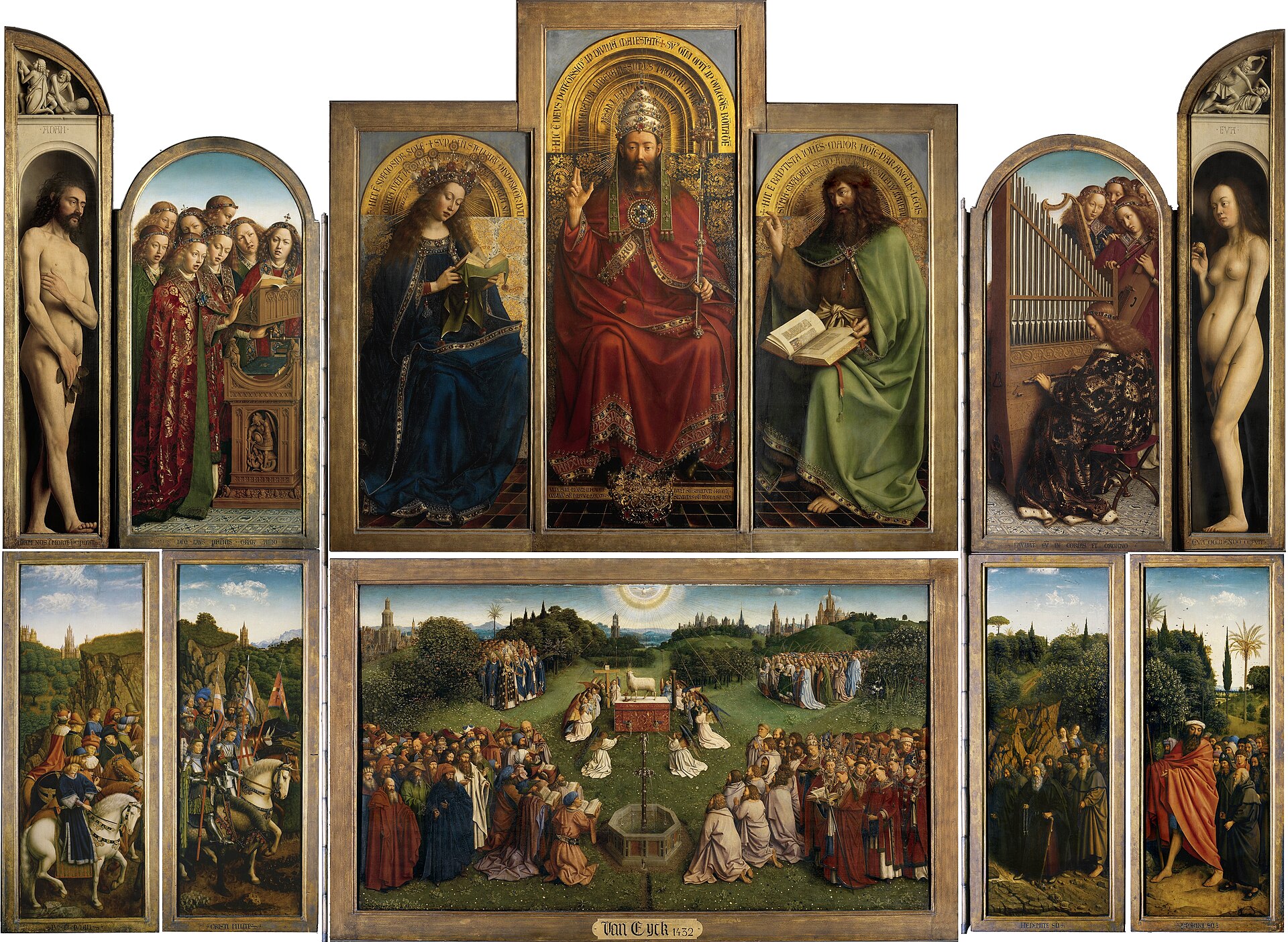
The Ghent Altarpiece resides in a climate-controlled chapel within St. Bavo's Cathedral, behind bulletproof glass that reflects overhead lights unless you position yourself carefully. Officially titled "The Adoration of the Mystic Lamb," this monumental polyptych consists of twelve oak panels painted by brothers Jan and Hubert van Eyck between 1426 and 1432, depicting biblical scenes from the Annunciation through the Apocalypse with technical precision that revolutionized European painting. When closed, the altarpiece shows an Annunciation scene in grisaille (monochrome painting imitating sculpture) that medieval viewers saw most of the year since the panels opened only for feast days. When opened, the interior reveals twenty-four brilliantly colored scenes arranged in three tiers: God the Father flanked by the Virgin Mary and John the Baptist in the upper register, musical angels and Adam and Eve in nude anatomical detail on the second level, and the famous central Adoration scene where angels, prophets, martyrs, and pilgrims converge on a lamb standing on an altar, blood flowing into a chalice, set against a jewel-like landscape stretching to an impossibly detailed horizon. What makes the Ghent Altarpiece historically revolutionary goes far beyond its religious iconography. Jan van Eyck pioneered oil painting techniques that allowed unprecedented realism: layering thin glazes of pigment mixed with linseed oil created luminous color that seemed to glow from within, while the slow-drying medium permitted meticulous detail work impossible with earlier egg tempera. Examine the central Adoration panel closely (the glass barrier makes this frustrating, but worthwhile) and you'll see individual flower species botanically identifiable in the foreground meadow, gem-cut facets reflecting light on the angels' jeweled crowns, textile weaves visible in the pilgrims' robes, and atmospheric perspective rendering distant Jerusalem's towers in progressively hazier blues. The naked Adam and Eve panels shocked medieval viewers with their unidealized bodies — Adam's protruding belly, Eve's post-childbirth figure — representing an unprecedented naturalism that rejected Gothic idealization for observed reality. These technical innovations established Northern Renaissance painting as distinct from Italian developments: while Florence pursued mathematical perspective and classical idealism, Ghent mastered optical realism through empirical observation and chemical innovation. The altarpiece's dramatic survival story rivals any thriller plot. Since 1432, thieves have stolen the panels thirteen times, making this the most frequently targeted artwork in history. Calvinists removed it during the 1566 Beeldenstorm (iconoclastic fury), but Catholic authorities hid the panels successfully. Revolutionary France confiscated the altarpiece to the Louvre in 1794, returning it after Napoleon's defeat in 1815. The cathedral sold the Adam and Eve panels to the Brussels museum in 1861 to fund repairs, later selling four more panels to a Berlin collector (recovered after World War I through the Treaty of Versailles). Nazi art loopers stole the entire altarpiece in 1942, hiding it in an Austrian salt mine where American Monuments Men discovered it in 1945. Most mysteriously, thieves stole the "Just Judges" panel in 1934 and it remains missing today — the current left wing displays a 1945 replica while the original's location continues generating theories involving ransom demands, clerical cover-ups, and deathbed confessions that led nowhere. This theft history paradoxically increased the altarpiece's fame: each recovery generated international headlines, transforming a medieval religious commission into a symbol of cultural heritage worth protecting at any cost. The cathedral installed the current climate-controlled chapel in 1986, but a major restoration project (2012-2020) transformed how visitors experience the altarpiece. Conservators removed centuries of overpainting that had darkened the panels, revealing van Eyck's original brilliant colors: the lamb's wool returned to gleaming white (earlier restorers had overpainted it brown, creating the "brown lamb" mystery that puzzled art historians for generations), the landscape greens intensified, and Adam's flesh tones regained lifelike warmth. More controversially, the restoration revealed that the lamb's face was originally painted with disturbingly humanoid features — forward-facing eyes and an eerily human expression that many viewers find unsettling. Curators debated whether to restore this "controversial lamb" or maintain later overpainting that had made the lamb more conventionally animal-like; they chose authenticity, meaning today's visitors see the lamb as 15th-century Ghent saw it, human gaze and all. This restoration sparked global media coverage, demonstrating how even 600-year-old paintings remain culturally contested objects where decisions about "original" appearance involve modern aesthetic judgments. Viewing the altarpiece now involves mandatory augmented reality tablets (included in admission) that overlay digital information onto the physical panels. Point the tablet at specific details and hotspots activate: biblical identifications for the 250+ figures in the Adoration scene, botanical names for the foreground flowers, explanations of symbolic elements like the octagonal fountain representing baptism or the distant towers symbolizing the celestial Jerusalem. The technology proves simultaneously helpful and distracting — you gain identification details impossible to remember otherwise, but constantly switching between tablet screen and actual painting fragments the viewing experience. Art historians debate whether this mediated viewing enhances or diminishes engagement with the original object, but the tablets undeniably democratize expert knowledge that previously required guidebooks or guided tours. The installation also includes ultrahigh-resolution gigapixel photography viewable on adjacent screens, allowing you to zoom into brushstroke-level detail that the glass barrier and viewing distance make impossible in person, revealing van Eyck's technique with forensic precision. The altarpiece functions within St. Bavo's Cathedral as both religious object and art museum centerpiece, creating tensions between devotional and tourist contexts. The panels were commissioned as liturgical furniture — an object to focus congregational worship during mass, not primarily for aesthetic contemplation. Yet today, most visitors are cultural tourists rather than worshippers, and the €6 altarpiece ticket (separate from €12.50 full cathedral admission) treats the panels as secular art requiring specialized viewing conditions divorced from liturgical function. The cathedral attempts to maintain sacred context through signage requesting silence and respectful behavior, but crowds cluster around the glass barrier photographing the panels with smartphones despite photography prohibitions, guards intervene to enforce rules, and the chapel atmosphere resembles a museum gallery more than consecrated space. This commodification of religious art creates philosophical questions about whether removing the altarpiece from worship context and placing it in controlled viewing conditions preserves or destroys its cultural meaning. For visitors trying to meaningfully engage with the altarpiece amid controlled conditions and tourist crowds, strategy matters. The chapel permits only 25 people simultaneously, creating queues during peak hours (11 AM - 3 PM daily, worse on weekends). Early morning visits (9:30-10:30 AM) or late afternoon (4:00-5:00 PM) reduce waiting and provide quieter contemplation time. Budget minimum 30 minutes with the panels — rushing through in 10 minutes wastes the admission cost and misses the opportunity to observe details that reward sustained attention. Alternate between close viewing (identifying figures, examining technique) and stepping back to appreciate compositional structure across all twelve panels. Use the AR tablet selectively rather than constantly — perhaps identify major figures during first viewing, then set the tablet aside for a second unmediated look at the painting itself. Consider visiting twice if staying multiple days in Ghent: once for basic orientation and tablet-guided identification, once for slower aesthetic contemplation without digital mediation. A knowledgeable guide contextualizes the panels within 15th-century theology, Flemish politics, and artistic technique in ways the tablet cannot, making a guided tour worthwhile despite the additional cost. The altarpiece represents just one element within St. Bavo's broader artistic holdings, but its fame overshadows everything else in the cathedral. After viewing the van Eyck panels, consider exploring the cathedral's Rubens paintings, baroque high altar, and medieval crypts (included in the €12.50 full admission but not the €6 altarpiece-only ticket). This contextualizes the Ghent Altarpiece within the building's longer devotional history rather than treating it as an isolated masterpiece. The cathedral also offers a combined ticket with Gravensteen castle (€20 for both), providing modest savings if visiting both sites. For deeper engagement, the nearby MSK (Museum of Fine Arts) houses other Flemish Primitive paintings that help you understand van Eyck's innovations within broader Northern Renaissance developments. The altarpiece rewards whatever time and attention you invest, but approaching it with historical context and technical understanding transforms the experience from "famous painting viewing" to encountering an object that fundamentally changed how Western art represented visual reality.
Visitor Etiquette
The Ghent Altarpiece resides within a consecrated cathedral: silence mobile phones, speak in whispers, and respect the sacred context even though the climate-controlled chapel functions more as museum gallery than devotional space. Photography is officially prohibited inside the altarpiece chapel — guards enforce this rule, and flash photography would damage the 590-year-old pigments. The 25-person capacity limit exists for conservation reasons (controlling humidity from human breath and body heat), so avoid lingering past your allotted viewing time during busy periods. When other visitors are waiting, share the front-row viewing positions rather than monopolizing the closest approach to the glass barrier. The AR tablets should be used at moderate volume with headphones if available.
Spiritual Significance
Mystic Lamb panel: Central Adoration scene with 250+ figures converging on the sacrificial lamb — recently restored to reveal original brilliant colors and controversial humanoid lamb face. Oil painting revolution: Jan van Eyck's pioneering oil glazing techniques created unprecedented luminosity and detail work that established Northern Renaissance style. Adam and Eve panels: Shockingly realistic nude figures with unidealized bodies — Adam's belly, Eve's post-childbirth figure — that rejected Gothic idealization for observed anatomy. Microscopic detail: Individually identifiable flower species, gem-cut jewels reflecting light, textile weaves, and atmospheric perspective rendering distant Jerusalem. Missing panel mystery: The "Just Judges" panel stolen in 1934 remains lost despite ransom demands and deathbed confessions — current left wing shows 1945 replica. Augmented reality: Mandatory tablets overlay biblical identifications, symbolic explanations, and conservation details onto the physical panels. Grisaille exterior: Closed altarpiece shows monochrome Annunciation painted to imitate sculpture — what medieval viewers saw most of the year before feast-day openings. Conservation reveals: 2012-2020 restoration removed centuries of overpainting, revealing van Eyck's original colors and the controversial humanoid lamb face that earlier restorers had hidden.
When to Visit
Altarpiece viewing: Monday-Saturday 9:30 AM - 5:00 PM, Sunday 1:00 PM - 5:00 PM. Last entry: 4:30 PM daily — guards enforce this strictly, arrive with time for full viewing. Best: Weekday mornings (9:30-10:30 AM) for shortest queues and quietest contemplation. Avoid: Midday (11 AM - 2 PM) when tour groups and cruise ship excursions create 30-45 minute waits for chapel entry. Sunday opening: 1:00 PM start accommodates morning masses — don't arrive expecting 9:30 AM access on weekends. Seasonal crowds: July-August sees longest waits; April-May and September-October offer better viewing conditions with fewer visitors.
Admission and Costs
Altarpiece only: €6 — includes climate-controlled chapel access and mandatory AR tablet, but not the rest of the cathedral. Full cathedral ticket: €12.50 — altarpiece plus Rubens paintings, Baroque altar, crypts, and all chapels. Combined ticket: €20 for St. Bavo's Cathedral + Gravensteen castle — modest savings versus separate admission. Guided tour: €15-20 added to admission for 45-minute expert-led altarpiece tour (check cathedral website for schedule). Private guide: €200-280 for 2-hour tour covering altarpiece, cathedral, and Ghent's medieval art context. AR tablet: Included in admission (mandatory).
Tips for Visitors
Arrive early: The 25-person capacity limit creates queues after 10:30 AM. First entry at 9:30 AM guarantees immediate access. Full vs. altarpiece ticket: The €6 altarpiece-only ticket excludes the rest of the cathedral. If interested in Rubens, baroque altar, or crypts, pay €12.50 for full access upfront. AR tablet strategy: Use the augmented reality tablet for initial figure identification, then set it aside for unmediated viewing. Constant digital mediation fragments engagement with the actual painting. Glass barrier positioning: The bulletproof glass reflects overhead lights. Angle yourself slightly to sides rather than standing directly center to minimize reflections in photos (despite photography being officially prohibited). Budget serious time: Minimum 30 minutes needed to appreciate details. Rushing through in 10 minutes wastes admission cost and misses details that reward sustained attention. Brown lamb mystery: Earlier restorations had overpainted the lamb brown, creating decades of art historical mystery. Recent conservation restored van Eyck's original white wool — what you see today is 15th-century authentic. Controversial lamb face: The restored lamb has disturbingly humanoid features with forward-facing eyes. This isn't conservation error — it's van Eyck's original vision that later painters found too unsettling and covered up. Gigapixel screens: Adjacent ultrahigh-resolution displays let you zoom to brushstroke level — details impossible to see through glass at viewing distance. Use these to study van Eyck's technique. Guided tours: The cathedral offers expert-led tours (check website for times) that contextualize theological symbolism and artistic technique beyond what the AR tablet provides. Worth the extra €15-20. Visit context: Combine with the cathedral's other St. Bavo's artworks (Rubens, baroque altar) and nearby MSK museum to understand van Eyck's innovations within broader Flemish painting traditions.