
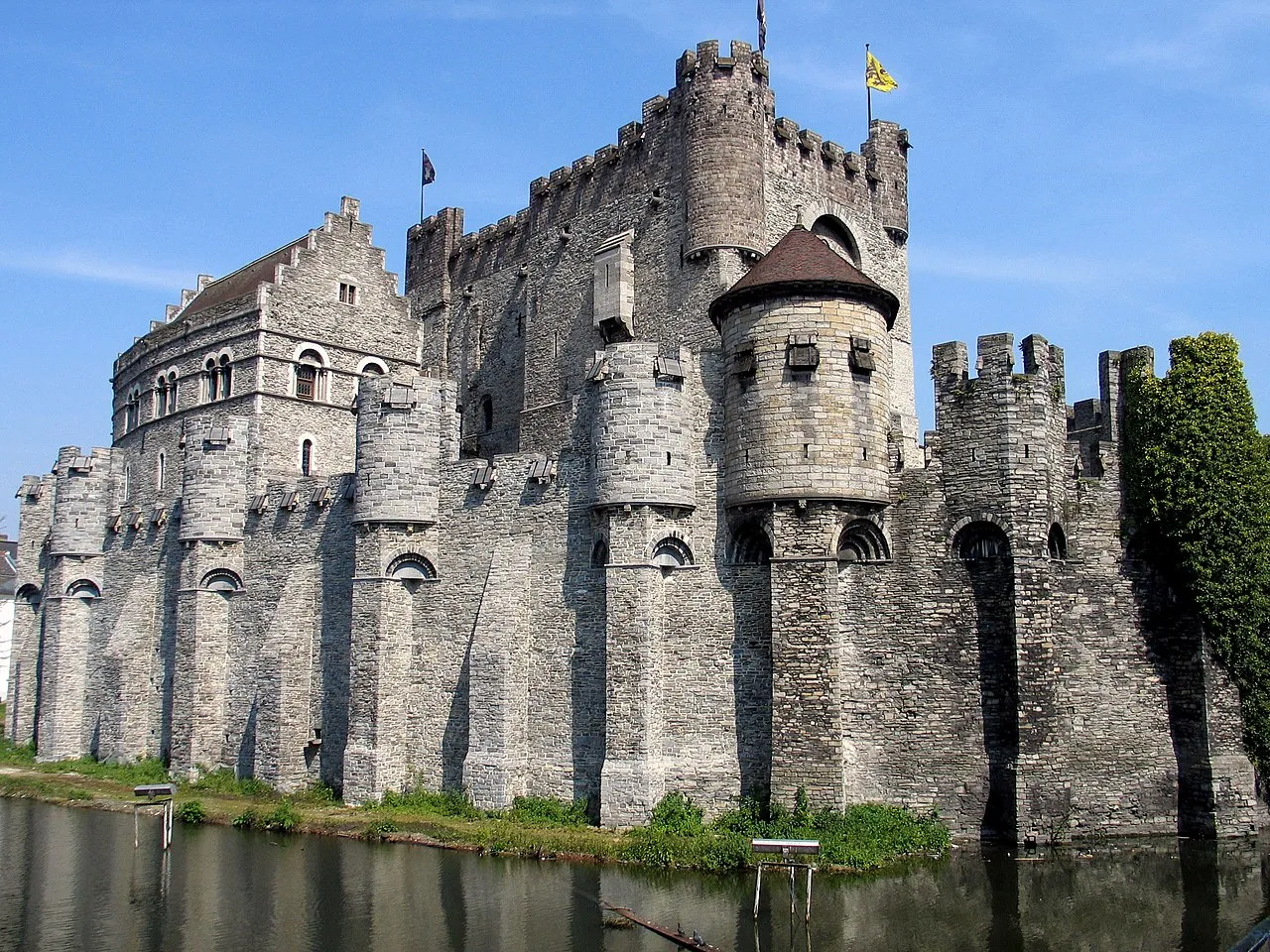
Fortification History
Gravensteen's foundations date to the 9th century when a wooden motte-and-bailey fortification guarded the confluence of the Lieve canal and Leie River — a strategic position controlling water access to Ghent's growing textile trade. The Counts of Flanders rebuilt in stone around 1180, modeling the fortress on Crusader castles observed during the Second and Third Crusades. The castle served dual purposes: military defense against French royal armies seeking to control Flanders' wealthy textile cities, and domestic intimidation aimed at Ghent's increasingly powerful merchant guilds who repeatedly challenged comital authority. By the 14th century, the guilds had accumulated sufficient economic power to rebel — the 1302 Guldensporenslag (Battle of the Golden Spurs) saw Flemish craftsmen defeat French knights, and by 1540, Holy Roman Emperor Charles V (ironically born in Ghent) brutally suppressed the city's independence. Gravensteen lost military relevance as gunpowder artillery made medieval stone walls obsolete. The castle was sold to private owners in 1800 and converted into a textile factory — an industrial period that paradoxically preserved the stonework until the 1893-1907 archaeological restoration.
Notable Rooms
Great Hall: The largest interior space where the Counts of Flanders received vassals and administered justice — austere stone floors, massive fireplace, and the donjon staircase entrance. Visitors can appreciate its medieval proportions, imagining the room filled with petitioners, guards, and the flickering light of torches and hearth fires. Donjon (Keep): Three-story cylindrical tower with progressively defensible levels — ground floor provisions storage, second floor guard barracks with arrow slits, top floor the count's final retreat chamber. The roof battlements provide the castle's finest panoramic views of Ghent's "three towers" skyline. Gatehouse: The entrance killing zone with murder holes, portcullis groove, and narrow passage designed to neutralize attackers — medieval military architecture at its most brutally functional. Dungeons: Basement cells near the water table where prisoners awaited trial — perpetually damp, minimal ventilation, and disturbingly cramped. Torture museum: Controversial collection spanning racks, pillories, and iron shackles with documented medieval use alongside questionable 19th-century fabrications. Chapel: Small devotional space within the fortress walls where the count and garrison attended daily mass.
When to Visit
Open daily: 10:00 AM - 6:00 PM year-round, including weekends and most holidays. Last entry: 5:00 PM — allow 90 minutes minimum, so arrive by 3:30 PM latest for full experience. Best: Early morning (10:00-11:00 AM) for smallest crowds on battlements and in narrow staircases. Photography: Late afternoon (4:00-5:30 PM) for golden hour light enhancing stonework and illuminating Ghent's cityscape from ramparts. Avoid: Midday (12:00-2:00 PM) when tour groups create bottlenecks in the keep's spiral staircase. Seasonal: April-May and September-October offer better weather than summer heat and smaller crowds than July-August peak tourism.
Admission and Costs
Adult admission: €14 — includes castle access, torture museum, battlements, and audioguide app. Youth (19-25): €10.50 — bring valid student ID or age verification. Children (under 19): Free when accompanied by paying adult. CityCard Gent: Free admission with the 48-hour or 72-hour Ghent city pass (€39/€45) that also includes unlimited public transport on Ghent's De Lijn trams and buses and other attractions. Combined ticket: €20 for Gravensteen + St. Bavo's Cathedral (modest savings versus separate €14 + €12.50). Guided tour: €180-220 for private 2-hour tour covering castle history and medieval Ghent context (separate from admission). Audioguide: Included in admission — download the app or borrow a device at entrance.
Tips for Visitors
Download audioguide first: The free app provides essential context for otherwise bare stone rooms. Download before arrival to avoid relying on castle WiFi. Wear appropriate shoes: Medieval staircases are narrow, uneven, and worn smooth by centuries of use. Avoid slippery-soled footwear and high heels. Start with the keep: Climb the donjon first while you have energy for the spiral stairs, then work your way through the easier ground-level exhibits. Budget serious time: 90 minutes minimum needed to explore thoroughly. Rushing through in 45 minutes means missing the battlements circuit and torture museum. Torture museum context: Take the implements with historical skepticism — some are authentic medieval devices, others are likely 19th-century Gothic fantasies. Labels don't always clarify which is which. Battlements photography: The ramparts offer spectacular Ghent skyline views. Visit during late afternoon golden hour for best light on the surrounding architecture. Accessibility limitations: Narrow medieval staircases and uneven floors make much of the castle inaccessible to wheelchairs. Inquire at entrance about alternative routes to accessible sections. Children considerations: The torture museum may disturb sensitive children — preview the content before deciding to include young ones. Industrial history: Don't skip the museum exhibits documenting the castle's textile factory period — they provide honest context about restoration work that many sites gloss over. Moat views: Walk around the exterior before entering to photograph the castle from Sint-Veerleplein square and the canal bridges, showing the full fortress in context. Crowd strategy: Arrive at 10 AM opening or after 4 PM to avoid midday tour group bottlenecks in the narrow staircases and keep.
Frequently Asked Questions
What season is ideal for exploring Gravensteen Castle?
May through September offers the best conditions for walking the exposed battlements, where late afternoon golden-hour light enhances the stonework and illuminates Ghent's three-tower skyline in warm tones. April-May and September-October combine pleasant weather with significantly smaller crowds than the July-August peak, when narrow spiral staircases become congested with tour groups.
When can visitors explore Gravensteen?
Open daily: 10:00 AM - 6:00 PM year-round, including weekends and most holidays. Last entry: 5:00 PM — allow 90 minutes minimum, so arrive by 3:30 PM latest for full experience.
What is the admission price for Gravensteen?
Adult admission: €14 — includes castle access, torture museum, battlements, and audioguide app. Youth (19-25): €10.50 — bring valid student ID or age verification. Children (under 19): Free when accompanied by paying adult.
Why download the Gravensteen audioguide before arriving?
Download audioguide first: The free app provides essential context for otherwise bare stone rooms. Download before arrival to avoid relying on castle WiFi.
How do you get to Gravensteen?
Gravensteen rises over the Sint-Veerleplein in the heart of central Ghent, a flat ten-minute walk north-west along the Leie from the Korenmarkt, so from anywhere in the largely car-free old town you simply walk to the moated castle — no fare or transport needed. Arriving from Gent-Sint-Pieters station, the easiest way in is tram 1 to the Korenmarkt, about fifteen minutes, then the short stroll to the gate; our guide to getting around Ghent sets out the tram lines and how to pay for a Ghent tram with a contactless card or the De Lijn app.