
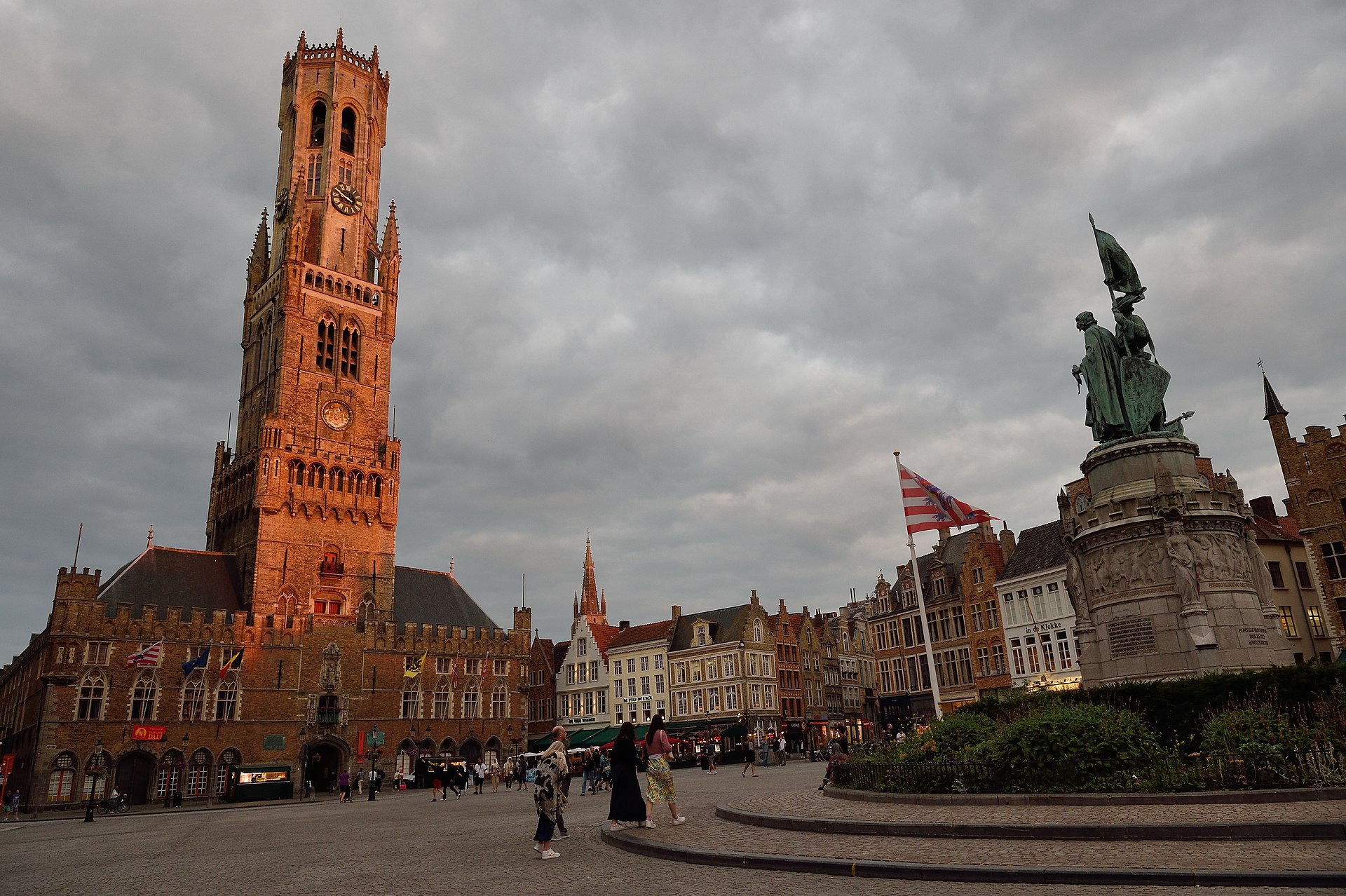

Overview
The Markt has anchored Bruges' commercial and civic life since the 10th century, when merchants gathered here to trade wool, cloth, and spices that arrived via the canals connecting to the North Sea. The square stretches roughly 100 meters on each side, ringed by gabled guild houses painted in ochres and crimsons that photograph beautifully against grey Flemish skies. The Belfry rises from the south end — 83 meters of medieval engineering begun in 1240, rebuilt after a lightning fire in 1280, and topped with an octagonal lantern in 1482-1486. Unlike church towers built for worship, this belfry served pure civic power: it housed the city treasury, legal documents, and the 47-bell carillon that regulated daily life. When the bells rang, markets opened, gates closed, and workers clocked their hours by sound rather than sight. Climbing the Belfry requires commitment: 366 steps spiral up through rooms that reveal the tower's functions. The treasury chamber on the second floor stored the city seal and charters behind a door with thirteen different locks — only when all keyholders agreed could crucial documents emerge. Higher up, the bell chamber houses a carillon of 47 bells cast between 1398 and the 20th century, still played three times weekly by a city-appointed carillonneur who performs seated at a wooden keyboard striking the bells with fists and feet. The final narrow stairs emerge onto a viewing platform where Bruges spreads in all directions: the three medieval church towers puncturing the skyline, canals threading through rust-red roofs, and on clear days the North Sea glinting 15 kilometers away. The view explains why Bruges prospered — surrounded by flat polders perfect for wool production, positioned between the sea and inland trade routes, compact enough to defend yet spacious enough to accommodate warehouses and markets. The Markt itself pulses with activity that shifts by season and hour. Wednesday mornings transform the cobblestones into a produce market where farmers from surrounding villages sell asparagus, endives, and North Sea shrimp. Summer evenings bring open-air concerts under strings of Edison bulbs. Winter sees a skating rink and Christmas market install themselves for December, the Belfry looming behind wooden chalets selling speculoos and hot chocolate. The square's southern side features the Provincial Court (Provinciaal Hof), a neo-Gothic confection from 1887 that replaced medieval buildings destroyed by French Revolutionary armies — its façade deliberately echoes the Belfry's verticality. In the center stands a statue of Pieter de Coninck and Jan Breydel, Flemish heroes who led the 1302 revolt against French occupation, commemorated because 19th-century Belgian nationalists needed medieval freedom fighters to justify the new country's independence. The square functions as Bruges' primary gathering space, which means it also attracts the bulk of tourist traffic — horse-drawn carriages clip-clop endlessly around the perimeter, their drivers offering 30-minute tours at inflated prices. Restaurant terraces on the north and east sides cater to visitors with menus in five languages and prices to match. Yet the Markt retains authenticity in unexpected moments: locals cutting through on bicycles, elderly women shopping the Wednesday market with wheeled carts, teenagers congregating on the steps of the Belfry after school. A knowledgeable guide separates the tourist veneer from the working square underneath, pointing out details most visitors miss — the cannonball embedded in a façade from the 1382 siege, the niches where medieval shops once operated, the slight downward slope engineered for drainage that makes the square feel more dynamic than perfectly level plazas. The Belfry earned UNESCO World Heritage status in 1999 as part of a collective inscription of Belgian and French belfries, recognizing these civic towers as symbols of municipal autonomy from feudal lords. Where church towers represented religious authority and castle keeps embodied military power, belfries manifested the wealth and independence of the merchant class. Bruges' Belfry stood taller than its cathedral (122 meters for Sint-Salvator, but built later), a deliberate statement about who truly controlled the city. Climbing it connects you physically to that civic pride — every step reminds you that medieval citizens built this without steel, cranes, or safety regulations, purely to announce their city's importance to rival trading centers across Flanders and beyond. The carillon concerts merit special attention. Unlike recordings of bells clanging randomly, a skilled carillonneur plays compositions written specifically for the instrument, exploiting its range from deep bourdon bells to tinkling trebles. The Bruges carillon performs Mondays, Wednesdays, and Saturdays year-round, with extended summer evening concerts during July and August. Standing in the Markt while the bells wash over you provides an auditory connection to medieval Bruges — these same tones regulated life for centuries before clocks became affordable. The best listening spot sits on the Belfry steps themselves, where you feel the vibrations through stone as much as hear them. Guides who time their tours to coincide with concerts understand that the Belfry is meant to be experienced through multiple senses, not just climbed for views. After descending (knees protesting more than they did going up), explore the Markt's edges to understand its relationship with surrounding streets. The Breidelstraat connects south to the Burg square, a five-minute walk threading through souvenir shops but also past the Basilica of the Holy Blood and City Hall. West leads through quieter lanes toward the Groeninge and Memling museums. North opens to residential neighborhoods where Bruges' 20,000 inhabitants actually live, far from tourist circuits. The Markt serves as hub from which the entire medieval city radiates — understanding its centrality means recognizing how Bruges functioned as an organic whole, not a collection of isolated attractions. A guide who grew up here knows which gables were rebuilt after fires, which cellars connect via medieval tunnels, and which restaurants locals actually patronize (hint: none facing the square).
Architecture
Carillon concert: Stand beneath the tower during Monday/Wednesday/Saturday midday concerts to hear 47 bells played by a live carillonneur. The sound physically moves through you. Treasury room: Halfway up, see the chamber where Bruges stored its charter and seal behind a door requiring thirteen simultaneous keys — medieval security through forced consensus. Viewing platform: At 83 meters, the panorama reveals Bruges' medieval street plan perfectly preserved, three church towers, and canals threading toward the North Sea horizon. Provinciaal Hof: The neo-Gothic building on the south side (1887) replaced structures demolished during French occupation. Its deliberate historicism shows 19th-century romantic nationalism. De Coninck and Breydel statue: The central monument commemorates the 1302 Flemish revolt against French rule — placed in 1887 when Belgium needed medieval heroes for national identity. Wednesday market: Watch locals shop for vegetables, flowers, and prepared foods while tourists photograph the Belfry backdrop — two different versions of Bruges occupying the same space.
Historical Significance
The Belfry's construction beginning in 1240 marked Bruges' assertion of mercantile independence from feudal authority — a civic tower deliberately built to rival church spires in height and symbolic power. The 1302 Guldensporenslag (Battle of the Golden Spurs), when Flemish guild militias defeated French knights, cemented the Markt as a symbol of urban self-governance: the treasury chamber's thirteen-lock door system ensured no single authority could access the city's charters without collective consent. The 1695 French bombardment of Bruges (contemporaneous with the destruction of Brussels' Grand Place) damaged but did not destroy the Belfry, whose survival through wars, fires, and political upheavals over 780 years embodies the persistence of Flemish civic identity. UNESCO's 1999 World Heritage inscription recognized the Belfry not merely as architecture but as a political symbol — proof that medieval European democracy expressed itself through stone towers as much as through written charters.
When to Visit
Belfry hours: Daily 9:30 AM - 6:00 PM (last entry 5:15 PM). Carillon concerts: Monday, Wednesday, Saturday 11:00 AM - 12:00 PM; summer evening concerts July-August 9:00 PM. Best: Early morning (9:30-10:30 AM) before tour groups arrive, or late afternoon (4:30-5:30 PM) for golden hour light. Wednesday market: 8:00 AM - 1:00 PM — arrive early for best selection and thinner crowds. Avoid: Midday in peak summer (July-August) when cruise passengers flood the square. Winter: Shorter lines, dramatic light, and you have the viewing platform nearly to yourself.
Admission and Costs
Belfry admission: €14 adults, €12 seniors (65+), free for children under 12. Group tours including Belfry: €20-30 per person for 2-3 hour walking tours of central Bruges. Private guide: €180-250 for 2-hour private tour focusing on Markt, Burg, and medieval history. Carriage rides: €50-60 for 30-minute circuit (touristy but popular). Cafe terraces: Coffee €4-5, beer €5-7 — you're paying for square views; walk three blocks for half the price.
Tips for Visitors
Climbing strategy: 366 steps sounds daunting but there are rest platforms. Pace yourself, read the informational panels, and your lungs will recover before the next section. Photography: The viewing platform has wire mesh safety barriers that interfere with photos. Shoot through the gaps or bring a lens hood to minimize reflections. Skip the horse carriages: They're expensive (€50+), provide minimal commentary, and the routes stick to the same over-touristed circuits. Walk instead and you'll see more. Carillon timing: Check concert schedules online before visiting. Standing in the square during a performance transforms the experience from sightseeing to sensory immersion. Café advice: The terraces ringing the Markt charge tourist premiums. Walk to 't Brugs Beertje on Kemelstraat (5 minutes south) for 300+ Belgian beers at local prices. Combine with Basilica of the Holy Blood: The Burg square is a 3-minute walk south via Breidelstraat — see both in one morning circuit. Weather check: The viewing platform is exposed to wind and rain. On stormy days, views get dramatic but you'll be cold. Dress accordingly. Evening return: Come back after dinner (9:00 PM in summer) when the Belfry is floodlit and the square empties. The same view transforms under artificial light and stars.