
Walking Route
Getting There
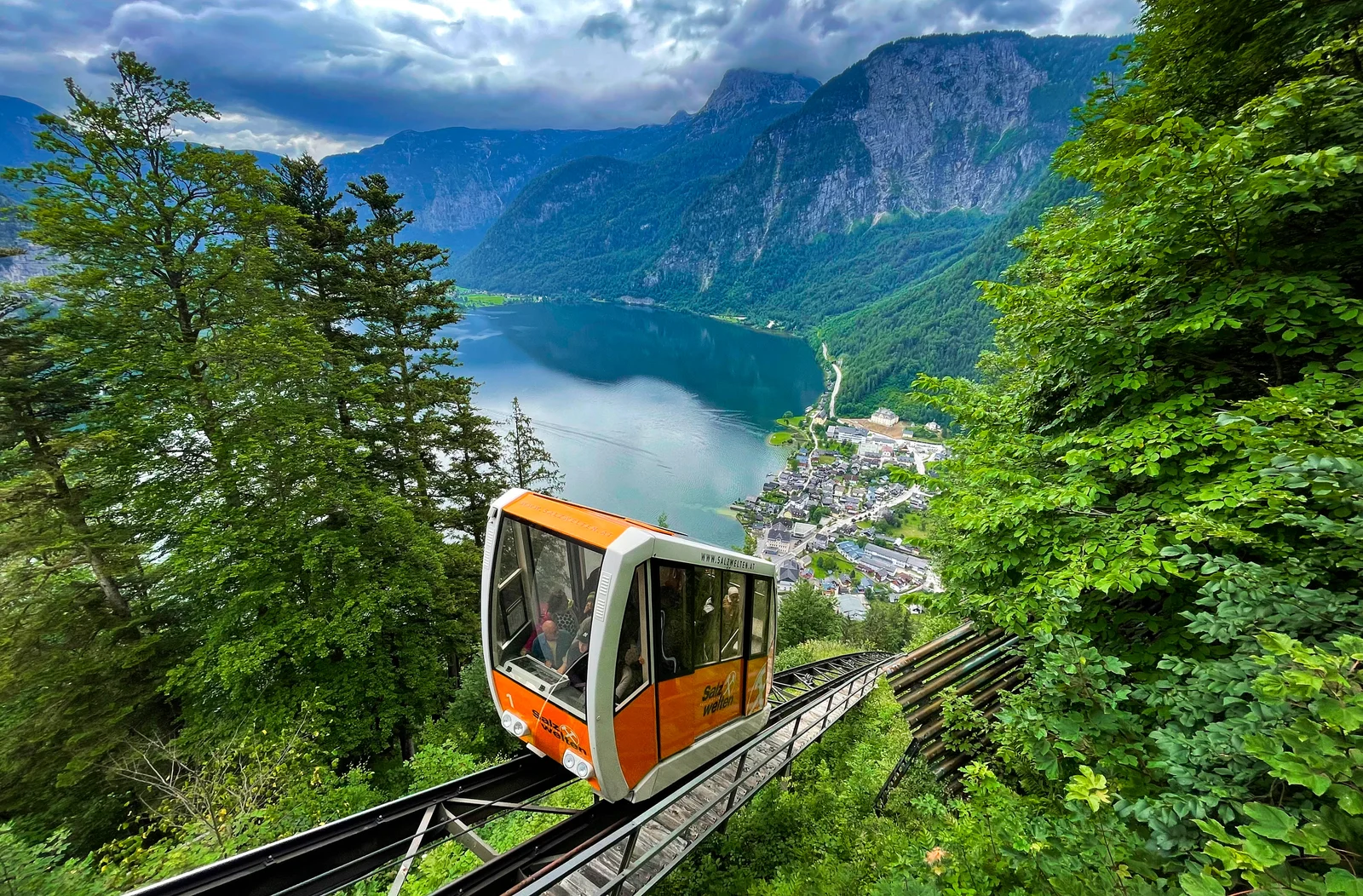
There is no road up to the platform and no car park at the top, so every visitor rides the Salzbergbahn funicular to reach the top of Hallstatt: the cable-hauled cabins climb the forested Salzberg slope in about three minutes to the Bergstation, from where the Welterbeblick is a level few-minutes' walk past the Rudolfsturm. The funicular's valley station stands at the southern Lahn end of the village, a short signposted walk from the lakeshore and from the salt mine it shares a ticket with.
How you get to that valley station depends on how you arrive in Hallstatt:
- By car — the funicular station has no parking of its own, so leave the vehicle in one of the village lots and walk in; the P1 tunnel car park in Lahn is the closest. In peak summer the lots fill by mid-morning, so start early.
- By train — trains stop at Hallstatt station on the far shore of the Hallstätter See, and the connecting lake ferry crosses to the village in a few minutes, landing a short walk from the valley station.
- By day trip from Salzburg — the most common approach, roughly 75 minutes by car or bus; riding straight up wins the aerial view before the day-trip coaches fill the lanes.
The only way to the platform without the funicular is the Salzberg hiking trail — a steep 45-minute climb from the village that saves no money, since the funicular ticket already bundles the Skywalk, so few walkers bother.
Because the funicular does all the climbing, the Skywalk is far more accessible than the salt mine it shares a ticket with: from the Bergstation the route to the Welterbeblick is a short, broadly level path rather than a staircase, and the steel deck itself is flat, so many wheelchair users and families with a stroller can reach it — a rare thing among Alpine viewpoints that usually begin with a hike. The caveats are the mountain setting rather than steps: the path has a gentle gradient and an unpaved stretch or two, the open edge and glass floor panels unsettle some visitors, and wet or icy shoulder-season surfaces are less sure underfoot. Crucially, anyone who cannot manage the mine's underground stairs and slides can still ride up for the view alone, since the ticket carries the Skywalk either way.
Engineering Facts
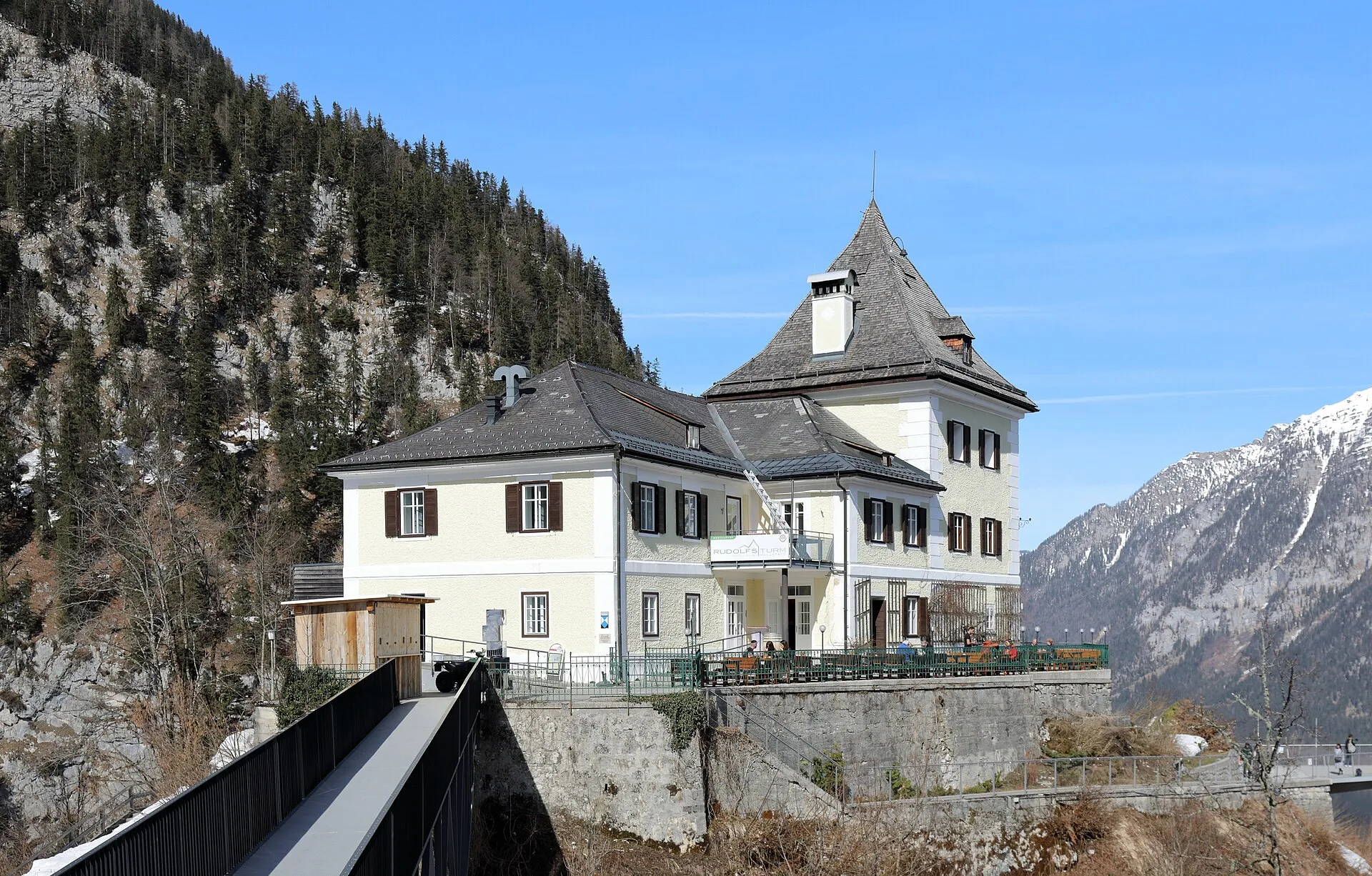
The Skywalk is a cantilevered triangular steel platform anchored to the Salzberg mountain face roughly 360 meters above the valley floor. It was engineered to carry Alpine wind loads and winter snow weight while projecting outward with no visible supports from below, creating the sensation of floating above Hallstatt. The glass floor panels at the tip use laminated safety glass rated to hold several tons, so visitors can stand over open air and look down to the village rooftops. Access is by the Salzbergbahn funicular, a modern cable-hauled system that replaced the original mining transport and climbs the steep forested slope from the village in about 3 minutes. The adjacent Rudolfsturm — a 13th-century tower built to guard the salt mines and salt trade — now houses a mountain restaurant a few steps from the deck, so the platform pairs medieval fortification with contemporary steel engineering in a single frame.
Observation Points
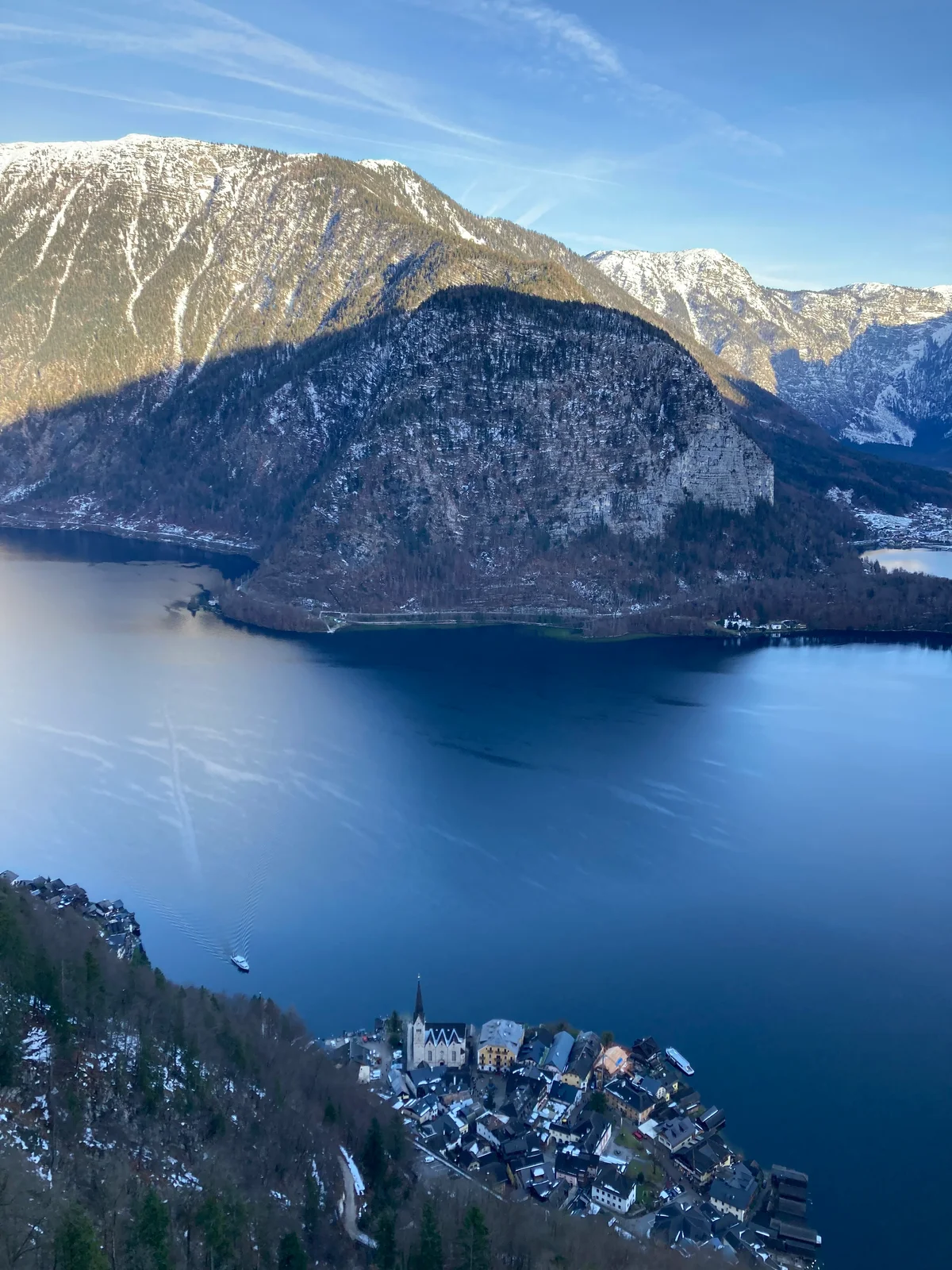
The Skywalk is the definitive panoramic viewpoint at the top of Hallstatt, and it is easy to confuse with the village's other famous vantage point. The postcard classic view — pastel houses stacked beneath the church spire — is a lake-level shot from the northern shore around Gosaumühlstraße, looking south across the water, and it costs nothing. The Skywalk gives the opposite frame: from 350 meters directly above the rooftops you look straight down onto the village, the Hallstätter See, and the Dachstein massif in a single sweep. For the head-on silhouette, use the lakeshore; for the bird's-eye panorama, ride up here — many visitors do both. From the shore you can even pick out where the platform waits: look up the wooded Salzberg slope on the western side of the village and the pale Rudolfsturm tower stands on the rock shelf right beside the deck, roughly 350 meters above the rooftops — the Skywalk's slim steel itself is harder to spot from lake level, but the tower marks the place, and from a boat on the Hallstätter See the whole shelf reads clearly against the sky. The visibility runs both ways: the view down is so complete precisely because the platform sits on open cliff with nothing between it and the village, so if the Rudolfsturm is in sight from your café table by the water, the deck beside it is looking straight back down at you. One further mix-up is worth heading off: the 5 Fingers platform, sometimes marketed as the "Dachstein Skywalk", is a separate attraction cantilevered off the Krippenstein above Obertraun on the far shore and reached by its own cable car near the Dachstein Ice Cave. It looks out over the open mountains rather than the rooftops, so for the classic aerial view of Hallstatt itself this Salzberg Welterbeblick is the platform you want, not the Krippenstein one across the lake.
Each corner of the plateau frames a different signature view — work around them rather than crowding the glass floor:
- Platform tip — The furthest point of the triangle, with the village directly 350 meters below and maximum exposure over the drop.
- Glass floor panels — Transparent sections let you look straight down to the rooftops; the Evangelical church spire appears almost directly beneath your feet.
- Dachstein panorama — The glacier-capped massif dominates the southern view on clear days, with the Hallstätter Gletscher visible on the upper slopes.
- Lake reflection — On still mornings the Hallstätter See mirrors the mountains perfectly, reading from above like a natural painting.
- Church spire view — The iconic lakeside church framed against the water — the exact angle that graces every Hallstatt postcard.
- Salzberg trail — A short walk from the platform leads to further mountain viewpoints and the Rudolfsturm restaurant terrace.
Hallstatt Skywalk timeline
- c. 5000 BCE
Salt mining begins on the Salzberg
Neolithic miners first worked the salt seams inside the mountain the Skywalk now overhangs — the start of the world's oldest documented salt industry.
- c. 800 BCE
Hallstatt culture flourishes
Salt wealth made the valley below so significant that its name marks an entire Iron Age horizon of European prehistory.
-
Rudolfsturm raised above the mines
The medieval watchtower beside today's platform guarded the salt trade; it now houses a mountain restaurant a few steps from the Skywalk.
-
UNESCO World Heritage listing
The Hallstatt-Dachstein/Salzkammergut Cultural Landscape was inscribed, protecting the village, lake, and salt mountain the Skywalk surveys.
-
World Heritage View opens
The cantilevered steel platform, marketed as the Welterbeblick, opened to give visitors the definitive aerial view of Hallstatt.
Hallstatt Skywalk in Pictures
When to Visit
The Salzbergbahn funicular from Hallstatt village sets the Skywalk's opening hours — the platform itself is open air and never gated. The funicular runs daily through the salt mine season, late March to early November, with first ascents around 9:00-9:30 AM and the last cars up in the late afternoon — roughly 4:30 PM in spring and autumn, and later during peak July and August. From mid-November to late March it closes for winter, and the exact daily times drift with the season, so confirm them on Salzwelten before you travel. Plan 15-20 minutes on the platform for photos and views; most visitors fold it into the mine tour on the same funicular ride. Aim for early morning, when the lake lies calm for mirror reflections and the mountain air is clearest before afternoon cloud builds. The view is entirely weather dependent: cloud and fog can obscure the panorama completely, so check conditions before ascending. For a season-by-season breakdown, our month-by-month guide to the best time to visit Hallstatt covers when the reflections peak and when Dachstein visibility is most reliable.
Admission and Costs
The Skywalk is never sold on its own — it comes bundled with any Salzbergbahn ticket. Included with the salt mine ticket: €40 (about $44) adults for mine + funicular + Skywalk. Funicular-only ticket that still includes the Skywalk: €20 (about $22) adults, with no mine tour. Children 4-15: €10 (about $11) funicular-only, and under-4s ride free. The only way to skip the fare entirely is to walk up the Salzberg trail (45+ minutes, steep), but since the funicular ticket already carries the Skywalk, few visitors bother.
Where to buy tickets: the counter is at the Salzbergbahn valley station on the western edge of the village, or you can book ahead on salzwelten.at — there is no separate Skywalk window to queue at up top, because the platform ticket simply rides along with the funicular. A funicular-only return is sold walk-up and untimed, so you rarely need to pre-book just for the viewpoint. The salt-mine tour is the part that runs to timed entry slots and sells out on peak July and August days, so if you want the combined €40 mine ticket, reserve an online time slot before you travel rather than gambling on same-day availability at the window.
The Case for a Guide
A local guide turns the Skywalk from a quick photo stop into the interpretive high point of a Hallstatt visit. From 350 meters up, the whole Salzkammergut is laid out like a relief map, and a guide reads it for you:
- Mountain identification — naming the Dachstein peaks, valleys, and glaciers, and pointing out the Hallstätter Gletscher on the upper slopes.
- Village history from above — locating the Evangelical church, the Beinhaus charnel house, the market square, and the ferry route in a single sweep of the arm.
- Salt-trade context — explaining why the salt mine directly behind you made this valley wealthy enough to name an Iron Age era, and how the Rudolfsturm guarded that trade.
- Timing and logistics — sequencing the funicular, Skywalk, and mine so you beat the day-trip crowds arriving from Salzburg.
Because the platform ticket is shared with the mine, guides almost always package the Skywalk into a wider Salzberg or Hallstatt walking tour rather than treating it in isolation.
Tips for Visitors
- Vertigo warning — The glass floor panels and exposed edge are not for those uncomfortable with heights.
- Go in the morning — Clearer views before afternoon clouds build, and a calmer lake for reflections.
- Check the weather first — Fog or low cloud completely obscures the view; it is not worth ascending in poor visibility.
- Combine with the salt mine — The mine ticket includes the Skywalk, so do both on the same funicular ride.
- Allow 15-20 minutes — Quick to see, but you'll want time for photos from multiple angles around the platform.
- Bring a jacket — The exposed mountain platform can be windy and noticeably cooler than the village below.
- Step-free option — The funicular and level path make the Skywalk reachable for wheelchairs and strollers, unlike the stair-heavy salt mine.
Frequently Asked Questions
When should I visit the Hallstatt Skywalk for the best views?
June through August offers the longest operating hours, clearest mountain visibility, and the best chance of seeing the Dachstein glacier reflected in the calm morning lake surface. The platform is closed from November through late March, and fog or low cloud — more common in shoulder months — can completely obscure the 350-meter drop and lake panorama that make this viewpoint worthwhile.
Is Skywalk Hallstatt suitable for visitors afraid of heights?
Vertigo warning: The glass floor panels and exposed edge are not for those uncomfortable with heights. Morning visits are best: Clearer views before afternoon clouds build, and calmer lake for reflections.
What does a visit to Skywalk Hallstatt cost?
Included with salt mine ticket: €40 (about $44) adults for mine + funicular + Skywalk. Funicular-only ticket that still includes the Skywalk: €20 (about $22) adults with no mine tour. Children 4-15: €10 (about $11) funicular-only, and under-4s ride free.
What do guides point out from the Skywalk Hallstatt platform?
Mountain identification: Guides name the Dachstein peaks, valleys, and glaciers visible from the platform. Village history from above: Pointing out the church, Beinhaus, market square, and lake ferry route from a bird's-eye perspective.
How do I get to the Hallstatt Skywalk — where do I park, and can I arrive by train?
The quickest route up is the Salzbergbahn funicular from the western edge of Hallstatt village, which climbs the forested slope to the top station in roughly three minutes; the Skywalk is then a level few-minutes' walk away. To reach the funicular's valley station — at the southern Lahn end of the village — drivers leave the car in Hallstatt's public lots, with the main P1 in Lahn the nearest and a short level walk away, since the station has no car park of its own. Travellers arriving by train get off at Hallstatt station on the far shore and cross by the short ferry before walking to the valley station. There is no road up to the platform, so the only alternative to the funicular is hiking the Salzberg trail from the village in about 45 minutes — steep, and no cheaper, since the funicular ticket already bundles the Skywalk, so most visitors ride up.
How long should I spend at the Skywalk, and what should I combine it with?
Budget 15-20 minutes for the platform itself, then keep going: the same funicular ride and ticket lead straight to the Hallstatt Salt Mine, and the Rudolfsturm restaurant sits a short stroll away. Together the funicular, mine tour, and Skywalk fill a comfortable half-day, and the Dachstein Ice Cave across the valley rounds out a full day.
Does the Hallstatt Skywalk have its own opening hours, or does it follow the funicular?
The platform has no ticket window, gate, or separate schedule of its own — the Welterbeblick is simply open whenever the Salzbergbahn funicular is carrying visitors up, so its "hours" are really the funicular's. Salzwelten publishes the definitive seasonal timetable on salzwelten.at, and it is worth confirming there before you travel: the last ascent creeps earlier as autumn draws in, and the funicular can pause outright in high wind or storms. Build in a buffer against the final descent, since being stranded at the top means the steep 45-minute Salzberg trail back down. On the quiet shoulder days at each end of the season the queues thin out, but that is also when low cloud most often swallows the panorama — so check the mountain webcam the morning of your visit.
How much is the Salzbergbahn funicular, and does the ticket include the Skywalk?
Yes — every Salzbergbahn ticket includes the Skywalk, which is never sold separately. A funicular-only return is about €20 for adults with no mine tour, or you can add the salt-mine tour on a combined ticket; the cost FAQ above breaks down the child and under-4 fares. The three-minute ride climbs the forested Salzberg slope from the western edge of Hallstatt village, and walking up the Salzberg trail (about 45 minutes, steep) is the only way to reach the platform without paying the fare.
What will the Salzbergbahn funicular ride up to the top of Hallstatt be like?
The Salzbergbahn sets off from its valley station at the edge of Hallstatt village, and the cabins run on demand rather than to a fixed timetable, so the wait is rarely long once the season is under way. As the car is hauled up the steep forested track, the view through the windows opens quickly: the pastel rooftops shrink, the church spire and the Hallstätter See spread out below, and within about three minutes you are set down at the Bergstation — the effective top of Hallstatt, with the Skywalk and the salt mine a short, near-level walk away. It is the ride itself, not only the platform, that first delivers the bird's-eye view the village is famous for.
Is the Hallstatt Skywalk worth it, or should I skip it?
It is worth it on a clear day and easy to skip on a bad one. Because the Skywalk comes bundled free with any funicular or salt-mine ticket, there is no extra cost to justify — if you are already riding up for the mine, walking the few minutes to the platform is a no-brainer for the definitive aerial view of the village, lake, and Dachstein massif. Skip it only when the summits are buried in cloud or fog, when the 350-meter drop and panorama simply vanish, or if you have genuine vertigo that the glass floor panels and open edge would make miserable. Buying the €20 funicular-only ticket purely for the Skywalk is reasonable in good weather but poor value under a grey forecast.