

Overview
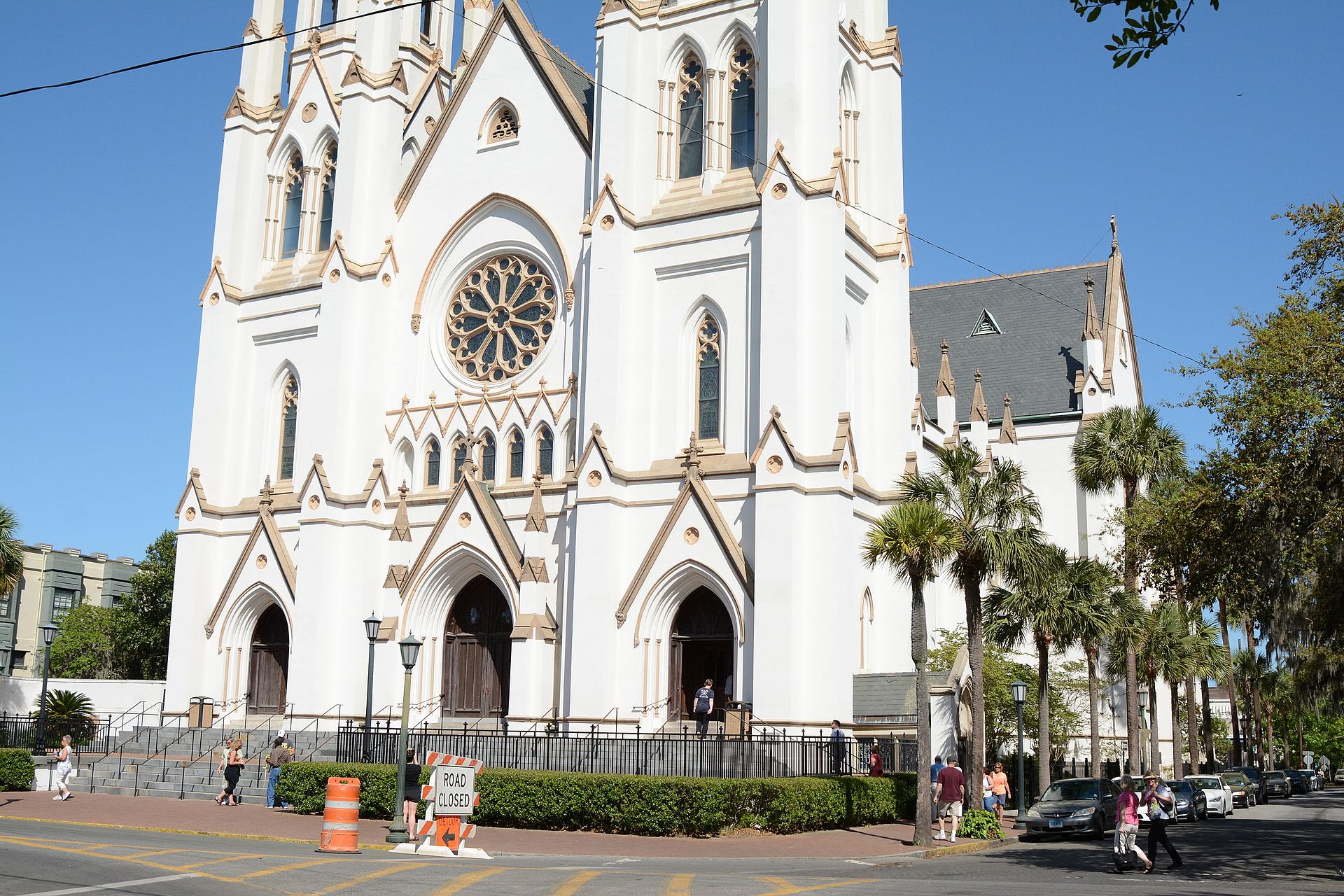
The Cathedral of St. John the Baptist dominates the western side of Lafayette Square, its twin white spires visible for blocks in every direction and its French Gothic facade representing one of the finest ecclesiastical buildings in the American South. The parish was established in 1799 by French Catholics fleeing the Haitian Revolution, making it the oldest Roman Catholic church in Georgia and one of the oldest in the entire United States. The current cathedral, built between 1873 and 1896 to replace an earlier structure, was designed in the French Gothic style with pointed arches, ribbed vaulting, flying buttresses, and a grand rose window over the entrance. A devastating fire in 1898 gutted the interior just two years after completion, and the parish spent the next decade painstakingly restoring and enhancing the space — the stained glass windows, murals, and decorative elements visitors see today largely date from this post-fire reconstruction. The cathedral's interior is breathtaking. Over 50 stained glass windows — most crafted by the Innsbruck Glassworks in Austria and the Mayer studio in Munich — fill the nave with colored light that shifts throughout the day as the sun moves across the sky. The vaulted ceiling soars 50 feet overhead, its ribbing painted in delicate patterns that complement the mural work on the walls. A massive pipe organ anchors the choir loft above the entrance, and the marble altar imported from Italy serves as the focal point of a sanctuary that combines European Gothic ambition with distinctly Southern warmth. The cathedral sits across Lafayette Square from the childhood home of Flannery O'Connor, linking two of Savannah's most significant cultural landmarks in a single block.
Visitor Etiquette
The cathedral's beauty is immediately apparent to anyone who steps through the doors, but its stories require interpretation. Each of the 50-plus stained glass windows depicts specific biblical scenes and saints, and guides who know iconography can walk visitors through the windows as a visual narrative, explaining the theological program that determined their placement. The Austrian and German craftsmen who produced these windows employed techniques — layered colored glass, silver staining, detailed enamel painting — that represent the pinnacle of 19th-century European glasswork, and understanding these methods deepens appreciation for what might otherwise register as simply "pretty windows." The fire of 1898 and the cathedral's reconstruction add drama to the architectural narrative. The parish had barely completed the building when flames consumed the interior, leaving only the exterior walls and spires standing. The decade-long restoration that followed was both a rebuilding and an enhancement: muralists, woodcarvers, and artisans imported from Europe added decorative elements that surpassed the pre-fire interior. Guides frame this as a story of community resilience and artistic ambition, connecting it to Savannah's broader tradition of recovering from catastrophe — fire, hurricanes, yellow fever epidemics, economic collapse — while maintaining its commitment to beauty.
Spiritual Significance
Austrian and German stained glass: Over 50 windows crafted by the Innsbruck Glassworks and Munich's Mayer studio, depicting biblical scenes in extraordinary chromatic detail. Rose window: The large circular window above the main entrance is the cathedral's most photographed interior feature, especially luminous in afternoon light. Pipe organ: The imposing instrument in the choir loft accompanies Masses and occasional recitals, its sound filling the Gothic nave with remarkable resonance. Italian marble altar: The high altar and surrounding sanctuary feature marble imported from Italy during the post-fire reconstruction. Ceiling murals: Look up to see painted vaulting that extends the full length of the nave, with decorative patterns and religious imagery that reward careful observation. Twin spires: The exterior's French Gothic spires are best photographed from across Lafayette Square, where the full facade is visible framed by live oaks
When to Visit
Self-guided visits: Monday through Friday 9:00 AM to 5:00 PM, Saturday 9:00 AM to 5:00 PM. Visitors are welcome to enter quietly when services are not in progress. Mass schedule: Multiple daily Masses; Sunday Masses typically at 8:00 AM, 10:00 AM, 11:30 AM (Latin), and 5:00 PM. Check the parish website for current times. Best for stained glass: Morning light (9-11 AM) illuminates the eastern windows most dramatically; afternoon light (2-4 PM) brings the western rose window to life. Docent tours: Volunteer-led tours are offered on select days, typically weekday mornings. Check with the parish office for the current schedule
Admission and Costs
Admission: Free. The cathedral welcomes all visitors at no charge. Donations are appreciated and support building maintenance. Group walking tour including the cathedral: $20-35 per person as part of a 2-hour Historic Squares walking tour. Private sacred architecture tour: $175-300 for up to 6 people, focusing on the cathedral's design, construction, fire, and reconstruction alongside other religious buildings in the Historic District. Photography permits: Personal photography is permitted without flash. Professional photography and filming require advance permission from the parish
Tips for Visitors
Dress respectfully: While there is no strict dress code for visitors, shoulders and knees should be covered as a courtesy in this active place of worship. Silence is expected: The cathedral is an active parish church. Keep voices to a whisper, silence phones, and avoid disrupting anyone who may be praying. Avoid Mass times for touring: If your goal is to explore the architecture and art, visit outside of scheduled Mass times when you can move freely through the nave. Bring binoculars: The ceiling details and upper window panels are far above eye level. Compact binoculars reveal extraordinary detail in the murals and glass. Visit Flannery O'Connor's home: The author's childhood home is directly across Lafayette Square from the cathedral. The O'Connor family attended Mass here, and the proximity connects two pillars of Savannah's cultural identity. Combine with the squares: Lafayette Square is one of the most beautiful in Savannah, and the surrounding blocks contain exceptional residential architecture that complements the cathedral visit