

Overview
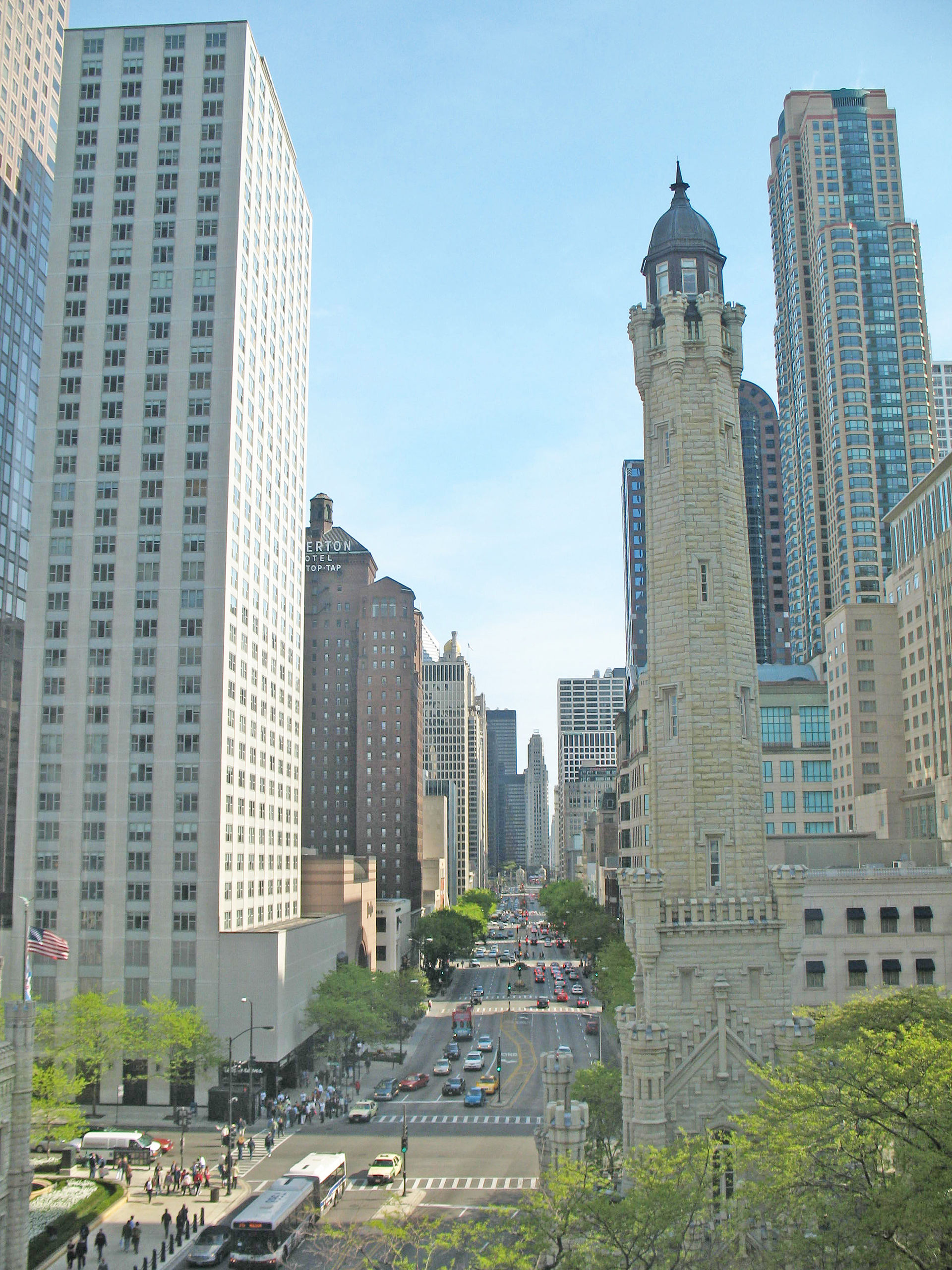
The Magnificent Mile is the name Chicagoans give to the stretch of North Michigan Avenue running from the Chicago River at Wacker Drive north to Oak Street at the edge of the Gold Coast. The boulevard earned its nickname in the 1940s, and today it functions as the commercial and architectural spine of the city's Near North Side. Within these 13 blocks stand more than 460 stores, 275 restaurants, and 60 hotels, but what makes the Mag Mile genuinely magnificent is the architecture above the storefronts.
The southern anchor is the Wrigley Building, completed in 1924 with a white terra-cotta facade modeled after the Giralda bell tower in Seville, its clock tower illuminated every night since the day it opened. Directly across the avenue stands Tribune Tower, a Gothic Revival skyscraper whose walls are embedded with fragments of famous structures from around the world: stones from the Parthenon, the Great Wall of China, the Taj Mahal, and the Berlin Wall, collected by the Chicago Tribune's foreign correspondents over decades. These two buildings frame the Michigan Avenue Bridge, creating one of the most photographed urban vistas in Chicago. Walking north, the architectural parade continues with the 100-story John Hancock Center (now 875 North Michigan Avenue), whose distinctive X-braced exterior was a structural innovation when completed in 1969, and the historic Water Tower, one of the few buildings to survive the Great Fire of 1871 and now a city landmark housing a photography gallery. Between the landmarks, the retail landscape ranges from flagship stores of global luxury brands to the multi-level Shops at North Bridge and the vertical mall of 900 North Michigan Avenue. But the Magnificent Mile is not just a shopping corridor: it is a living timeline of Chicago's recovery from fire, its embrace of bold architecture, and its insistence on building upward. A knowledgeable guide transforms a walk along these 13 blocks from a retail stroll into an architectural education, connecting the Wrigley Building's Beaux-Arts ambitions to the Hancock's modernist engineering to the latest residential towers pushing the skyline higher. The mile connects naturally to Millennium Park to the south and the Navy Pier lakefront to the east.
Photo Spots
Walking the Magnificent Mile without looking up is like reading a book while covering half the page. Most visitors focus on the storefronts, missing the extraordinary architectural details that define Chicago's vertical ambitions: the Wrigley Building's facade of six graduating shades of white terra-cotta, designed to catch sunlight differently at each level; the Tribune Tower's Gothic flying buttresses and over 150 stone fragments embedded in its walls by globe-trotting correspondents who chipped pieces from the Parthenon, the Great Wall of China, the Taj Mahal, and the Berlin Wall. Guides know the stories behind each stone and point out fragments most visitors walk past without a glance.
The 1871 Great Fire destroyed everything on this stretch except the Gothic limestone Water Tower, and understanding that catastrophe is essential to understanding Chicago itself. Guides explain how the fire shaped zoning laws, building codes, and the civic ambition that transformed a burned-out city into the birthplace of the modern skyscraper. The Wrigley Building and Tribune Tower rose from that ambition in the 1920s, framing the Michigan Avenue Bridge in what became one of the most photographed urban vistas in America. The 100-story John Hancock Center followed in 1969, its distinctive X-braced exterior a structural innovation that changed how engineers thought about supertall construction. The avenue stretches 13 blocks from the Chicago River to Oak Street, and side streets conceal gems that casual strollers miss entirely: the peaceful courtyard of Fourth Presbyterian Church, the Museum of Contemporary Art tucked behind the high-rises, the hidden lobby of 875 North Michigan with its rotating exhibitions. Guides build routes that cover architectural highlights, retail history from Marshall Field's pioneering department store concepts to the vertical malls of the 1970s, and natural connections to Millennium Park to the south and Navy Pier to the east.
Landmarks Along
Wrigley Building: The gleaming white twin towers on the south bank of the Chicago River, modeled after the Giralda in Seville, are illuminated nightly and best photographed from the Riverwalk at sunset. Tribune Tower: Look closely at the exterior walls for over 150 fragments of famous buildings embedded by globe-trotting correspondents, from Westminster Abbey to the Berlin Wall and beyond.
Water Tower and Pumping Station: The Gothic limestone Water Tower survived the 1871 fire and now houses a photography gallery; the Pumping Station across the street is still operational and contains the Lookingglass Theatre. 360 CHICAGO: The observation deck on the 94th floor of the former Hancock Center offers panoramic views of the lake, the skyline, and on clear days four states. Fourth Presbyterian Church: A peaceful Gothic Revival courtyard tucked behind the avenue between high-rises, offering free lunchtime concerts and a moment of calm amid the urban bustle. Michigan Avenue Bridge: The double-deck bascule bridge at the southern end frames one of Chicago's most iconic views -- the Wrigley Building and Tribune Tower rising above the Chicago River.
When to Visit
The avenue itself: Open 24 hours as a public street; store hours typically 10 AM to 8 PM Monday through Saturday, 11 AM to 6 PM Sunday. Best for architecture: Early morning before 9 AM, when sidewalks are empty and low-angle sunlight illuminates the upper facades of the Wrigley Building and Tribune Tower.
Best for shopping: Weekday mornings offer the shortest lines and most attentive service; weekend afternoons bring heavy foot traffic, especially in summer and during the holidays. Holiday season: Late November through December, the avenue is decorated with over one million lights on 200 trees during the Magnificent Mile Lights Festival, making evening walks spectacular. Avoid: Saturday afternoons in July and August when tourist density peaks and temperatures on the concrete canyon can feel 10 degrees hotter than the lakefront.
Admission and Costs
Walking the mile: Completely free; the architecture, window displays, and street-level spectacle cost nothing to enjoy. Guided architectural walking tour: $25-40 per person for a 2-hour tour covering the major buildings, their architects, and the engineering innovations behind them.
Private guide: $250-450 for a customised 2-3 hour tour tailored to your interests, whether architecture, history, food, or luxury shopping. 360 CHICAGO (Hancock observation deck): $30 per person for views from the 94th floor, including the TILT experience that angles you out over the avenue. Shopping: Ranges from affordable chain stores to luxury flagships; budgets vary widely.
Tips for Visitors
Start from the south: Begin at the Michigan Avenue Bridge for the dramatic framing of the Wrigley Building and Tribune Tower, then walk north with the best light behind you in the morning. Wear walking shoes: The full mile is 1.2 miles end to end, and with stops and detours into side streets, most visitors walk 3-4 miles total.
Combine with the Riverwalk: The Chicago Riverwalk runs east-west directly below the southern end of the Magnificent Mile and offers waterfront dining, boat tours, and kayak rentals. Transit access: The Red Line stops at Grand (south end) and Chicago (midpoint); the #151 bus runs the full length of Michigan Avenue. For the best shots of the Wrigley Building and Tribune Tower together, stand on the south side of the river near the Riverwalk stairs at the DuSable Bridge. Millennium Park and the Art Institute are a 15-minute walk south; Navy Pier is a 15-minute walk east along the river.