
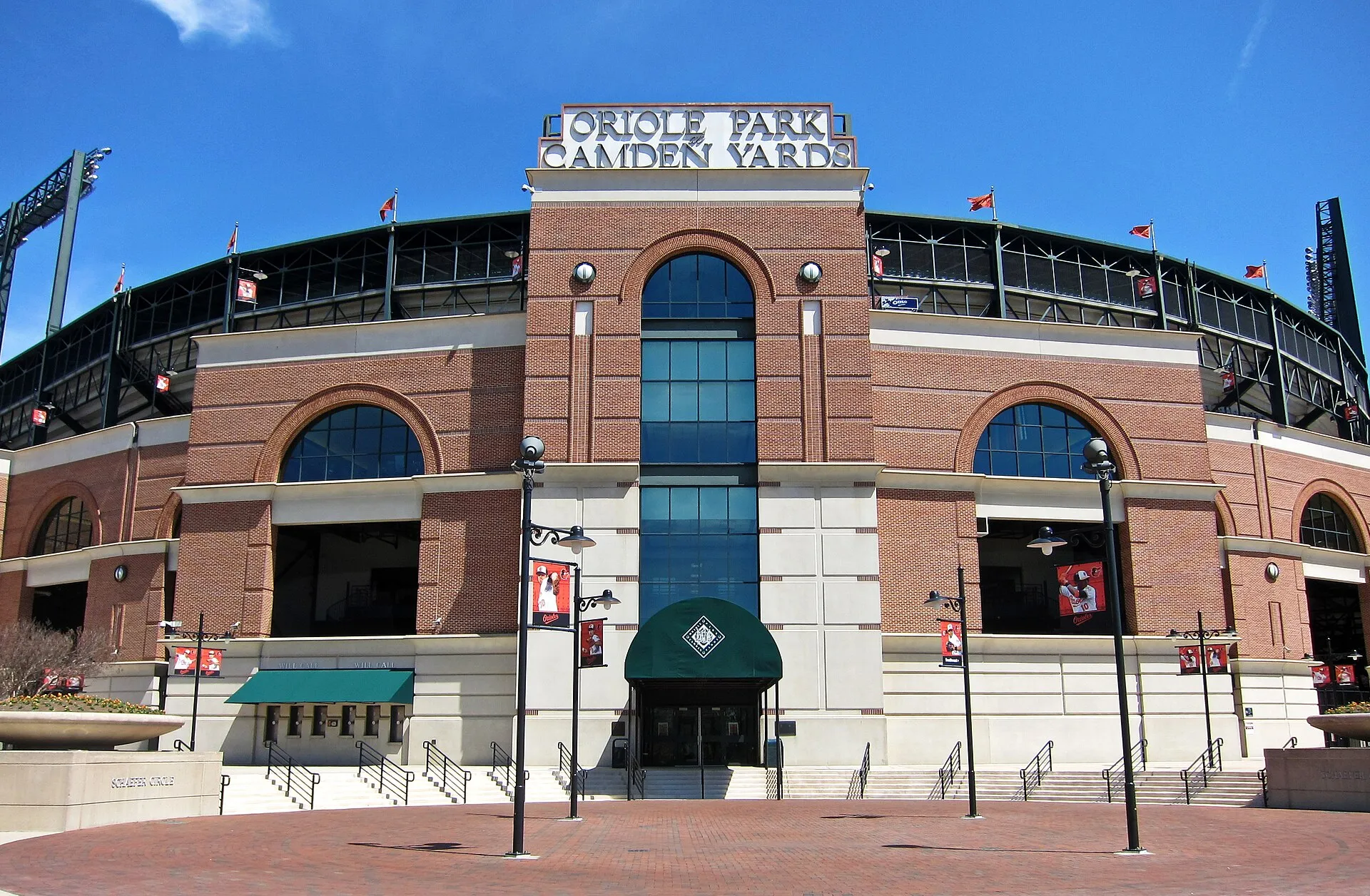
Collection Highlights
The B&O Warehouse
The 1,016-foot brick warehouse beyond right field, built for the Baltimore & Ohio Railroad around the turn of the 20th century, is the longest building on the East Coast and the visual signature of the ballpark. Preserving it rather than razing it was the decision that defined Camden Yards. No batter has ever struck it on the fly during a game, though Ken Griffey Jr. clanged one off its brick during the 1993 Home Run Derby.
Eutaw Street's home-run baseballs
The pedestrian promenade running between the warehouse and the outfield fence is studded with small bronze baseballs set into the pavement, each marking the exact spot where a home run landed on the street. A game ticket lets you walk it, read the plaques, and stand where the longest blasts came down.
The Babe Ruth statue
A larger-than-life bronze of a young George Herman Ruth stands near the main gate, glove in hand, honoring Baltimore's most famous native son, who was born just two blocks away in 1895 and learned the game in the city's streets and yards.
Legends Park statues
In the picnic area beyond the bullpens, six bronze statues honor the Orioles greats who built the franchise's identity - Brooks Robinson, Frank Robinson, Jim Palmer, Eddie Murray, Earl Weaver, and Cal Ripken Jr. - each captured in a characteristic pose from the club's championship years.
The Orioles dugout
The official tour walks you down into the home dugout, where you can sit on the same bench as the players and look up at the roughly 45,000-seat bowl from field level - a perspective invisible from any ticketed seat.
The press box panorama
On non-game-day tours the route reaches the press level, which commands a sweeping view down the first-base line, across the warehouse, and out to the downtown Baltimore skyline - the classic photograph of the whole ballpark in one frame.
Boog's BBQ on Eutaw Street
Boog Powell, the towering first baseman and 1970 American League MVP, runs a pit-beef and barbecue stand on Eutaw Street that has become as much a Camden Yards ritual as the game itself, often with Boog himself signing programs beside the smoker.
Babe Ruth Birthplace Museum
Two blocks west at 216 Emory Street, the narrow row house where Ruth was born in 1895 is now a museum tracing his path from Baltimore street kid to the most famous athlete in America. It sits just off the ballpark tour route and makes a natural companion stop.
Events Schedule
The rhythm of Camden Yards follows the baseball calendar. Plan around these fixtures:
- ⚾ Home season (April–September) — The Orioles play 81 home games across the season, so on most spring and summer dates a game is on. Weeknight first pitches are usually 7:05 PM, with weekend afternoon starts around 1:05 PM or 4:05 PM. Check the official schedule before you commit to a date.
- 🎈 Opening Day (early April) — The season opener is the hottest ticket of the year, with pregame ceremonies, the full roster introduced along the baselines, and a charged, sold-out house.
- 🎇 Fireworks nights — Select Friday-night home games and the games nearest July 4th end with fireworks launched over the outfield and the illuminated warehouse.
- 🏆 Promotional & theme games — Bobblehead giveaways, heritage nights, and kids-run-the-bases days appear throughout the schedule; giveaway items typically go to the first several thousand fans through the gates.
- 🎪 Ballpark tours — Guided tours run daily during the season (commonly 10 AM, 12 PM, and 2 PM) and on a reduced schedule from October through March, when the empty park allows deeper behind-the-scenes access.
Seating Guide
Camden Yards seats roughly 45,000 across a single-sport bowl designed so almost every seat faces the diamond honestly - a deliberate break from the multipurpose stadiums it replaced. Use these zones to choose:
- Lower bowl (field, club, and terrace levels) — The closest sightlines and the shortest walk to the field. Club-level and dugout-adjacent seats carry the highest prices; terrace-box seats down the lines are the value end of the lower bowl.
- Upper deck — The best value in the house, and the higher rows reward you with a sweeping view over the right-field wall to the B&O Warehouse and the downtown skyline beyond.
- Eutaw Street standing room & the flag court — With a general game ticket you can watch from the promenade between the warehouse and the outfield fence, the best place in the park to chase a home-run ball.
- Sun & shade — For a summer evening game, the low sun drops behind the stands and lights the warehouse in right field; upper-deck and third-base-side seats fall into shade first, while the last light makes the outfield the signature photograph.
- Accessibility — Companion and wheelchair-accessible seating is available on every level, reached by elevator and ramp; request it when booking rather than at the gate.
Camden Yards timeline
-
Babe Ruth born two blocks away
George Herman Ruth was born at 216 Emory Street, in a row house that now anchors the neighborhood's baseball heritage as the Babe Ruth Birthplace Museum.
-
The Browns become the Orioles
The St. Louis Browns relocated to Baltimore and were reborn as the modern Orioles, restoring a major-league identity to a city whose diamond history reached back to the National League Orioles of the 1890s.
-
Ground broken downtown
The Maryland Stadium Authority broke ground beside the old Camden rail yards and made the defining choice to preserve, rather than demolish, the B&O Warehouse looming beyond right field.
- April 6, 1992
Oriole Park at Camden Yards opens
Rick Sutcliffe threw a complete-game shutout as the Orioles beat Cleveland 2-0, and the retro-ballpark era of American sports architecture began.
- September 6, 1995
Cal Ripken Jr. breaks Gehrig's record
Ripken played his 2,131st consecutive game before a roaring home crowd, eclipsing Lou Gehrig's mark on the way to an unbroken streak of 2,632 games.
-
Legends statues unveiled
For the ballpark's 20th anniversary, six bronze statues of Orioles Hall of Famers were installed in the picnic area beyond the bullpens.
When to Visit
Ballpark tours run daily at select times, typically 10:00 AM, 12:00 PM, and 2:00 PM during the season (April–September) and on a reduced schedule in the offseason. Each tour lasts about 90 minutes.
Game days: gates open 90 minutes before first pitch for Orioles home games, with the season running from late March through September.
- Best for tours: non-game-day mornings, when the route reaches the press box, the dugout, and the warning track that are off-limits when the team is home.
- Best for atmosphere: a Friday or Saturday evening game in summer, when the sunset floods the B&O Warehouse and a full house creates a genuine Baltimore night.
- Offseason: tours continue October through March with no crowds and, often, more behind-the-scenes access - the trade-off is a quiet ballpark rather than a live game.
Admission and Costs
All prices are in US dollars. Game-ticket ranges shift with the opponent, the day of the week, and demand, so treat these as typical guides rather than fixed rates.
| Experience | Price | Notes |
|---|---|---|
| Public ballpark tour | $10 adult / $8 child & senior | ~90 minutes; book via the Orioles |
| Orioles game — upper deck | $15–25 | Best value; sweeping warehouse views |
| Orioles game — lower bowl | $40–100 | Closest sightlines |
| Orioles game — premium/club | $250+ | Dugout-level and club seating |
| Private group tour (15+) | Discounted per person | Arrange in advance through the Orioles |
| Babe Ruth Birthplace Museum | $10 adult | Two blocks west on Emory Street |
| Full-day baseball-heritage guide | $200–350 | Ballpark, warehouse, Babe Ruth Museum, city baseball history |
Reserve tours and premium seats through the official Orioles site; the museum is ticketed separately from the ballpark.
The Case for a Guide
A game ticket gets you a seat; a guide gets you the story that makes Camden Yards matter. Here is where an expert earns their fee:
- Design revolution: a guide explains the specific choices - baseball-only geometry, brick and steel, the preserved warehouse - that ended three decades of concrete-bowl convention and were copied across the league.
- Access you cannot buy with a game ticket: official tours reach the dugout, the press box, the scoreboard control room, and the warning track, spaces sealed off on game days.
- The franchise's deep roster of legends: guides connect the bronze statues to living memory, from Brooks and Frank Robinson through Jim Palmer, Eddie Murray, Earl Weaver, and Cal Ripken Jr.'s 2,632-game streak.
- Neighborhood and city context: a heritage guide threads the ballpark to the Babe Ruth Birthplace Museum and the wider downtown, turning a stadium visit into a chapter of Baltimore history.
- Timing and logistics: a guide knows which tour dates open the most rooms and how to fold the park into an Inner Harbor day without wasted backtracking.
Tips for Visitors
- Book tours in advance: ballpark tours are popular and space is limited. Reserve through the Orioles website, especially for weekend dates in season.
- Walk from the harbor: Camden Yards sits about 10 minutes on foot west of the Inner Harbor, making it easy to combine both in one day.
- Skip the parking hassle: the Light Rail's Camden stop and the MARC Camden Line both drop you at the gates; game-day lots around the stadium charge $15–30.
- Arrive 90 minutes early: that leaves time to walk Eutaw Street, see the statues, and grab a sandwich at Boog's BBQ before first pitch.
- Choose a non-game day for the fullest tour: when the Orioles are on the road, tours open the dugout and press box.
- Make it a baseball-heritage day: combine the ballpark tour with the Babe Ruth Birthplace Museum two blocks west, then walk east through the harbor toward Fells Point for lunch, or south to Fort McHenry for the War of 1812 story.
- Check accessibility needs ahead: the tour route is largely step-free apart from the dugout; flag any requirements when you reserve.
Frequently Asked Questions
When is the best time of year to visit Camden Yards?
The Orioles play an 81-game home schedule from April through September, and that is the only window to catch a live game. May, June, and September offer the ideal blend of pleasant Baltimore weather and a full ballpark, while Opening Day in early April carries a special electric charge. The stadium runs limited tours from November through February, but the surrounding Eutaw Street promenade loses its buzz without a game-day crowd, so pair an offseason visit with the nearby Inner Harbor instead.
When are Camden Yards ballpark tours offered?
Guided ballpark tours run daily at select times during the season (typically 10:00 AM, 12:00 PM, and 2:00 PM, April–September) and on a reduced schedule in the offseason. Tours last roughly 90 minutes. Non-game days give the fullest access, reaching the dugout and press box that are closed to visitors when the Orioles are home. Reserve ahead through the official Orioles site, especially on summer weekends.
What do tickets and tours cost at Camden Yards?
A public ballpark tour is about $10 for adults and $8 for children and seniors. Orioles game tickets start around $15–25 for the upper deck, run $40–100 for the lower bowl, and climb past $250 for premium club and dugout-level seats. Private group tours (15+) and a full-day baseball-heritage guide combining the ballpark, the B&O Warehouse, and the Babe Ruth Birthplace Museum cost more; book those in advance.
How do you get to Camden Yards?
Camden Yards sits on the west edge of downtown, about a 10-minute walk from the Inner Harbor. The Light Rail's Camden stop and the MARC Camden Line's Camden Station drop you steps from the gates, which spares you game-day parking (lots around the stadium charge roughly $15–30). Arriving early lets you walk Eutaw Street and reach your seats before first pitch.
Is Camden Yards accessible for visitors with disabilities?
Yes. The ballpark offers step-free entry, elevators and ramps to every seating level, accessible and companion seating throughout the bowl, assistive-listening devices, and accessible restrooms and concessions. The public tour follows a largely step-free route, though the dugout involves a few steps; ask the tour desk in advance if you need an adapted path, and request accessible seating when you buy game tickets.
How much time should visitors budget for Camden Yards?
Allow about 90 minutes for the guided tour, or arrive 90 minutes before first pitch on a game day to walk Eutaw Street, see the statues, and grab a barbecue sandwich before settling in. Adding the Babe Ruth Birthplace Museum two blocks west turns Camden Yards into a comfortable half-day of Baltimore baseball history.