
Alcázar de los Reyes Cristianos timeline
- 8th c.
Caliphal residence
A Moorish palace-fortress stood on this bend of the Guadalquivir, itself layered over Roman and Visigothic foundations near the western edge of the walled city.
-
Christian conquest
Ferdinand III of Castile took Córdoba from the Almohads, and the riverside caliphal residence passed to the Christian crown.
-
Alfonso XI's fortress
Alfonso XI raised the present Mudéjar fortress with its four corner towers, giving it the name "of the Christian Monarchs".
-
Seat of the Inquisition
The Tribunal of the Holy Office installed itself in the Alcázar, where it would sit, judge, and imprison for well over three centuries.
-
Columbus received
Ferdinand and Isabella first heard Christopher Columbus set out his plan to sail west while wintering at the fortress.
- 1482–92
Reconquista headquarters
For a decade the Catholic Monarchs used Córdoba and this Alcázar as a base to direct the long war against the Emirate of Granada.
-
Turned into a prison
After the Inquisition was abolished the building served as a civil and military prison, a grim role it kept until 1931.
- 1950s
Restored as a monument
The city cleared the prison, restored the halls, and laid out the terraced pools and gardens that draw visitors today.
Fortification History
Alfonso XI's fortress is a quadrangular design built for defence rather than display: high sandstone curtain walls enclose a roughly square parade ground, with a stout tower anchoring each corner. Compared with the ornate palaces of Granada and Seville, the exterior is deliberately austere — its power reads in mass and line, not ornament. Four towers define the silhouette, and each has its own character:
- Torre de los Leones (Tower of the Lions) — the oldest, crowned by a pointed Gothic spire and the usual climb for panoramic views.
- Torre del Homenaje (Tower of Homage) — the tallest, an octagonal keep that served as the symbolic heart of the fortress.
- Torre de la Inquisición (Tower of the Inquisition) — a cylindrical tower whose name records the building's darkest tenants.
- Torre de la Paloma (Tower of the Dove) — the southeast corner, much altered over the fortress's long institutional life.
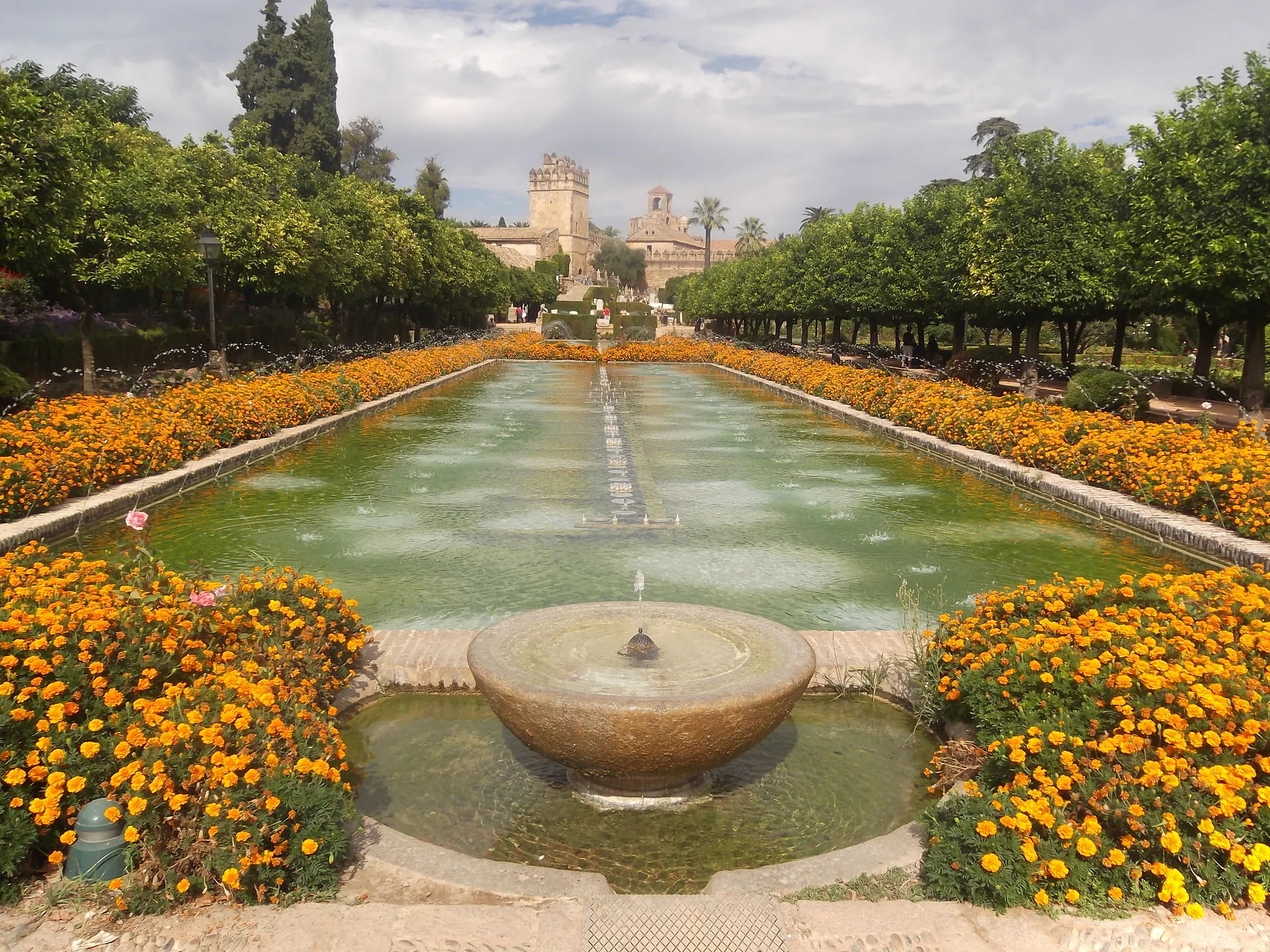
The real engineering marvel lies below the walls, in the gardens. Their terraced pools and fountains descend toward the Guadalquivir on a system of channels and basins that revives the Moorish hydraulic tradition — the same water-management genius on show at the Alhambra — moving river water by gravity through cypress-lined walks, orange and lemon groves, and long rectangular estanques that mirror the towers. It is this marriage of blunt Christian fortress and refined Islamic waterworks that gives the Alcázar its unusual double personality.
Notable Rooms
Inside, the halls are spare but hold genuine treasures — this is a monument to read room by room:
- Salón de los Mosaicos (Hall of Mosaics) — vast Roman floor panels, some 2nd–3rd century, excavated in the late 1950s from beneath Córdoba's Plaza de la Corredera and re-laid on these walls; look for the marine deity Oceanus and mythological scenes rendered in tiny tesserae.
- The Roman sarcophagus — a 3rd-century marble tomb carved with a half-open door to the underworld, one of the finest ancient pieces in the city, displayed near the mosaics.
- The Columbus audience — the vaulted royal rooms where the Catholic Monarchs held court and first weighed Columbus's westward gamble; standing here connects a small Andalusian fortress to the map of the modern world.
- The chapel and vaulted galleries — cool, high-ceilinged spaces that once served the resident court and, later, the Inquisition's administration.
- The tower interiors — narrow stone spiral staircases climb to the battlements, where the wall-walk opens onto rooftop views over the old town and the river.
Below the ramparts, the Baños Reales (royal Mudéjar baths) and the ground-floor courtyards preserve the domestic rhythm of a working medieval palace, while just outside the walls the Caballerizas Reales — the royal stables founded by Philip II in 1570 to breed the Andalusian horse — extend the story into the Renaissance.
When to Visit
In the main season the Alcázar opens Tuesday–Saturday 8:30 AM – 8:45 PM (last entry 8:15 PM) and Sunday 8:30 AM – 2:30 PM; it is closed Monday. In high summer the timetable contracts — the mid-afternoon block usually closes, often reopening for illuminated night visits between roughly mid-June and mid-September (exact dates vary by year). Because hours shift around the season and civic events, verify the current schedule with the official Córdoba tourism board before your visit. Best timing: arrive at opening or come late in the day — afternoon light makes the gardens glow, and the large tour groups typically pass through before lunch.
Admission and Costs
- General admission: €5 (~$5) — covers the fortress halls, Roman mosaics, towers, and gardens.
- Children under 14: free.
- Combined municipal ticket: about €9 (~$10) — bundles the Alcázar with other Córdoba monuments.
- Guided group tour: €15–20 (~$16–22) per person — 1 to 1.5 hours, monument entry usually included.
- Private guide: €90–150 (~$97–162) for up to six people, with entry tickets bought separately.
- Night visit: around €7 (~$8) when the summer evening openings run.
Reduced rates and free days are set by the Ayuntamiento de Córdoba, so confirm current tariffs and any free windows on the official Córdoba tourism board before you go.
The Case for a Guide
The Alcázar's walls have witnessed seven centuries of power, persecution, and transformation, but its spare military architecture doesn't announce those stories the way an ornate cathedral does. A guide fills the silence. Without narration the fortress is a pleasant walk; with it, the visit becomes a thriller spanning Roman Córdoba to the Age of Exploration. A licensed guide adds value by:
- Placing the Columbus audience in context — why the Catholic Monarchs were wintering here, what they had already refused, and how the 1486 meeting fits the decade-long push toward Granada.
- Decoding the Roman layer — how 2nd–3rd-century mosaics from beneath the Plaza de la Corredera ended up on the walls of a medieval Christian castle.
- Explaining the Inquisition's tenancy — which towers held prisoners, how the tribunal operated, and why it chose this building for over three centuries.
- Reading the water gardens — pointing out the Moorish irrigation borrowed from the tradition that peaks at the Alhambra, and the design echoes with the Real Alcázar of Seville.
- Sequencing the old town — chaining the fortress efficiently to the Mezquita-Cathedral and the Jewish Quarter so you see the historic core in a single, unhurried morning.
Only holders of the official Guía Oficial de Turismo de Andalucía licence may lead tours inside the monument, so look for that accreditation when booking.
Tips for Visitors
- Go late in the day: afternoon light makes the gardens glow, and the big tour groups tend to visit before lunch.
- Mind the tower stairs: the stone spiral staircases to the battlements are tight and steep, with no lift — take your time and let descending visitors pass; the towers are not wheelchair accessible, though much of the gardens is.
- Bring sun protection: the terraces are largely open, so a hat, water, and sunscreen are essential from May to September.
- Time your photos: the stillest reflections on the long pools happen in the calm air of early morning or dusk; the summer night lighting turns the fountains into a separate spectacle.
- Allow 1–1.5 hours, adding thirty minutes to linger or sketch by the water.
- Combine strategically: walk south across the Roman Bridge for river views, then loop back north through the Jewish Quarter to the Mezquita-Cathedral — all within a ten-minute stroll.
Frequently Asked Questions
When is the best season to visit the Alcázar de los Reyes Cristianos?
April, May, and October are the standout months, when Córdoba's courtyard gardens burst with colour and temperatures sit around a comfortable 20–25°C. The early-May Festival de los Patios turns the whole city into a floral spectacle, and the Alcázar's own terraces are at their most vivid then. Avoid July and August, when afternoons routinely pass 40°C — Córdoba is regularly the hottest provincial capital in mainland Spain — and the largely shadeless gardens become punishing after midday. In midsummer, aim for the 8:30 AM opening or the illuminated night visits.
What are the opening hours of the Alcázar de los Reyes Cristianos?
In the main season the fortress opens Tuesday–Saturday 8:30 AM – 8:45 PM (last entry 8:15 PM) and Sunday 8:30 AM – 2:30 PM; it is closed Monday. Hours shorten in high summer, when the mid-afternoon block often closes and reopens for evening night visits (roughly mid-June to mid-September). Because the schedule flexes around the season and civic events, confirm the current timetable with the official Córdoba tourism board before you go.
How much does it cost to visit, and is a guide worth it?
General admission is just €5 (~$5) for the halls, mosaics, towers, and gardens, and under-14s go free; a combined municipal ticket covering other city monuments runs about €9 (~$10). A guide is worth it here precisely because the architecture is spare: a licensed Guía Oficial de Turismo de Andalucía explains why the Catholic Monarchs received Columbus in these rooms, how the Inquisition used the towers, and where the Roman mosaics came from — context the bare stone never volunteers.
What are the must-see highlights inside the Alcázar?
Don't miss the Hall of Mosaics with its 2nd–3rd-century Roman floor panels and the great carved sarcophagus, the climb up the Tower of the Lions for a sweep from the Mezquita-Cathedral to the Sierra Morena, and the terraced gardens with their long reflecting pools, fountains, and citrus groves running down toward the Guadalquivir. The room where Ferdinand, Isabella, and Columbus met ties the whole visit to the Age of Exploration.
How does it compare with the Real Alcázar of Seville and the Alhambra?
They complement one another. Córdoba's Alcázar is a compact Christian military fortress with an unusually rich Roman layer and formal water gardens, best seen in an hour or so. The Real Alcázar of Seville is a far larger, still-royal Mudéjar palace of gilded halls, and the Alhambra in Granada is the crowning Nasrid palace-city that inspired both. Seeing Córdoba first makes an excellent, low-crowds primer for the grander two.
How much time should I allow, and how do I combine it with the rest of Córdoba?
Allow 1 to 1.5 hours, adding half an hour to linger by the pools. The Alcázar sits at the southwest corner of the old town: walk south to the Roman Bridge for river views, then loop north through the Jewish Quarter to the Mezquita-Cathedral — the three sights and the bridge all lie within a ten-minute stroll of each other.