
Walking Route
Engineering Facts
Palacio's design married nineteenth-century ironwork to a genuinely new idea, and the numbers still impress:
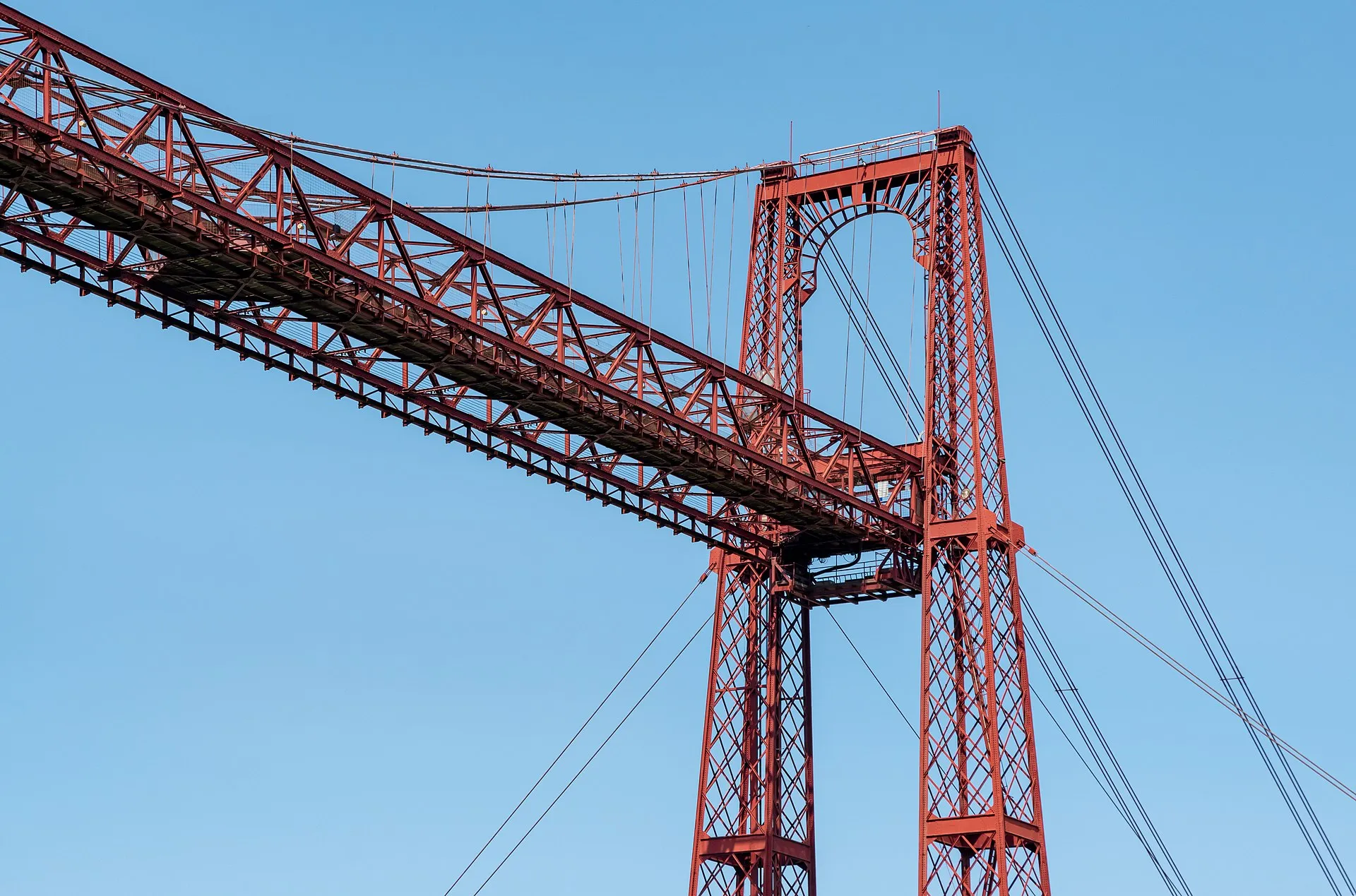
- Two iron portals, 61 metres tall — a pair of latticed towers anchors each bank, framing the crossing like a giant gateway over the water.
- A 160-metre suspended span — the horizontal top beam bridges the channel without a single mid-river pier, keeping the shipping lane completely open below.
- Twisted-steel-cable haulage — rather than a fixed roadway, a trolley runs along the top beam and pulls the hanging gondola across on cables, a technique credited to the French engineer Ferdinand Arnodin and singled out in the bridge's UNESCO listing.
- A gondola that carries road traffic — the barquilla platform holds several cars plus foot passengers at once, so it functions as a genuine river crossing, not merely a viewing ride.
- From steam to electricity — the original steam plant that hauled the gondola was later replaced by electric motors, still visible in the engine house at the Portugalete abutment.
- Rebuilt after wartime destruction — the top span was blown up in June 1937 during the Spanish Civil War and rebuilt by 1941, which is why the towers are original ironwork while the crossbeam and gondola are twentieth-century replacements.
Observation Points
Where you stand changes the bridge completely, so plan for at least two vantage points on opposite banks:
- Portugalete quayside at low tide — the south-bank quay gives the head-on shot with the full height of the iron legs exposed above the mud; morning light favours this side.
- Las Arenas promenade — from the Getxo bank the belle-époque mansions of Areeta line up behind the terminal, framing the structure against the town rather than the open estuary.
- The upper walkway, 50 metres up — the open metal deck lets you photograph straight down through the grating at ships and the gondola, with the Cantabrian coast opening out toward the sea.
- Sunset from the south bank — late afternoon turns the estuary amber behind the lattice; time a walkway crossing for golden hour and walk back across for the changing light.
Vizcaya Bridge timeline
-
World's first transporter bridge opens
Inaugurated on 28 July 1893 to Alberto de Palacio's design, linking Portugalete and Las Arenas without blocking the shipping channel below.
-
Upper span destroyed in the Civil War
Retreating forces dynamited the horizontal top beam in June 1937, halting the gondola and leaving only the two iron towers standing.
-
Bridge rebuilt and reopened
A new span and gondola restored the crossing, and electric motors later replaced the original steam machinery in the engine house.
-
Inscribed as a UNESCO World Heritage Site
Recognised as an outstanding iron construction of the Industrial Revolution and the prototype for transporter bridges worldwide.
When to Visit
- Gondola crossing — runs daily at roughly 8-minute intervals through the day, continuing on a reduced night-time schedule, so the ferry itself effectively never closes.
- Walkway and exhibition — daily, 10 AM – 7 PM, extended to 8 PM in summer; tower lifts carry you up to the panoramic deck and the small exhibition on the bridge's construction.
- Weather closures — the exposed upper walkway shuts when gusts pass the safety threshold, though the gondola keeps operating below; check the operator's website on blustery days.
- Best time to arrive — late afternoon delivers golden light over the estuary and thinner crowds on the walkway; time the crossing for sunset and watch the Cantabrian sky turn amber above the iron lattice.
- How long to allow — budget 1 to 1.5 hours for the gondola ride, the walkway crossing, the exhibition, and photographs from both banks.
Admission and Costs
Prices are set by the bridge operator; confirm current fares on site before you queue.
- Gondola crossing, pedestrian — €2 (~$2) one way, the everyday commuter fare.
- Gondola crossing, car and passengers — €6.35 (~$7), if you want the full drive-on experience.
- Walkway and gondola combined — €10 (~$11), covering the tower lift, the panoramic walkway, and one gondola ride; the construction exhibition is included with this ticket.
- Guided group tour — €8–15 (~$9–16) per person for a 45–60 minute walk through the history and engineering.
- Private guide — €80–120 (~$86–130) for up to six people, usually folding in a stroll through Portugalete's old town or the Getxo mansions on the far bank.
The Case for a Guide
The Vizcaya Bridge reads as a curiosity from the promenade and as a landmark of industrial history up close — a good guide is what closes that gap, turning an eight-minute ferry ride into the story of how the Basque Country built the modern world.
- Engineering, decoded — a guide explains the twisted-steel-cable haulage, the counterweight and trolley system, and how Palacio adapted the iron-construction methods of Eiffel's generation for an entirely new job.
- Industrial Revolution context — the bridge grew out of the same iron-mining and shipbuilding boom that built Bilbao; a guide weaves the economic, social, and technological threads that the structure ties together.
- A family of bridges — learn how this prototype inspired transporter bridges in Middlesbrough, Rouen, and Buenos Aires, and why so few of its descendants survive today.
- The neighbourhoods on each bank — many guides add a walk through Portugalete's medieval streets or the grand mansions of Getxo, layering the towns onto the monument.
- Why UNESCO listed it — understand exactly which criteria the World Heritage inscription recognised, and what makes this the first, not merely the oldest, of its kind.
Tips for Visitors
- Check the wind first — the walkway 50 metres up closes in strong gusts; if the upper deck is shut, the gondola below still runs, so the crossing is rarely a wasted trip.
- Dress for the estuary — the channel funnels coastal wind even on mild days, so bring a windbreaker for the exposed walkway, and note the metal deck floor is an open grid.
- Ride one way, walk the other — take the gondola across and return on the upper walkway (or the reverse) for the full experience without retracing your steps.
- Arrive by metro — both Areeta (Getxo) and Portugalete stations sit a short walk from the terminals, so no taxi is needed from central Bilbao.
- Extend along the coast — from the Getxo bank it is about 20 minutes on foot along the cliffside path to Ereaga beach and the old port of Algorta, an easy add-on to a half-day visit.
Frequently Asked Questions
When is the best period to visit the Vizcaya Bridge?
Summer months from July through August deliver the clearest skies for the gondola crossing and the upper walkway panoramas over the Nervión estuary. May and September offer slightly cooler but still pleasant conditions with fewer tourists queuing for the elevated walkway. Winter visits from November to February are hampered by frequent rain and biting coastal winds that make the open-air upper deck considerably less enjoyable.
When should visitors plan to see Vizcaya Bridge?
Gondola crossing: The suspended car runs every day at roughly 8-minute intervals through the day and continues on a reduced night-time schedule, so the ferry itself never fully closes. Walkway and exhibition: Daily, 10 AM - 7 PM (extended to 8 PM in summer). Closed: The upper walkway may shut during high winds or severe weather for safety, though the gondola keeps running below.
How does a guide enhance a visit to Vizcaya Bridge?
Engineering depth: A guide explains the twisted-steel-cable mechanics, the counterweight and hauling system, and how Alberto de Palacio adapted the iron-construction techniques of Gustave Eiffel's era for an entirely original purpose -- moving people across a working shipping channel without blocking it.
What should visitors know before visiting Vizcaya Bridge?
Check the wind: The panoramic walkway 50 metres up closes when gusts exceed safety thresholds -- check the operator's website or ask at the ticket booth on blustery days. Dress warmly: The estuary funnels coastal wind even on mild days, so a windbreaker is essential for the exposed upper deck, and comfortable shoes help on the open-grid walkway floor.