
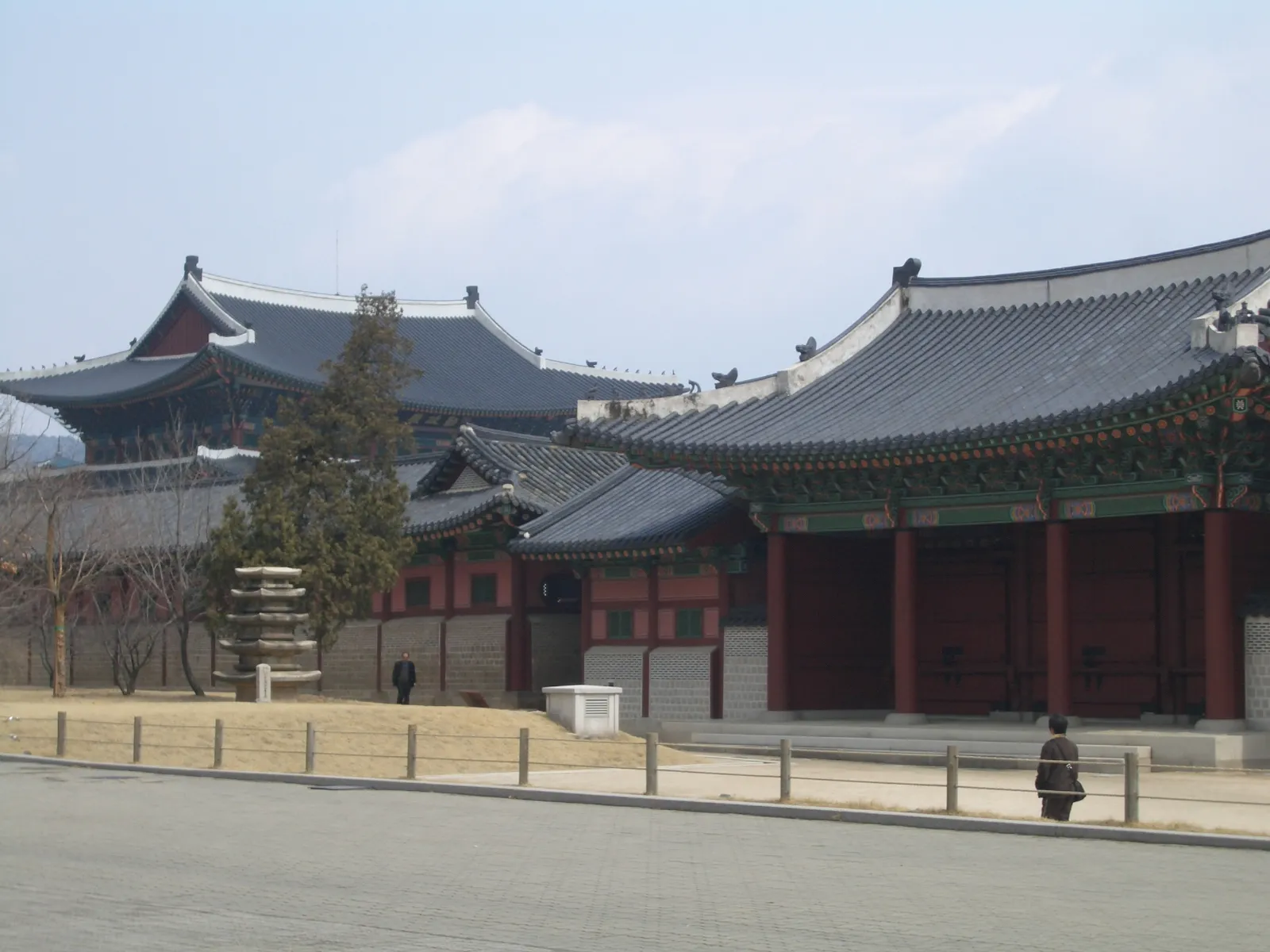
Architecture
Gyeongbokgung's architecture embodies Joseon Confucian cosmology made physical. The palace's north-south axis aligns with Bugaksan mountain to the north and the Han River to the south — a baesanimsu (mountain-behind, water-before) arrangement considered ideal in Korean geomancy. Each structural element carries symbolic weight:
- Gwanghwamun Gate: Three arched passageways; the central arch reserved exclusively for the king, eastern for civil officials, western for military
- Geunjeongjeon throne hall: Elevated on a two-tiered woldae platform; the king literally sat above all others — the floor level of the throne dais is the highest point in the main complex
- Haetae stone creatures: Positioned at stairs and gates; the mythical fire-eating haetae were considered protection against conflagration — particularly important given how many Korean wooden palace complexes burned
- Dancheong painted woodwork: The red, blue, green, and gold geometric painting on structural timbers follows strict hierarchical codes — the complexity and colour density of the patterns on the throne hall exceed those of any secondary structure
- Gyeonghoeru columns: The 48 granite columns of the banquet pavilion were deliberately left unpainted (unlike the coloured main halls) — their natural stone was considered appropriate to a pleasure pavilion rather than a ceremonial structure
Historical Significance
Gyeongbokgung's history encodes three separate traumas that shaped modern Korean identity:
The Imjin War (1592–1598): Japanese forces under Toyotomi Hideyoshi invaded the Korean peninsula and sacked Seoul, burning Gyeongbokgung to its foundations. The court fled north; the palace lay in ruins for 273 years. The decision not to rebuild for so long reflects both resource constraints and the political complications of the regent system that governed for child-kings through much of that period.
The 1867 Reconstruction: Regent Heungseon Daewongun's project to rebuild the palace was simultaneously a genuine act of dynastic restoration and a politically calculated assertion of royal authority over the Confucian scholar class that had dominated governance during the interregnum. The reconstruction employed tens of thousands of workers, levied a controversial timber tax, and was completed in just three years — a pace that generated resentment but produced the most complete Joseon palace complex ever assembled.
Japanese Colonial Demolition: The systematic destruction of palace buildings from 1911 onward, culminating in the construction of the Government-General Building directly in front of the throne hall (blocking its connection to Gwanghwamun), was a deliberate colonial act of cultural erasure. Restoring the palace since 1990 — and demolishing the colonial building in 1995 — has been a conscious project of historical reclamation that resonates deeply with Korean visitors.
When to Visit
Open: Wednesday–Monday 9 AM – 6 PM (March–October until 6 PM, November–February until 5 PM). Closed: Tuesday.
Changing of the guard: 10 AM and 2 PM at Gwanghwamun Gate (except Tuesdays); arrive 15 minutes early for a good position.
Sunrise program: Lottery entry before regular opening hours — check the official Gyeongbokgung Palace website for application windows.
Recommended duration: 2–3 hours for a self-guided visit; 3–4 hours with a guide who covers the two on-site museums.
Admission and Costs
Palace admission: ₩3,000 (~$2.25) — adults. Free for children under 7 and seniors over 65. National Folk Museum and National Palace Museum: Free with palace admission.
Hanbok rental: Visitors wearing traditional hanbok enter free — rental shops outside Gwanghwamun Gate charge ₩15,000–25,000 ($11–18) for 2–4 hours.
Sunrise lottery: Free to enter and visit if selected; no additional charge beyond regular admission.
The Case for a Guide
Without interpretation, Gyeongbokgung can read as an impressive series of empty courtyards. A guide transforms the physical space into a narrative:
- Cosmological symbolism: The guide decodes why each gate, courtyard, and building occupies its specific position — the geomantic logic that placed the throne hall precisely where it is, and the symbolic meanings encoded in every carved stone creature and painted timber
- Joseon social hierarchy: Understanding who was permitted to walk through which gate, stand in which courtyard position, and occupy which hall tier makes the empty spaces comprehensible as a functioning social and political machine
- Colonial erasure narrative: The guide explains what stood where during the Japanese colonial period and why the 1995 demolition of the Government-General Building was a nationally significant event — context essential for understanding why Korean visitors engage emotionally with the restoration project
- Museum navigation: The National Folk Museum contains thousands of artefacts with Korean-only labels; a guide contextualises the daily life objects within the broader Joseon social structure that the palace itself embodied
- Guard ceremony commentary: The guide explains the rank insignia, military unit roles, and Confucian protocol governing the ceremony in real time during the performance
Tips for Visitors
Wear hanbok for free entry: Dozens of rental shops cluster around Gyeongbokgung — arriving in hanbok waives the admission fee and makes palace photography significantly more memorable.
Start at Gwanghwamun: Enter through the main gate rather than side gates; the approach through the full ceremonial sequence (Gwanghwamun → Heungnyemun → Geunjeongjeon) gives the correct spatial understanding of the palace hierarchy.
Gyeonghoeru in cherry blossom season: The pavilion pond is ringed by cherry trees that bloom in early April — arrive before 9 AM to photograph the reflection without crowds.
Combine with Bukchon Hanok Village: The village is a 15-minute walk northeast through Gyeongbokgung's eastern gate — a natural half-day combination that traces the journey from royal court to aristocratic residential neighbourhood.
Changdeokgung comparison: If visiting multiple palaces, note that Gyeongbokgung is grander and more restored while Changdeokgung feels more intimate and has the UNESCO-listed Secret Garden (Huwon) — both are worth separate visits.
Frequently Asked Questions
What is the history of Gyeongbokgung Palace?
Gyeongbokgung — whose name translates as "Palace Greatly Blessed by Heaven" — was founded in 1395 by King Taejo, the founder of the Joseon dynasty, as the primary seat of government and royal residence. For nearly two centuries it functioned as the dynastic heart of Korea until Japanese invasions in the 1590s destroyed most of its structures. The palace remained in ruins for over 250 years until Regent Heungseon Daewongun ordered a massive reconstruction beginning in 1867, restoring it to a complex of over 330 buildings. Tragically, Japanese colonial authorities demolished approximately 90% of those structures between 1911 and 1926, replacing the central grounds with the colonial Government-General Building. Since 1990, ongoing restoration work has rebuilt dozens of structures, and the removal of the colonial building in 1995 was itself a symbolic act of historical reclamation.
When is the changing of the guard ceremony at Gyeongbokgung?
The Royal Guard Changing Ceremony (Sumunjang Gyodaeeui) takes place at Gwanghwamun Gate — the grand main gate facing south toward the city — at 10 AM and 2 PM daily, except on Tuesdays when the palace is closed. The ceremony lasts approximately 20 minutes and involves elaborately costumed guards in Joseon military dress performing the formal handover ritual with drums, flags, and choreographed movement. Arriving 15 minutes early secures a front-row position at the gate's stone bridge. A guide can explain the rank insignia, the specific military units represented, and the Confucian protocol governing the ceremony — details that transform a visually impressive spectacle into a historically meaningful encounter.
What is the sunrise entry program at Gyeongbokgung Palace?
The Yeongje program (also called the sunrise entry or dawn entry program) allows a small number of visitors to enter the palace grounds before regular opening for the dawn atmosphere. Entry is awarded by lottery — applications open through the official Gyeongbokgung Palace website, typically two to four weeks in advance, and competition is significant especially in cherry blossom season. The experience of the empty palace grounds in early morning light, with the Bugaksan mountain ridge behind the rear halls turning pink, is described by those who secure tickets as one of Seoul's most memorable experiences. A guide who assists with the lottery application process and accompanies the visit adds considerable value by narrating the dawn setting in historical context.