
Observation Spots
Formation
Gwangalli occupies the inner shore of Suyeong Bay (Suyeongman), a shallow, roughly semicircular inlet on Busan's southeastern coast where the Suyeong River meets the Korea Strait. The bay's gentle curve and its partial enclosure by headlands give the beach its calm, shelving profile: the sand grades so gradually into the water that the shallows stay warm and safe far from shore, which is exactly what an exposed, open-ocean beach cannot offer.
The beach itself is a fine, pale sand deposited over centuries by river and tidal action and now actively maintained — Busan periodically replenishes the sand and grooms the strand to hold the 1.4 km arc against erosion. Just as important as the sand is the water. Through the mid-20th century Suyeong Bay was heavily polluted by urban run-off, and swimming was effectively off-limits; a sustained water-quality restoration programme across the 1990s and 2000s cleaned the bay back to bathing standard, and Gwangalli's return as a designated swimming beach is the visible payoff of that effort.
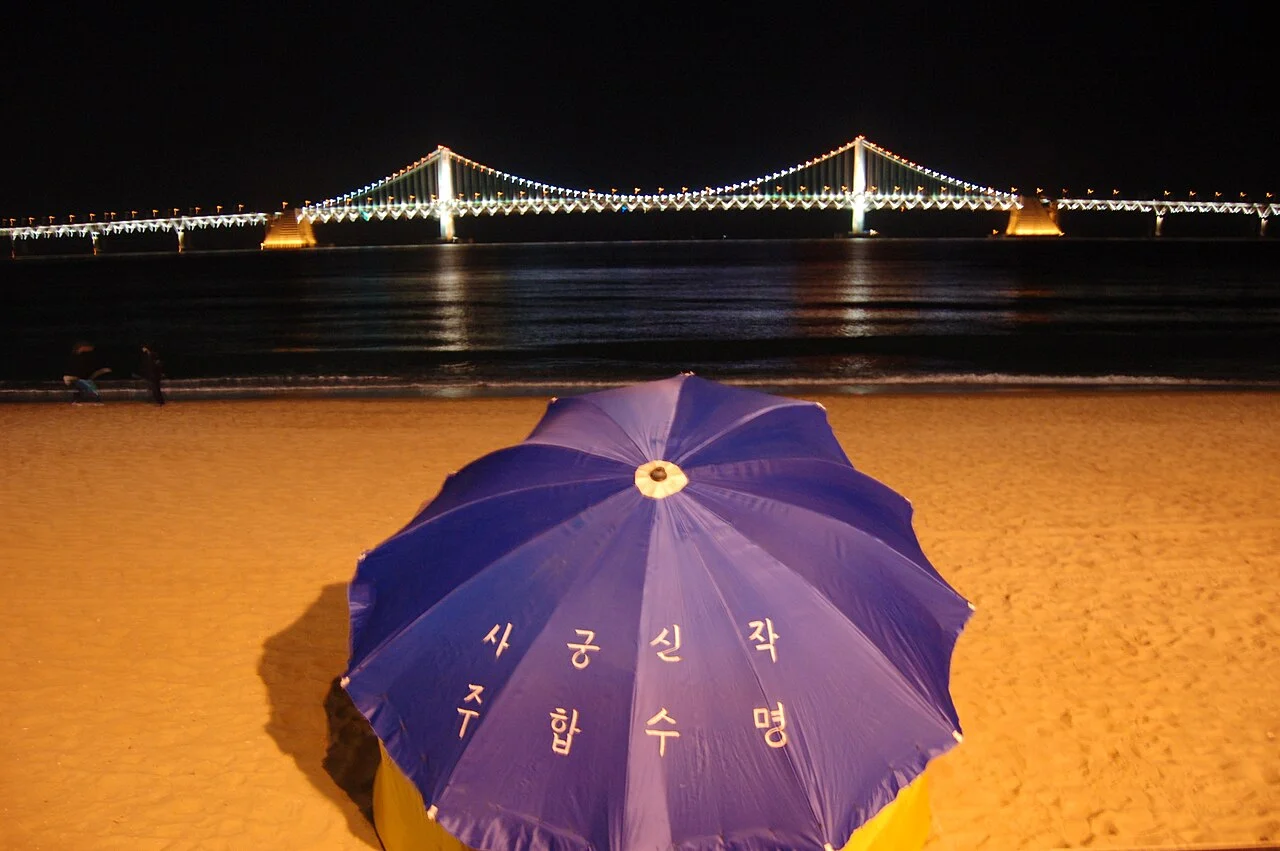
The single most dramatic feature of the setting is human-made: the Gwangan Bridge springs across the very mouth of the bay, so from anywhere on the sand the water is framed by a continuous horizon of towers and cables. Climatically, Gwangalli enjoys Busan's mild maritime moderation — milder winters and cooler, breezier summers than inland Korea — which is why the beach stays comfortable for evening visits from late spring through October, well beyond the short July–August swimming peak.
Wildlife
Gwangalli is an urban beach, not a wilderness, but the living bay behind it is the whole reason the neighbourhood eats the way it does. The waters of Suyeong Bay and the adjacent Korea Strait supply the seasonal catch that fills the tanks of Millak Raw Fish Town: gwangeo (olive flounder) and ureok (rockfish) year-round, meongge (sea squirt) at its briny best in spring, and shellfish and jeonbok (abalone) through the colder months when Busan locals insist the hoe tastes richest.
Overhead, black-tailed gulls (Larus crassirostris) wheel over the surf and the fishing rocks year-round — the same gulls whose cat-like call is a fixture of every Korean harbour — while migratory shorebirds work the tide line in spring and autumn. On the rocks at the beach's eastern and western ends you'll see amateur anglers pulling small rockfish from the shallows, and at low tide children hunt for crabs and shellfish in the exposed pools. The one seasonal caution is biological: warm late-summer currents can bring jellyfish into the shallows in August, when the posted beach flags will warn swimmers off.
Trails
Gwangalli is best experienced on foot along its flat, continuous beachfront promenade, which runs the full 1.4 km of sand and is genuinely level and accessible — a rarity in mountainous Busan. The walk rewards a slow evening pace timed to the bridge illumination, and it connects three distinct zones rather than being a single monotonous strip.
- Millak (eastern) end — anchored by Millak Waterside Park and the Raw Fish Town complex, this is the seafood-and-view quarter, with wooden deck platforms built out over the water for the classic symmetrical bridge photograph.
- Central beach — the widest sand and the liveliest social scene, where summer evenings fill with barbecues, buskers, and pojangmacha stalls, and where the Eobang Festival and fireworks crowds gather.
- Namcheon-dong (western) end — the quieter, more design-led side, where the promenade feeds into a dense grid of cafés, dessert bars, and boutiques locally known as the Gwangalli café street, best in the golden hour before the crowds move on to dinner.
From the western end it is a short walk or one bus stop to Namcheon-dong's cherry-blossom-lined streets, spectacular in early April, while a coastal bus from the eastern end links Gwangalli to Haedong Yonggungsa Temple further up the shore. The promenade is at its most comfortable from late April through October; in the depths of winter the sea wind off the bay makes the walk brisk and short.
Gwangalli Beach timeline
-
Gwangan Bridge construction begins
Work started on the double-deck span that would come to frame the entire beach.
-
Gwangan Bridge opens
The 7.42 km bridge opened to traffic, instantly becoming Gwangalli's defining backdrop.
-
Busan Fireworks Festival launches
The annual autumn fireworks show over the bay turned Gwangalli into Busan's signature event stage.
-
Weekend drone light show begins
The city added a regular Saturday-evening drone display over Suyeong Bay to the bridge illuminations.
When to Visit
Beach access: 24 hours, free. Swimming season: June–September (lifeguards on duty July–August, typically 9 AM – 6 PM). Gwangan Bridge illumination: Daily from sunset to around midnight. Weekend drone light show: The city runs a drone display over Suyeong Bay on most Saturday evenings (added in 2022); check current schedules with Visit Busan as timings shift seasonally. Millak Raw Fish Town: Restaurants open typically 11 AM – 10 PM (last order). Eobang Festival: Usually first or second weekend of May. Busan Fireworks Festival: Autumn (October or November) — the single busiest evening of the Gwangalli year.
Admission and Costs
Beach access, the promenade walk, the bridge illumination, and the weekend drone show are all free. Hoe at Millak Raw Fish Town: ₩30,000–60,000 ($22–44) per person with side dishes and rice. Craft beer bars: ₩6,000–12,000 ($4.50–9) per pint. Pojangmacha raw oysters: ₩5,000–10,000 ($3.70–7.40) per serving. Café-street coffee and dessert: ₩5,000–9,000 ($3.70–6.70). Gwangan Bridge itself: No pedestrian access — it is an expressway, so it is for viewing from the beach only.
The Case for a Guide
Gwangalli's neighbourhood layout rewards those who know where to go rather than those navigating it blind. The gap between a tourist seafood experience and a local one is significant here.
- Millak Hoecenter navigation: The multi-floor complex has over 30 restaurants with identical-looking tanks of live seafood and no English menus; a guide selects the vendor with the freshest gwangeo (olive flounder) and orders the seasonal meongge (sea squirt) that first-time visitors would never identify from a tank
- Craft beer scene: The Gwangalli craft beer concentration is the most significant in Busan — a guide knows which breweries are locally owned versus chain operators, and which seasonal collaboration brews are worth seeking out
- Bridge photography positions: The beach has three distinct positions for Gwangan Bridge photography — near the Millak complex for symmetrical long-distance shots, the mid-beach for intimate foreground waves, and the western café-street end for the full bay panorama (see the marked viewpoints below)
- Festival timing: The Eobang Festival, the autumn fireworks, and the weekend drone shows each draw very different crowds — a guide knows the viewing positions, which food stalls serve the traditional festival seafood, and when to arrive to claim a spot on the sand
Tips for Visitors
Evening timing: Arrive at sunset (roughly 7 PM in summer, 5:30 PM in winter) to watch the Gwangan Bridge illumination activate — the transition from natural light to the LED display is the best 20 minutes of the visit. Summer weekends: The beach fills to capacity on hot weekends in July–August; arrive by 4 PM to secure a spot. Fireworks nights: On Busan Fireworks Festival evenings the whole bay is standing-room only — come hours early or watch from the Namcheon-dong high ground. Craft beer: The best local breweries are 3–4 streets inland from the beach — ask specifically for Galmegi Brewing, which pioneered the Gwangalli craft scene. Combine with: Haedong Yonggungsa Temple is a short bus ride along the same coastal road — a full-day northern Busan coastal route connects both.
Frequently Asked Questions
What is the Gwangan Bridge and why is it famous?
The Gwangan Bridge (Gwangandaegyo) is a 7.42 km double-deck suspension bridge connecting Suyeong-gu and Haeundae-gu across Suyeong Bay — one of the longest bridges in South Korea. Its LED lighting system creates a spectacular illumination display visible from Gwangalli Beach each evening, and on major holidays the bridge runs synchronized colour shows. The bridge forms the dominant visual backdrop of Gwangalli Beach and is Busan's most recognisable piece of infrastructure, doubling as the finale stage for the city's autumn fireworks festival.
What is the best time to visit Gwangalli Beach?
Evening from 6 PM onwards — when the Gwangan Bridge illuminations activate and the beachfront restaurants and bars are fully alive. Summer evenings (June–August) transform the beach into an enormous outdoor socializing space with Busan's younger residents. The annual Gwangalli Eobang Festival in May includes performances on the sand, and the autumn Busan Fireworks Festival draws well over a million spectators to the bay. For daytime swimming and sunbathing, July and August are the main season; September and October remain warm enough for evening beach visits with far smaller crowds.
What food is available at Gwangalli Beach?
Gwangalli is one of Busan's dining hotspots. The Millak Raw Fish Town (Millak Hoecenter) — a multi-floor seafood complex directly on the beach — serves the full Korean raw fish (hoe) experience with Gwangan Bridge views. The surrounding streets have Busan's most concentrated selection of craft beer breweries and bars, makgeolli (Korean rice wine) halls, and raw oyster pojangmacha (street food stalls). The dwaeji gukbap (pork and rice soup) specialty associated with Busan is available at specific restaurants just inland from the beach. For the daytime market version of the same raw-fish culture, Jagalchi Fish Market across the city is the counterpart.
Can you swim at Gwangalli Beach?
Yes. Gwangalli is an official designated swimming beach with a decades-long water-quality restoration behind it — the once-polluted Suyeong Bay was cleaned up through the 1990s and 2000s until the sand and shallows returned to bathing standard. The formal swimming season runs June to September, with lifeguards on duty through July and August (typically 9 AM to 6 PM). The gently shelving, fine-grained sand makes the water calm and shallow close to shore, which is why families favour it over the bigger surf at Haeundae. Jellyfish advisories occasionally appear in late August, so check the posted flags before swimming.