
Machu Picchu timeline
-
Pachacuti builds the estate
The emperor Pachacuti raises a royal retreat on the ridge, its terraces, temples, and fountains fitted from local granite without mortar or iron tools.
-
The Inca abandon the site
Emptied around the collapse of the nearby Inca refuge of Vilcabamba, the citadel is left to the cloud forest and never found by the Spanish.
-
Lizárraga reaches the ruins
The Cusco muleteer Agustín Lizárraga climbs to the overgrown terraces and charcoals his name on a temple wall, nine years before Bingham.
-
Bingham brings it to the world
Hiram Bingham, searching for Vilcabamba, is led up on 24 July and publicises the site through Yale and the National Geographic Society.
-
UNESCO World Heritage listing
Machu Picchu is inscribed as a combined cultural and natural World Heritage Site for its architecture and its dramatic mountain setting.
-
New Seven Wonders of the World
A global public vote names the citadel one of the New Seven Wonders, cementing its place on the world tourism map.
-
Timed circuits introduced
The Ministry of Culture reorganises entry into three one-way circuits with fixed slots to curb crowding and slow erosion of the stone.
Key Artifacts
A guide reads Machu Picchu building by building, and these are the structures to slow down for:
- ☀️ Temple of the Sun (Torreón): The only curved wall on the site, wrapped around a sacred boulder — its trapezoidal window is cut so the June-solstice sunrise falls exactly along one edge. The cave beneath it, the Royal Tomb, holds the finest stepped niches at Machu Picchu.
- 🪨 Intihuatana stone: The carved granite "hitching post of the sun," a ritual gnomon on the highest point of the urban sector. Near the equinoxes the midday sun stands almost directly above it, and the pillar casts virtually no shadow.
- 🏛️ Temple of the Three Windows: Part of the Sacred Plaza, its three trapezoidal windows frame the sunrise over the eastern range — some scholars tie the trio to the Inca origin myth of three windows at Tampu T'oqo.
- 🧱 Principal Temple: A three-walled megalithic shrine of enormous fitted blocks beside a House of the High Priest; the slight settling of its rear wall is a reminder that the mountain is still moving beneath the city.
- 🗿 Sacred Rock: A tall flat stone at the northern end whose silhouette echoes the mountain profile rising behind it, marking the trailhead for the Huayna Picchu climb.
- 🦅 Temple of the Condor: Two natural rock outcrops splayed like wings above a stone carved as a condor's head and collar, with a niche below thought to be a shrine or ceremonial space.
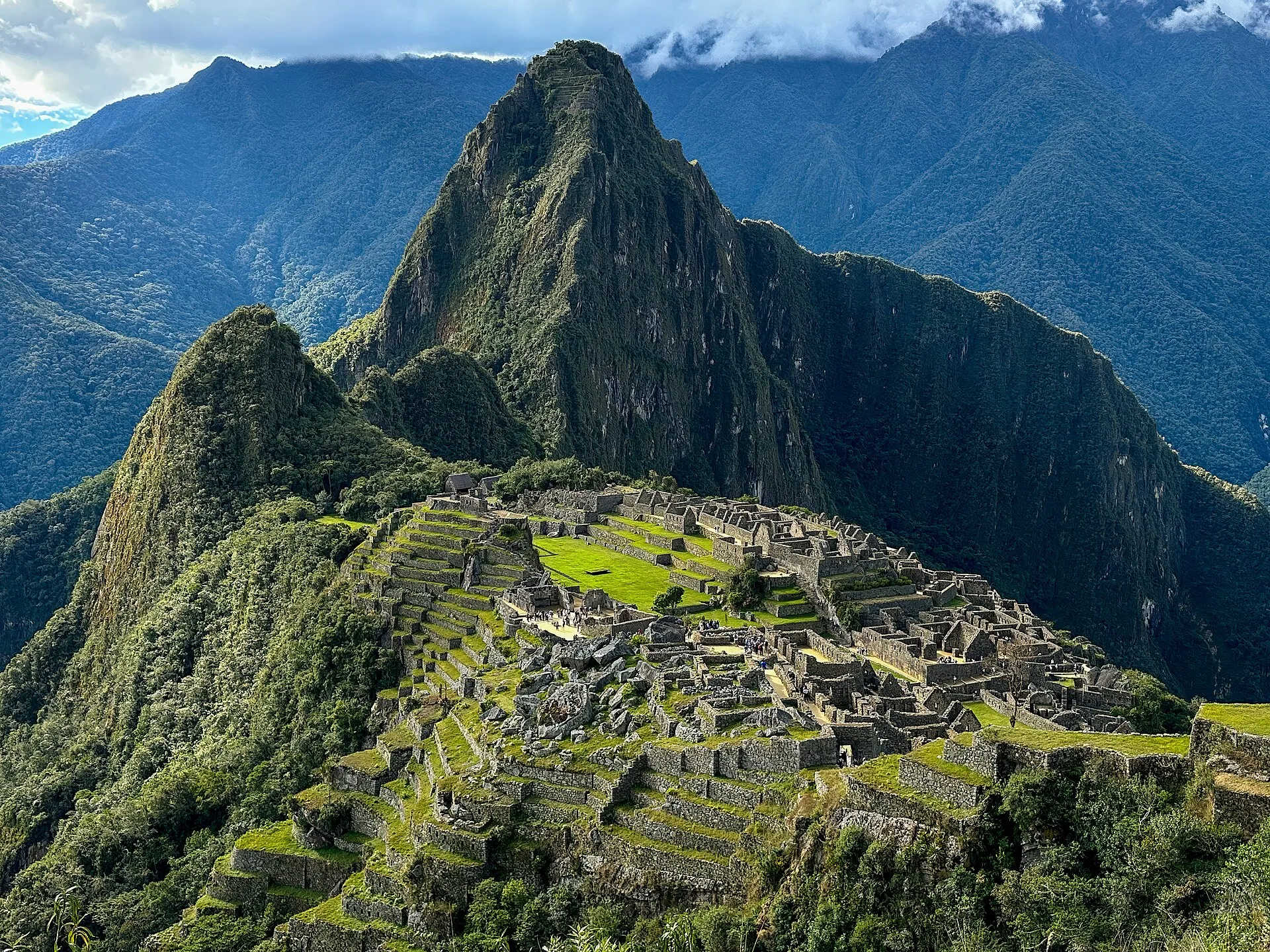
- 🌾 Agricultural terraces: Hundreds of stepped platforms held by retaining walls and back-filled with the layered drainage that keeps the site from sliding — the green foreground of the classic view.
- ⛩️ Inti Punku (Sun Gate): The original Inca Trail gateway on the ridge to the southeast, where trekkers get their first, mist-parting sight of the citadel at dawn.
Excavation History
Machu Picchu was never truly "lost." Local Quechua families farmed its terraces for generations, and in 1902 the Cusco muleteer Agustín Lizárraga climbed to the ruins and charcoaled his name on a temple wall — nine years before Hiram Bingham arrived. Bingham, a Yale historian hunting for Vilcabamba, the last Inca refuge, was led up on 24 July 1911 and grasped the scale of what the undergrowth was hiding. His 1911-1915 expeditions, backed by Yale and the National Geographic Society, cleared the site and shipped thousands of ceramics, bones, and metal objects to New Haven — artifacts Peru spent decades demanding back. Yale began returning them in 2011, and they are now displayed in the Casa Concha museum in Cusco.
The citadel still guards real mysteries. Its Inca name is uncertain — recent archival research argues the Inca themselves called it Huayna Picchu or simply Picchu, so "Machu Picchu" may be a modern label. Most scholars now read it, from a colonial-era land record, as the royal estate of Pachacuti built around 1450 — not the fortress, sun-temple, or Virgins of the Sun sanctuary that earlier writers imagined — yet why it was emptied within roughly a century, and whether smallpox, Inca civil war, or the Spanish conquest did it, is still debated. How the Inca quarried, dressed, and fitted its granite with only stone hammers and sand is reconstructed experimentally rather than known for certain. A DIRCETUR-licensed guide can separate what the record documents from what remains argued over.
When to Visit
Daily: 6 AM - 5:30 PM, entry only on a timed slot booked in advance. Best: the 6 AM slot for the sunrise mist and the thinnest crowds, though on rainy-season mornings the citadel can stay cloud-wrapped until mid-morning. Since 2024 the Ministry of Culture routes every ticket along one of three one-way circuits — an upper panoramic circuit for the classic postcard terrace view, a classic lower circuit through the temples and urban core, and a shorter royalty circuit — with no backtracking and no re-entry, so choose the circuit that matches what you most want to see. The add-on peaks sit on separate timed slots: Huayna Picchu (steep, exposed, ~1.5-2 hours, morning slots capped at 200 climbers each) and the higher but gentler Machu Picchu Mountain (~3 hours round trip). Plan 2-3 hours for the citadel itself. Dry season (May-September): clearest skies but heaviest demand — book 2-3 months ahead. Rainy season (November-March): afternoon showers and cloud, but greener terraces and lighter crowds; the classic Inca Trail closes every February for maintenance.
Admission and Costs
Entry ticket: S/152 ($41) for foreign adults and S/77 ($21) for foreign students with an ISIC card and children — bought online in advance through the official tuboleto.cultura.pe portal with a fixed date, circuit, and time. Machu Picchu + Huayna Picchu or + Machu Picchu Mountain: S/200 ($54) — the peak combinations sell out first. Licensed on-site guide: S/150-250 ($40-68) for a 2-hour tour, mandatory for groups and strongly advised for independent visitors. Train from Ollantaytambo to Aguas Calientes: S/200-800 ($54-216) round trip by class — Expedition, Vistadome, or the Hiram Bingham luxury service — on operators such as PeruRail. Shuttle bus Aguas Calientes to the gate: S/95 ($26) round trip, or a free but brutal 90-minute climb up roughly 1,700 stone steps. 4-day Inca Trail with a licensed operator: S/1,500-3,500 (~$400-950) all-inclusive.
The Case for a Guide
Machu Picchu is extraordinary without any explanation — but understanding which buildings were temples versus elite residences versus agricultural storehouses, and what the Intihuatana stone actually measured, requires a DIRCETUR-licensed guide who can read Inca architecture like a text.
- Intihuatana stone solar alignment: The carved granite pillar is positioned so that near the equinoxes the midday sun stands almost directly above it and the pillar casts virtually no shadow — a precise astronomical alignment achieved without instruments or written mathematics; guides demonstrate the geometry and explain what the Inca word inti-huatana (hitching post of the sun) reveals about how they conceptualized solar time.
- Urban vs. agricultural terrace function: The terraces are not all for farming — the upper terraces near the royal sector were ornamental and ceremonial, while the lower agricultural terraces used sophisticated hydraulic engineering to prevent the entire city from sliding off the ridge; guides identify the difference and explain the water-channeling system still functioning after 500 years.
- Which buildings were temples vs. homes: The Temple of the Sun, the Temple of the Three Windows, and the Intihuatana sector look similar to tourist eyes — guides identify each by the quality of the stonework (tighter joints indicate higher status), the orientation, and the presence of niches used for offerings versus storage.
- Llama symbolism in the city plan: Viewed from the Inti Punku sun gate on the Inca Trail, the entire city plan traces the silhouette of a llama — a sacred Inca animal whose constellation in the Milky Way the Inca tracked as carefully as European astronomers tracked their star patterns.
- Why Spain never found it: Machu Picchu sits below the sight lines of all the Inca road network's main routes, was deliberately concealed from Spanish pursuers after the 1572 fall of Vilcabamba, and was known only to local Quechua farmers until 1911 — guides explain the specific geography and political circumstances that kept it hidden for 350 years after the Conquest.
Tips for Visitors
Book everything early: entry tickets, Huayna Picchu and Machu Picchu Mountain slots, and Inca Trail permits sell out months ahead in peak season — reserve as soon as your dates are confirmed. Acclimatise in Cusco or the Sacred Valley first: the citadel (2,430 m) is actually lower than Cusco (3,400 m), but arriving altitude-sick will ruin the day — give yourself at least two days up high before you visit. Sleep in Ollantaytambo or Aguas Calientes to catch the first morning train or bus. Pack light and by the rules: the site bans large backpacks (over roughly 20 litres), tripods, drones, walking poles without rubber tips, and single-use plastics; there is no re-entry and the only toilets are outside the gate, so use them first. Bring your passport for the free Machu Picchu ink stamp at the entrance, plus water, sun protection, and a rain layer whatever the forecast. Above all, hire a DIRCETUR-licensed guide: the ruins are near-mute without one, and a good guide turns fitted stone into astronomy, hydraulics, and empire.
Frequently Asked Questions
What months give the best experience at Machu Picchu?
May through September is the dry season and the undisputed best window, offering clear mornings that reveal the iconic sunrise mist without the drenching rains that plague the wet season. June and July are the driest months but also the most crowded, so May and September offer a sweet spot of good weather with somewhat lighter visitor numbers. January through March is the wet season when trails turn muddy, clouds often obscure the ruins entirely, and the Inca Trail closes in February for maintenance.
What time of day is best for touring Machu Picchu?
Daily: 6 AM - 5:30 PM, with timed entry slots. Best: First entry slot (6 AM) for the famous sunrise mist and thinnest crowds. Huayna Picchu hike: Separate morning slots limited to 200 people each (book months ahead).
What is the entrance fee for Machu Picchu?
Entry ticket: S/152 ($41) foreign adults, S/77 ($21) foreign students and children — must be purchased online in advance with a fixed date, circuit, and time. Machu Picchu + Huayna Picchu or + Machu Picchu Mountain: S/200 (~$54) — sells out fastest.
How far in advance should visitors book tickets for Machu Picchu?
Book everything early: Entry tickets, Huayna Picchu slots, and Inca Trail permits sell out months ahead in peak season — book as soon as your dates are confirmed.
How do the visitor circuits work at Machu Picchu?
Since 2024 every ticket is tied to one of three one-way circuits, and you follow a fixed route with no backtracking and no re-entry. The upper "panoramic" circuit delivers the classic postcard view from the terraces; the "classic" lower circuit passes through the temples and urban core, including the Temple of the Sun and the Sacred Plaza; a shorter "royalty" circuit suits limited time or mobility. Choose your circuit when you buy, because you cannot switch on site.
Should I climb Huayna Picchu or Machu Picchu Mountain?
Both are separate timed add-ons booked with your entry ticket. Huayna Picchu is the sharp peak in the postcard behind the ruins — a steep, exposed 1.5-2 hour scramble on narrow Inca stairs, capped at 200 climbers per slot and usually sold out first. Machu Picchu Mountain is higher but a wider, gentler path of about 3 hours round trip, with sweeping views back over the whole citadel. Neither is advisable if heights make you nervous or you are not yet acclimatised.