

Overview
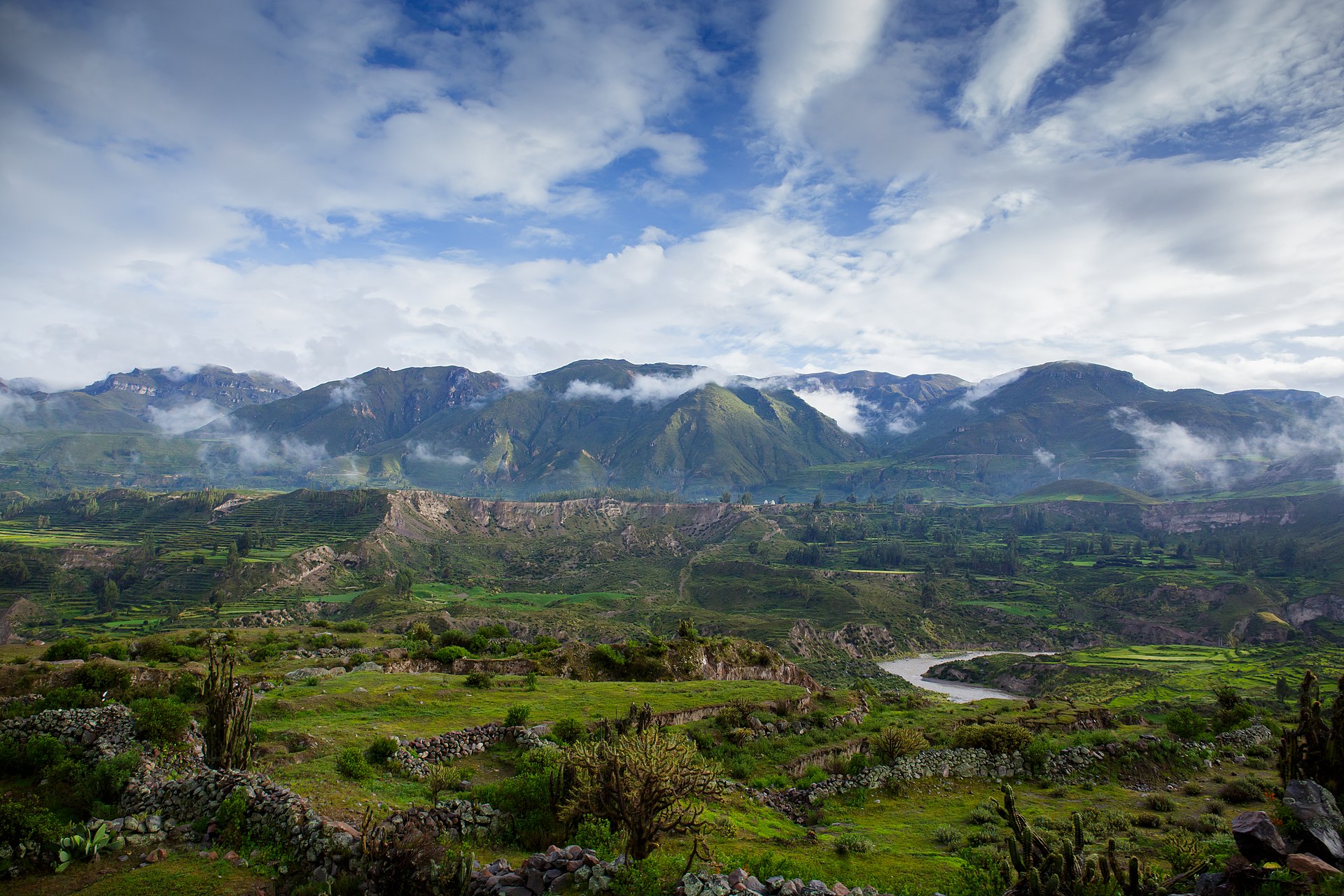
Colca Canyon plunges 3,400 meters from rim to river — making it roughly twice as deep as the Grand Canyon — yet it feels less like an abyss and more like a living, inhabited landscape. The canyon walls are carved into thousands of pre-Inca agricultural terraces, some still cultivated by Collagua and Cabana communities who have farmed these slopes for over a millennium. Villages with whitewashed churches and baroque bell towers dot the rim, and hot springs steam at the canyon floor where the Colca River cuts through volcanic rock. The signature experience is the Cruz del Cóndor viewpoint, where visitors gather at dawn to watch Andean condors — the world's largest flying birds, with wingspans reaching 3.2 meters — launch from their overnight roosts and ride the canyon's morning thermals in wide spirals that bring them level with the viewing platform. The spectacle lasts roughly an hour, with condors sometimes passing close enough to hear the air through their feathers. Beyond the viewpoint, the canyon offers multi-day trekking routes that descend to the Oasis (a green valley at the canyon floor), overnight stays in traditional villages, and soaks in the hot springs of La Calera near Chivay. Most visitors reach Colca Canyon on a 2-day trip from Arequipa, crossing a high pass at 4,910 meters where vicuñas graze on the altiplano and flamingos wade in high-altitude lagoons.
Trails
Cruz del Cóndor: Watch condors soar at eye level against a 3,400-meter canyon backdrop — one of the most thrilling wildlife encounters in South America. 4,910m pass: The drive from Arequipa crosses a high-altitude plateau with vicuñas, viscachas, and flamingos wading in shallow lagoons. Pre-Inca terraces: Agricultural terraces carved into the canyon walls over a thousand years ago, many still actively farmed by local communities. La Calera hot springs: Natural thermal pools near Chivay where you soak under the stars after a day of canyon exploration. Canyon villages: Yanque, Chivay, and Cabanaconde offer colonial churches, traditional festivals, and local cuisine including alpaca steak. Oasis trek: A challenging two-day descent to a palm-fringed valley at the canyon floor with swimming pools and basic lodges.
Wildlife
The Andean condor (Vultur gryphus) is the undisputed star of Colca Canyon — with a wingspan reaching 3.2 meters and weighing up to 15 kg, it is the largest flying bird in the Western Hemisphere. The Cruz del Cóndor viewpoint provides one of the most reliable condor-watching opportunities anywhere in their range, with birds riding the canyon's thermal updrafts most mornings between 8-10 AM. Beyond condors, the canyon ecosystem supports Andean foxes (culpeos), which are occasionally spotted at dawn near the rim; viscachas (Andean relatives of chinchillas) sunning on rocks near the viewpoints; and herds of wild vicuñas — the undomesticated relatives of llamas — grazing on the high-altitude grasslands above 4,000m on the drive from Arequipa. Birdwatchers should look for giant hummingbirds (the world's largest hummingbird species), Andean ibis, and puna ibis along the canyon rim, and Andean flamingos at the high-altitude lagoons near the Patapampa pass.
When to Visit
Cruz del Cóndor: Best between 8-10 AM when thermals are strongest and condors most active. Dry season (May-November): Clearest skies, best condor viewing, ideal for trekking. Wet season (December-April): Greener terraces but cloud cover can obscure the condors. Duration: 2-day/1-night trip minimum from Arequipa; 3 days for trekking to the Oasis.
Admission and Costs
Canyon entry ticket: S/70 ($19) — purchased at the Chivay checkpoint. Group 2-day tour from Arequipa: S/200-400 ($54-108) including transport, guide, and one night. Private 2-day tour: S/500-1,000 ($135-270) with flexible itinerary. 3-day trekking trip (to Oasis): S/300-600 ($80-162) per person including meals. La Calera hot springs: S/15 (~$4) entry.
Tips for Visitors
Early start: Most 2-day tours leave Arequipa at 3 AM to reach Cruz del Cóndor by dawn — bring warm clothing for the predawn cold. Altitude preparation: The drive crosses 4,910m — if you haven't acclimatized, take altitude medication and drink coca tea at the Chivay hotel. Stay overnight: Day trips from Arequipa exist but are exhausting (7-hour round drive); a 2-day trip lets you enjoy the hot springs and morning condors properly. Condor season: Condors are visible year-round, but dry season (June-September) offers the best viewing with clearer skies and stronger thermals. Trek fitness: The Oasis trek involves a steep 1,200m descent and a punishing climb back up — start the return climb before dawn when temperatures are cooler. Combine with Santa Catalina: Do the monastery the day before Colca — it makes a perfect contrast between urban refinement and raw natural grandeur.