
Bryggen Wharf timeline
-
Waterfront trading begins
When Bergen was founded under King Olav Kyrre, merchants began mooring and trading along the sheltered eastern shore of the Vågen harbour, the exact strip of quay where Bryggen still stands.
-
Hanseatic Kontor established
German merchants of the Hanseatic League formalised their Bergen office (the Kontor), making the wharf one of the League's four great overseas trading stations.
-
Great fire and rebuild
The most destructive of Bergen's many fires levelled the wharf; the merchants rebuilt at once on the identical medieval plots, fixing the street plan visitors walk today.
-
Kontor dissolved
The Hanseatic Kontor was wound up and replaced by the Norwegian-run Kjøpmannskontor, which carried the stockfish trade forward under local ownership.
-
Hanseatic-era trade ends
The last of the old trading offices at Bryggen closed, ending more than five centuries of continuous mercantile use rooted in the medieval system.
-
Fire exposes medieval layers
A fire destroyed the northern tenements, and the salvage excavation that followed uncovered the runic inscriptions and timber foundations now central to Bryggens Museum.
-
Inscribed by UNESCO
Bryggen entered the UNESCO World Heritage List as the best-preserved relic of the Hanseatic League's northern trading world.
Architecture
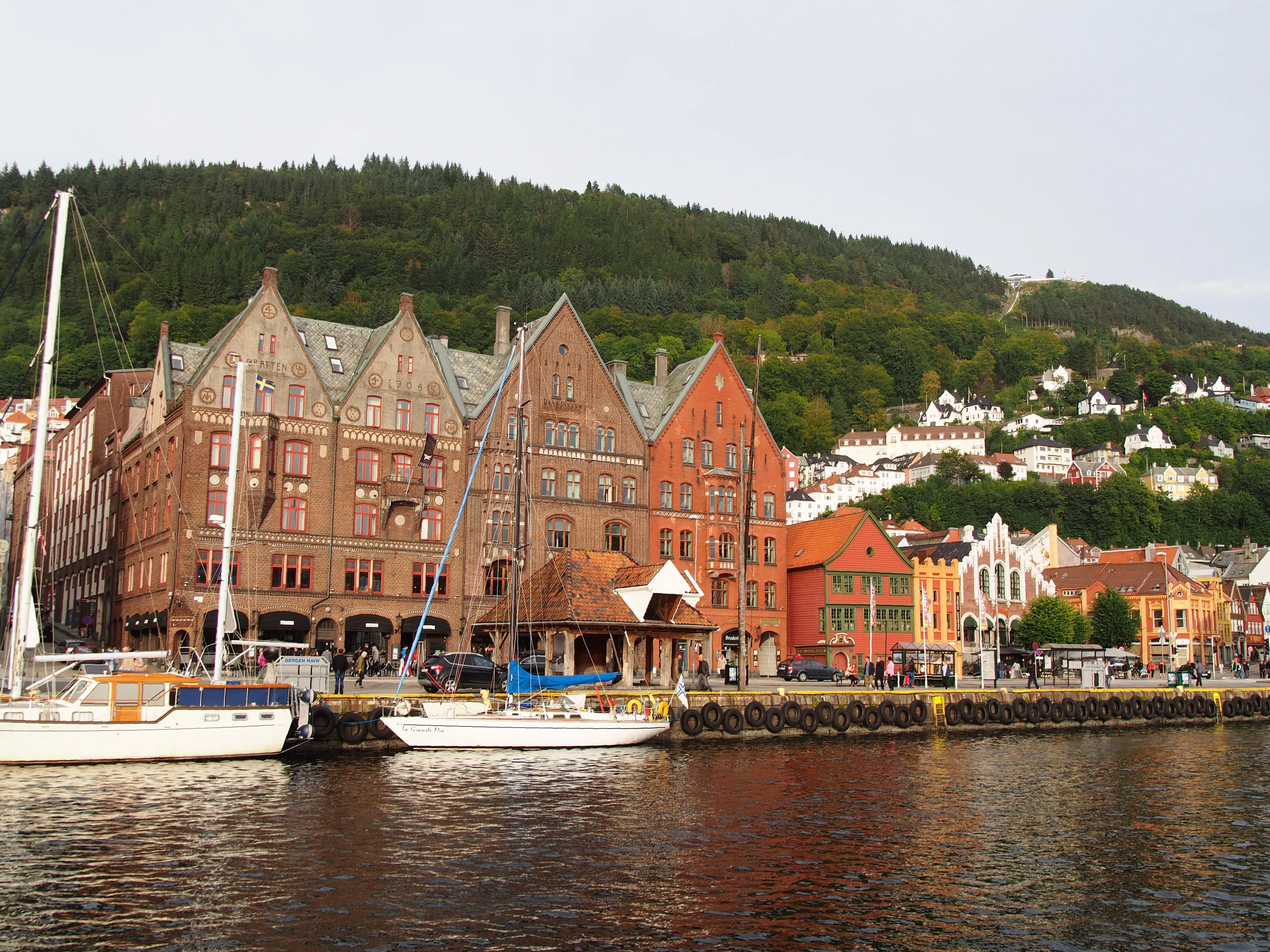
Bryggen is not a terrace of houses but a chain of tenements — long, narrow properties known as gårder, each a double row of gabled timber buildings facing one another across a covered wooden passage. Individual gårder still carry their historic names: Bellgården, Jacobsfjorden, Svensgården, Bugården, and the Enhjørningsgården ("the Unicorn"), whose facade is crowned by a gilded unicorn figurehead that is among the wharf's most photographed details. Roughly 62 buildings survive today — about a quarter of the pre-1900 wharf — standing on the same plots that have defined the frontage since the Middle Ages.
The construction logic is governed entirely by trade and by fire:
- Timber, jettied for storage. Each row rises two to three storeys in notched-log and post-and-plank timber, the upper floors jettied out over the passage to shelter goods and gain volume, with external stair-galleries (svalganger) threading the inner yards.
- Stone cellars at the water. Vaulted stone cellars at the harbour end held the driest, most valuable stock, closest to the loading quay.
- Fire kept at arm's length. No open flame was permitted among the tenements; the merchants' only heated rooms, the communal assembly halls called schøtstuene, stood apart at the rear near St Mary's Church (Mariakirken) — a deliberate firebreak still legible in the plan of the site.
For photographers, the classic frame is the full run of pointed gables mirrored in the still water of Vågen, best caught in the low golden light of a summer evening; the tilted timber corridors, shot end-to-end, are the other signature composition. For a wider angle that sets the whole colourful frontage against the harbour, cross the bay toward Bergenhus Fortress, or ride the Fløibanen funicular for the bird's-eye view down onto the gable roofs.
Historical Significance
Bryggen's importance is inseparable from the Hanseatic League, the confederation of German merchant towns that dominated northern European commerce for four centuries. Bergen held one of the League's four principal overseas Kontors — the others were at London, Bruges, and Novgorod — making the wharf the westernmost hinge of a network that moved goods from the Arctic to the Mediterranean. From Bryggen the Germans controlled the export of Norwegian stockfish (tørrfisk): air-dried cod carried down from the Lofoten islands and traded on for the grain, malt, cloth, and wine that Norway's terrain could not yield.
The wharf ran as a closed male society. Journeymen and apprentices lived, ate, and slept in the tenements under the Kontor's own law — forbidden to marry locally or to trade on their own account — a near-monastic commercial discipline sustained across generations. This separateness, a German town operating inside the Norwegian one, is precisely what UNESCO recognised in judging Bryggen the surviving embodiment of that vanished world:
Bryggen, the old wharf of Bergen, is a reminder of the town's importance as part of the Hanseatic League's trading empire from the 14th to the mid-16th century.
— UNESCO World Heritage Centre, which inscribed the site in 1979.
The archaeological record beneath the boards deepens the story. The salvage digs that followed the 1955 fire yielded more than 600 medieval runic inscriptions — business notes, name tags, prayers, and even love messages scratched into wood — a find that reshaped historians' understanding of everyday literacy in medieval Scandinavia. Many are displayed a few steps from the passages at Bryggens Museum, built directly over the excavated foundations.
When to Visit
The exterior and passages of Bryggen are freely accessible at all hours — the harbour frontage faces west and catches the afternoon light in summer, while the narrow inner passages are atmospheric at any time of day. Individual shops, galleries, and restaurants inside Bryggen typically open at 10 AM and close at 6–8 PM (later in summer); some restaurants stay open until 10–11 PM. The Bryggens Museum (adjacent, to the south) is open daily 10 AM–4 PM (extended to 5 PM in summer). The Hanseatic Museum inside a historic Bryggen building is open Tuesday to Sunday; check current hours as it has undergone renovation. Allow 1.5 to 2 hours for a thorough exploration of the passages, exterior, and one museum.
Admission and Costs
Walking through Bryggen's passages: Free. Bryggens Museum: NOK 120 adults. Hanseatic Museum: NOK 110 adults (verify current status after renovation). Private guided tour of Bryggen (1.5–2 hrs): NOK 1,500–2,500 for groups of up to 6. Group walking tours from Bergen's tourist office: NOK 250–400 per person. The Bergen Card covers both museums and the Fløibanen funicular — worth buying for any visit of more than one day, especially if you are also touring Bergenhus Fortress across the bay.
The Case for a Guide
Bryggen is a place where the visual impact is immediate — the colourful facades and tilted gables are among the most photographed images in Norway. A guide reveals the commercial, political, and social history that those facades conceal.
- The Hanseatic system decoded: The League's trading monopoly, the social isolation of German merchants within Bergen, and the mechanisms by which dried cod reached every Catholic table in Europe during Lent — a guide turns economic history into a compelling human story, explaining why Norwegian fishermen were paid in foreign currency they couldn't spend locally.
- Reading the building rows: Each row at Bryggen has a specific structure — harbour frontage with overhanging first floor, inner yard with storage building, passage connecting them — that reflects the specific functions of the trade. A guide walks you through this logic in the actual space, making the architecture legible.
- The fires and the continuity: The story of how merchants rebuilt on the same footprint after each catastrophic fire — not from sentiment but because the tomter (building plots) had economic and legal value regardless of what stood on them — reveals the deep commercial logic underpinning what looks like organic historical growth.
- The archaeological layers: The Bryggens Museum holds extraordinary objects excavated from beneath the current buildings — a medieval shoe, a carved runestick with a love message, a 12th-century chess piece — that a guide uses to populate the abstract history with specific individuals.
- Bergen's contested identity: The tension between the Norwegian city and the German trading community it hosted for four centuries has left traces in Bergen's language (Bergensian dialect contains Low German loan words), its street names, and its civic psychology. A guide from Bergen makes this cultural inheritance personal.
Tips for Visitors
Visit the inner passages before 10 AM in summer to experience them without the midday crowds. The north end of the Bryggen row (furthest from the fish market) is the least visited section and contains some of the most structurally original buildings. Rain is no obstacle — the passages are sheltered overhead where the upper floors extend over the paths. The fish market (Fisketorget) is a 5-minute walk south along the harbour; combine both in a morning, then continue to the lower station of the Fløibanen funicular a few steps further on. Bergenhus Fortress sits a 5–10 minute stroll north around the quay, making an easy pairing with Bryggen for a single morning of medieval Bergen. In December, the area around Bryggen hosts one of Norway's most atmospheric Christmas markets. The leaning of the buildings — caused by centuries of foundation settlement in the filled harbour ground — is most visible when you stand at the end of a passage and look down its length.
Frequently Asked Questions
When was Bryggen added to the UNESCO World Heritage List?
Bryggen was inscribed on the UNESCO World Heritage List in 1979, making it one of the earliest Norwegian cultural sites to receive international recognition. UNESCO cited its significance as the best-preserved example of the Hanseatic League's trading architecture in Scandinavia. The Hanseatic merchants who operated from Bryggen controlled the North European dried cod trade for over 400 years, and the buildings' layout — long parallel rows of trading halls and living quarters separated by narrow passages — directly reflects the commercial organisation of that trade.
How old are the current Bryggen buildings?
Bryggen has occupied the same waterfront position since King Øystein established a trading wharf here around 1070 CE, but the specific buildings standing today mostly date from after the great fire of 1702. Bergen burned repeatedly — at least seven major fires swept the wharf between the 14th and early 20th centuries — and each time the merchants rebuilt on precisely the same medieval footprint, preserving the street layout and building orientation that the UNESCO inscription now protects. Beneath the current structures, archaeological excavations have uncovered medieval layers going back to the 12th century.
What is inside the Bryggen buildings today?
The ground floors of many Bryggen buildings now house artisan workshops making traditional Norwegian crafts — rosemaling painted goods, leather work, silver jewellery, and knitwear. Upper floors contain galleries, small boutiques, and several well-regarded restaurants and cafés, including the historic Bryggen Tracteursted that has operated in the same building since the 18th century. The Bryggens Museum adjacent to the main row displays the remarkable archaeological finds from excavations beneath and around the wharf, including medieval runes, leather goods, and structural timbers from 12th-century buildings.
Is it safe to walk through the passages between the Bryggen buildings?
Yes — the narrow passages (almenningene) between the parallel rows of merchant buildings are freely accessible on foot and form the most atmospheric part of the visit. The passages were the functional streets of the medieval trading community, and walking them gives a physical sense of the compressed, semi-secretive world that the Hanseatic merchants inhabited — essentially a German town within the Norwegian city, operating under its own rules. The buildings lean noticeably in various directions from centuries of foundation settlement; some have been reinforced with modern structural supports, but the character is wholly original.