
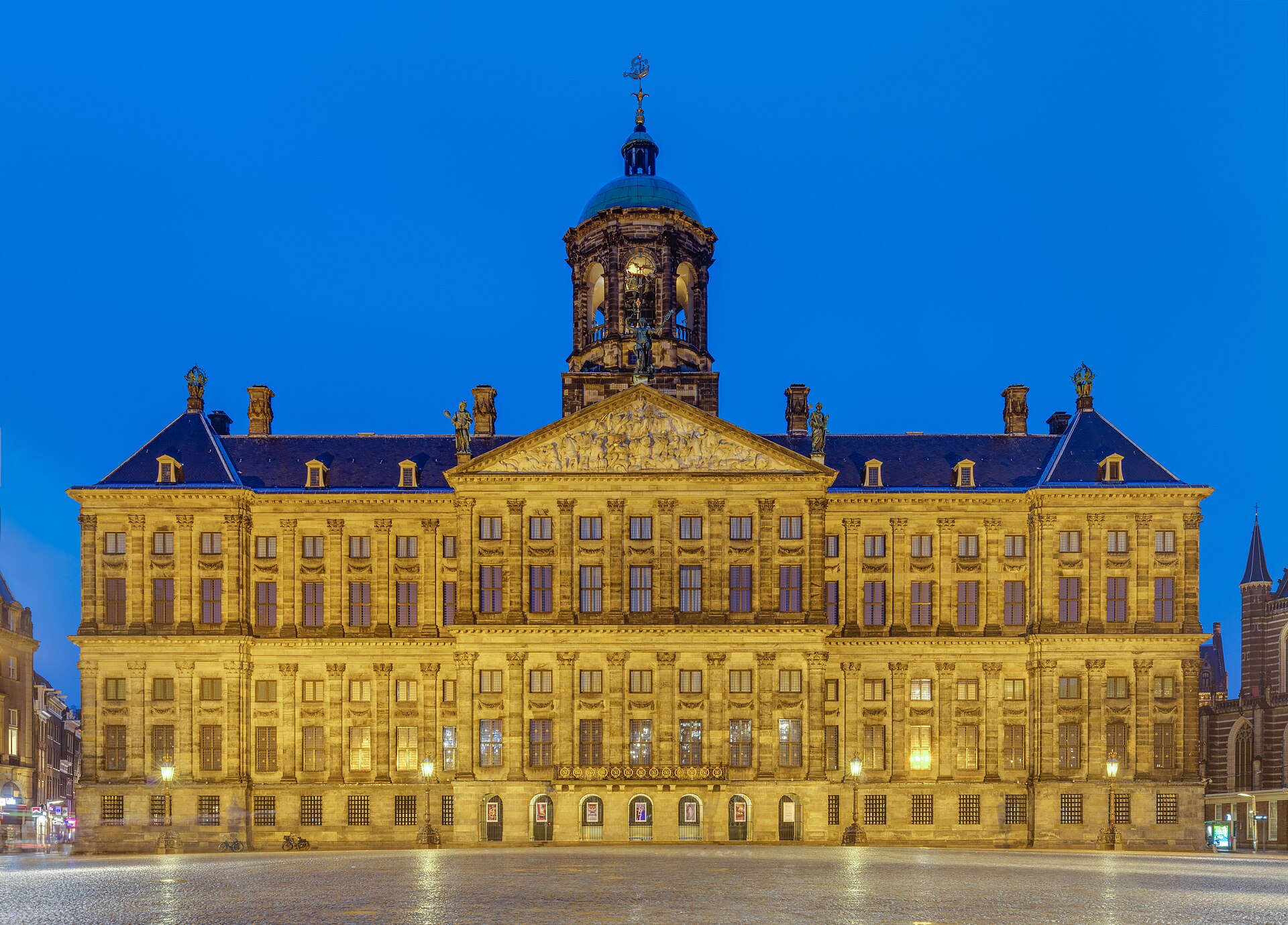

Overview
When Amsterdam's city fathers commissioned a new town hall in 1648, they were celebrating the end of the Eighty Years' War and the birth of the Dutch Republic as a sovereign nation. Architect Jacob van Campen delivered a building that deliberately eclipsed every royal palace in Europe — not for a king, but for a city of merchants who considered themselves the equal of any monarch. The Citizens' Hall at its center, floored with marble maps of the world, announced Amsterdam's commercial reach across the globe. Sculptures by Artus Quellinus decorate virtually every surface, depicting classical allegories of justice, peace, and prudence that reflected the Republic's self-image.
Napoleon converted it to a royal palace in 1808 when he installed his brother Louis as King of the Netherlands, and it has remained in royal possession since, though the Dutch monarchs have never lived here — they prefer The Hague's more intimate Huis ten Bosch. The palace sits on Dam Square, Amsterdam's ceremonial heart, resting atop 13,659 wooden piles driven into the marshy ground (a fact every Dutch schoolchild learns). It opens to visitors when not in use for state functions — inaugurations, New Year's receptions, and diplomatic events still take place in the same marble halls. Inside, the scale impresses even visitors who've toured Versailles: the Citizens' Hall occupies the entire central volume of the building, its ceiling paintings by Ferdinand Bol and Govert Flinck (Rembrandt's students) depicting Amsterdam receiving the tributes of the world. A guide who understands Dutch Republic politics explains why this building matters beyond its aesthetics — it embodies an era when a republic of traders created the world's first stock exchange, first multinational corporation, and this city hall that dared monarchies to match its grandeur.
Architecture
Citizens' Hall: The enormous central hall features marble floor maps showing the Eastern and Western hemispheres — Amsterdam placed at the center, naturally — flanked by ceiling paintings glorifying the city's global dominion. Tribunal Chamber: Where sentences were pronounced, including death sentences carried out on the scaffold outside. The sculptural program here depicts the Judgment of Solomon — a pointed message to judges about wisdom. Gallery Paintings: Works by Rembrandt's students Ferdinand Bol and Govert Flinck fill the galleries — Rembrandt himself was originally commissioned but much of his contribution was replaced after disagreements. Empire Furniture: Napoleon furnished the palace with French Empire pieces when his brother ruled — these furnishings remain, creating an intriguing French layer atop a Dutch Republican building. 13,659 Piles: The entire building rests on wooden piles driven through Amsterdam's soft peat into the firm sand layer below — a feat of 17th-century engineering visible in cross-section displays.
Historical Significance
The Royal Palace embodies the audacity of the Dutch Golden Age — a city hall built to surpass every royal palace in Europe by a republic that had no king. The Citizens' Hall marble floor maps placed Amsterdam at the center of both hemispheres, a visual claim to global commercial dominance that was, in 1648, literally true. Artus Quellinus's sculptural program across the building's facade and interior represents one of the most ambitious decorative schemes in Northern European Classicism. The conversion from city hall to royal palace under Napoleon in 1808 marks a pivotal shift in Dutch governance — from merchant republic to monarchy — that the building's architecture makes visible. Today the palace still hosts state functions including royal inaugurations, connecting eight centuries of Dutch governance to a single building on Dam Square. Combine with the Rijksmuseum to see how the same Golden Age prosperity produced both civic architecture and the art collection that defines Dutch cultural identity.
When to Visit
Open: Tuesday-Sunday 10:00-17:00 (closed Mondays; closed during state events — check the official website). Best: Mid-morning on weekdays when tour groups haven't yet arrived. Closures: The palace closes without notice for royal events — always verify before visiting. Allow: 1-1.5 hours for the full audio-guided experience.
Admission and Costs
General admission: €12.50 adults; free for under 18. Audio guide: Included with admission (available in multiple languages). Guided tours: Group tours occasionally offered; check the schedule — otherwise book an independent guide for €100-180 for a combined Dam Square and palace visit.
Tips for Visitors
Check opening status: State events close the palace without much advance notice. The official website posts closures, but schedules change — call ahead if your visit depends on it. Audio guide is worthwhile: The included audio tour provides essential context for the allegorical sculptures and paintings that would otherwise appear as generic classical decoration. Dam Square context: Spend time on the square before entering. The National Monument (WWII memorial), Nieuwe Kerk (exhibition space), and the surroundings provide context for this civic heart. Combine with Jordaan: A 10-minute walk west from Dam Square reaches the Jordaan neighborhood — a natural contrast between mercantile grandeur and everyday Amsterdam life. Photography: Allowed throughout the building without flash. The Citizens' Hall is best captured from the mezzanine level for full perspective.