
Tips for Visitors
Dawn kora: The best single experience at Boudhanath is joining the pre-dawn kora at around 5:30 AM when the crowd is genuinely devotional — monks completing multiple circuits, elderly Tibetan women spinning prayer beads, juniper incense smoke rising in the early light. Café views: Multiple rooftop cafés around the stupa perimeter offer elevated views across the dome and the mountains beyond — try Stupa View Restaurant for morning chai with mountain backdrop on clear days. Clockwise only: Never walk counter-clockwise on the kora circuit. Combine with: Pashupatinath Temple is 2 km south — the standard Kathmandu morning pairs both sites to contrast Hindu and Buddhist practice side-by-side. Festival timing: Losar (Tibetan New Year) transforms the entire Boudhanath area for two weeks — worth planning a visit around if your travel dates are flexible.
When to Visit
Stupa complex: Daily 5 AM – 9 PM. Dawn kora: The pre-dawn circumambulation of monks and residents (approximately 5–7 AM) is the most spiritually concentrated time — candles, burning juniper incense, and the chanting of mantras. Losar (Tibetan New Year): Late January/February — two weeks of festival ceremonies, the best period for cultural immersion. Evening: The illuminated dome after dark is dramatic from the upper café terraces.
Admission and Costs
Foreign visitor entry: NPR 400 (approximately $3). Inner monastery visits: Many gompas are open to respectful visitors; small donations appropriate. Guided visit: Part of a Kathmandu Valley day tour from any licensed guide.
The Case for a Guide
Boudhanath can be experienced independently, but its iconographic depth and the monastic community's rhythms are vastly richer with guidance.
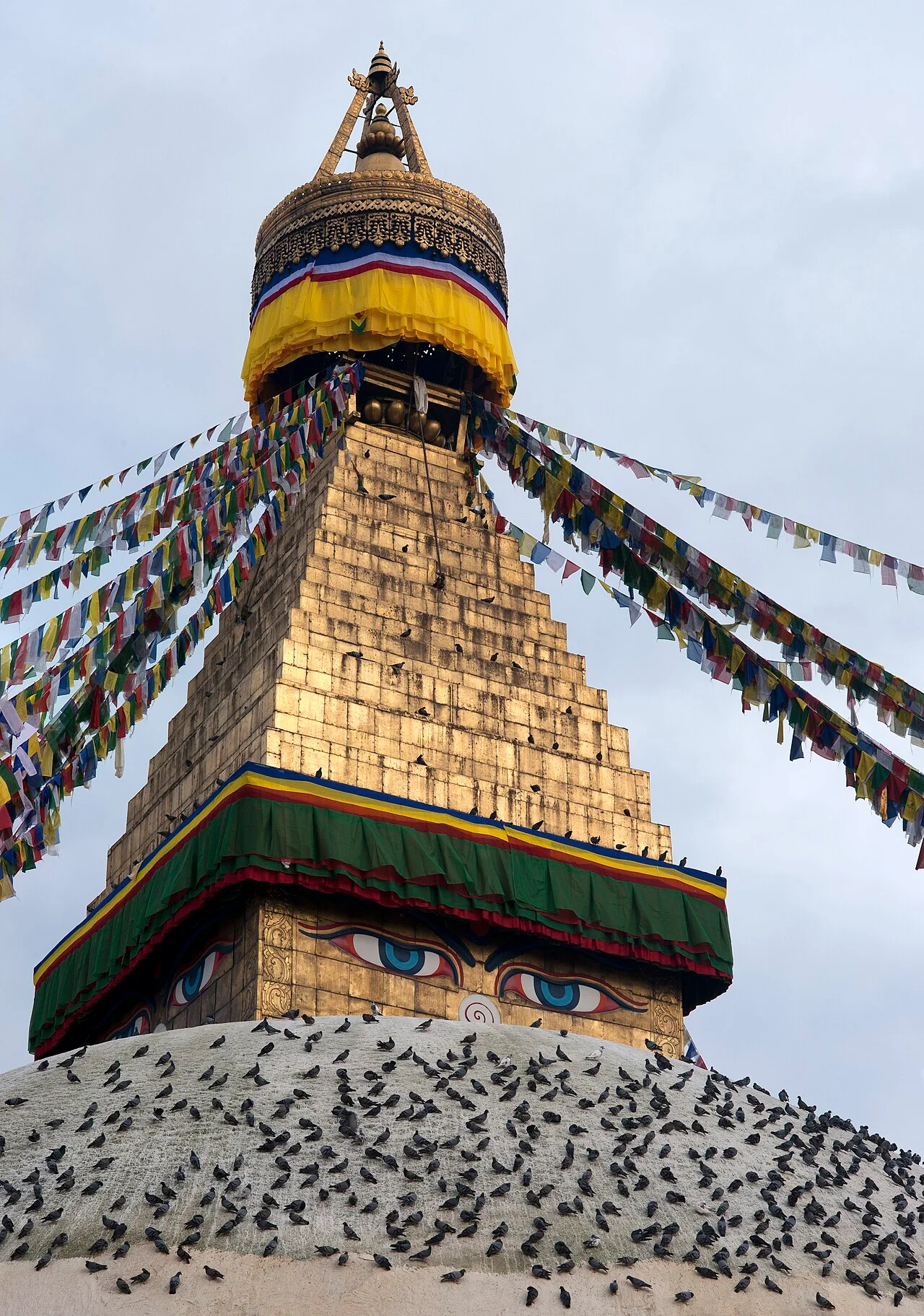
- Stupa symbolism layer by layer: The guide explains each structural element — plinth, dome, harmika, spire, parasol — and its corresponding cosmological meaning, turning what looks like a large white dome into a complete three-dimensional map of Buddhist cosmology
- Prayer wheel activation: The 147 prayer wheels around the base each contain printed mantras; a guide explains the significance of spinning them (releasing the mantra into the world), the specific mantra most commonly used (Om Mani Padme Hum), and why clockwise direction matters
- Monastery selection: With 50+ gompas surrounding the stupa, a guide introduces you to one or two monasteries at specific times (morning puja around 6 AM, evening puja around 5 PM) for genuine observation of Tibetan Buddhist ritual rather than aimless wandering
- 2015 earthquake and restoration: The restoration story — how the spire was disassembled and rebuilt using both traditional techniques and modern engineering support — is a recent and moving chapter in the stupa's history that a guide explains in context
Frequently Asked Questions
How old is Boudhanath Stupa?
The exact founding date of Boudhanath is debated. Nepali chronicles place its construction in the 5th or 14th century CE, while some accounts connect it to the Licchavi period (400–750 CE). What is certain is that Boudhanath was an established pilgrimage site on the Tibet-to-India trade and pilgrimage route well before the medieval period, and has been continuously maintained for at least 1,500 years. UNESCO inscribed it as a World Heritage Site in 1979. The stupa was partially damaged in the 2015 earthquake and restored to its present form by 2016.
What is the kora and how do you do it correctly?
The kora is the practice of circumambulating a sacred site — in this case, walking around the entire base of the stupa in a clockwise direction while spinning prayer wheels, reciting mantras, and performing prostrations. At Boudhanath, the kora circuit around the base of the stupa is approximately 400 metres per loop. The clockwise direction is essential — circumambulating counter-clockwise is considered spiritually incorrect in Tibetan Buddhism. Monks and residents typically complete multiple circuits; visitors are welcome to join the flow and walk one complete kora.
What do the eyes painted on the Boudhanath spire mean?
The large painted eyes on the four sides of the Boudhanath spire (harmika) are the Eyes of the Buddha — specifically, the eyes of Wisdom (jnana). They gaze in all four cardinal directions, symbolizing the Buddha's all- seeing wisdom. The question-mark shape between the eyes is a nose in the Nepali numeral form representing one — symbolizing the one path to enlightenment. The thirteen rings on the spire above represent the 13 stages of enlightenment, with the parasol at the very top representing sovereignty over suffering.