
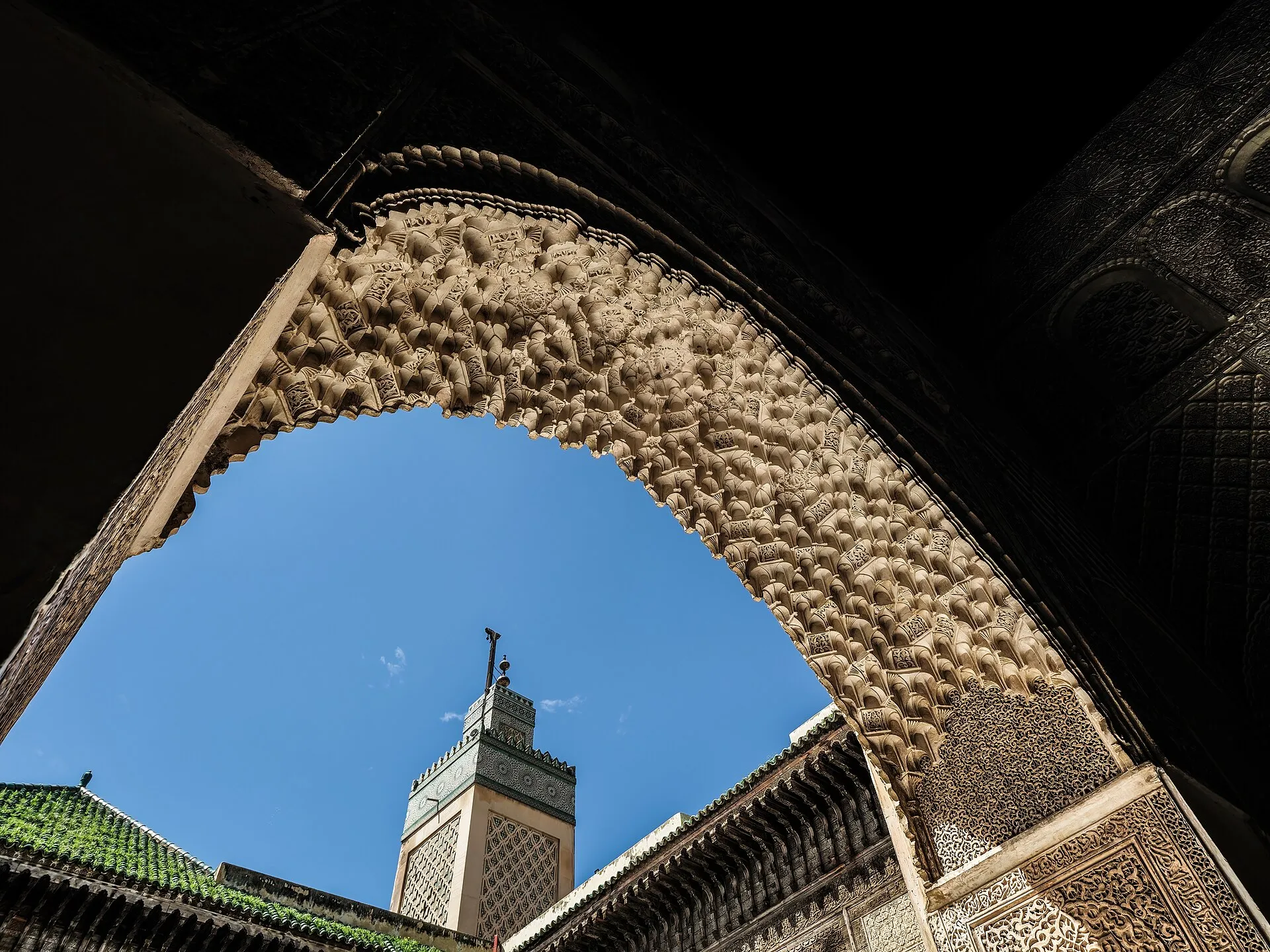
Visitor Etiquette
Bou Inania is one of the very few madrasas in Morocco that also functions as an active mosque with a minaret — visitors should be aware that the call to prayer occurs five times daily and that access to certain interior areas may be temporarily restricted during prayer times. Remove shoes before stepping onto the courtyard carpet or prayer areas. Non-Muslim visitors are generally welcome to view the courtyard and its decoration, but entry into the prayer hall itself may be restricted depending on the time of day. Dress conservatively — covered shoulders and knees — throughout the medina, and especially inside the madrasa. The upper student cells visible from the courtyard are not open to visitors; do not attempt to access them. Photography of the intricate zellige, carved stucco, and cedarwood is permitted in the open courtyard areas, but refrain from photographing worshippers or during prayer. Speak quietly and move at a measured pace — the narrow courtyard echoes and loud voices carry disruptively through the space. The entrance fee (30 MAD for non-residents at time of publication) is collected at the door.
Spiritual Significance
Sultan Abu Inan Faris built Bou Inania as a theological school whose students were expected to memorize the entire Quran, master Islamic jurisprudence (fiqh), and study the traditions of the Prophet (hadith) — an education understood not as intellectual achievement but as preparation for a life of religious service. When the Sultan reportedly threw the construction accounts into the river declaring that beauty transcends accounting, he was articulating a theological position: that expenditure in service of God's worship falls outside the ordinary calculations of human prudence. The school's unique status as both a madrasa and a congregational mosque with its own minaret reflects the Marinid dynasty's ambition to make Bou Inania a complete spiritual community in itself — students could study, pray, perform ablutions, and hear the call to prayer without leaving the building. The Quranic calligraphy carved into the stucco bands is not decoration in the Western sense but sacred text made architectural: the same words that students memorized internally were inscribed externally around them, so that the building itself was the book. The ablution fountain at the courtyard's center embodies the Islamic theology of tahara (ritual purity) as a precondition for prayer: the water that purifies the worshipper before approaching God flows at the physical and symbolic heart of the space.
Bou Inania Madrasa timeline
- 1351-1356
Sultan Abu Inan Faris builds the madrasa
The Marinid ruler commissions the college on Talaa Kebira, sparing no expense on zellige, carved stucco, and cedar; it is the only Fez madrasa given a full minaret and congregational Friday-mosque status.
-
The Dar al-Magana water clock is installed
A hydraulic clock of twelve brass bowls and carved wooden platforms is set into the wall directly across Talaa Kebira, facing the madrasa; its exact mechanism is still debated by historians.
-
Death of Abu Inan Faris
The sultan who reportedly threw the construction accounts into the river dies two years after completion, leaving Bou Inania as the architectural high point of Marinid Fez.
-
The Fez medina joins the UNESCO World Heritage List
Bou Inania is inscribed as part of the Medina of Fez (Fes el Bali), recognized among the finest surviving works of Marinid craftsmanship.
- Today
A living monument on the medina's main street
Restored and open to visitors, it is one of the few Fez madrasas non-Muslims can fully enter, while the prayer hall still hosts Friday services.
When to Visit
Hours: Daily 9:00 AM - 5:00 PM (closed during Friday midday prayers). Prayer closure: Brief closures during the five daily prayers; guides time visits between them. Best time: 9:00-10:00 AM when morning sunlight illuminates the courtyard's zellige and the crowds are thin. Avoid: Midday during the peak tour bus window (11 AM - 1 PM). Allow: 30-45 minutes with a guide for a proper appreciation.
Admission and Costs
Admission: 30 MAD (€2.80) per person. Private guide for the madrasa: 200-400 MAD (€18-37) for a focused 30-45 minute tour. Included in medina walking tours: Most half-day and full-day Fez guides include Bou Inania as a standard stop. Islamic art specialist: 800-1,400 MAD (€74-130) for a tour connecting Bou Inania, Attarine, and Al-Qarawiyyin.
The Case for a Guide
Bou Inania rewards interpretation more than almost any single room in Fez: unguided, most visitors spend five minutes photographing the courtyard and walk out having missed the entire theological program carved into its walls. A licensed guide earns the 200-400 MAD fee here by making the surfaces legible:
- Reading the Kufic and cursive Quranic inscriptions band by band, so the carved stucco stops being abstract pattern and becomes text you can follow.
- Explaining the darj-w-ktaf and sebka motifs that tie this courtyard to the Alhambra and to Marinid work across the Fes el Bali medina.
- Timing your entry around the five daily prayers, when the prayer hall closes to non-Muslim visitors.
- Pointing out the Dar al-Magana water clock across Talaa Kebira — the kind of detail you walk straight past without someone to name it.
- Sequencing Bou Inania with Al-Qarawiyyin and the Attarine Madrasa so the three read as one intellectual golden-age story rather than three disconnected stops.
Tips for Visitors
Located on Talaa Kebira: The madrasa sits on Fez's main thoroughfare, making it an easy first stop on a medina tour from Bab Boujloud. Photography: Allowed inside the courtyard; the best light is mid-morning when the sun reaches the zellige walls. Shoes off: Remove shoes at the entrance (this is both a madrasa and an active mosque). Look up: The most intricate details are on the upper walls and ceiling; bring binoculars if you are serious about art history. Brief but essential: Do not skip this because it is small; 30 concentrated minutes here outweigh hours at lesser sites.
Frequently Asked Questions
During which season does Bou Inania Madrasa look its finest?
Spring (March through May) and autumn (September through November) offer the best combination of comfortable walking weather and beautiful light on the zellige tilework and carved stucco. Mid-morning sunlight reaches the courtyard walls during these months at exactly the angle that makes the geometric mosaics shimmer. Peak summer turns the medina into a furnace, while winter brings shorter days and occasional rain that dims the courtyard's natural illumination.
What are the sightseeing hours at Bou Inania Madrasa?
Hours: Daily 9:00 AM - 5:00 PM (closed during Friday midday prayers). Prayer closure: Brief closures during the five daily prayers; guides time visits between them.
Are there any costs associated with visiting Bou Inania Madrasa?
Admission: 30 MAD (€2.80) per person. Private guide for the madrasa: 200-400 MAD (€18-37) for a focused 30-45 minute tour. Included in medina walking tours: Most half-day and full-day Fez guides include Bou Inania as a standard stop.
What should visitors know before visiting Bou Inania Madrasa?
Located on Talaa Kebira: The madrasa sits on Fez's main thoroughfare, making it an easy first stop on a medina tour from Bab Boujloud. Photography: Allowed inside the courtyard; the best light is mid-morning when the sun reaches the zellige walls.
Can non-Muslims go inside Bou Inania Madrasa?
Yes. Bou Inania is one of the very few working religious buildings in Fez that non-Muslims may fully enter, which is exactly why it is such a rewarding stop. You can walk the marble courtyard and study the zellige, carved stucco, and cedar from close range. Access to the prayer hall itself is restricted around the five daily prayers and during Friday congregational services, so guides time entry between prayers. This openness sets it apart from Al-Qarawiyyin, whose prayer hall stays closed to non-Muslims year-round.
How long should you spend at Bou Inania Madrasa?
Budget 30 to 45 minutes. The building is compact, but the detail rewards slow looking: allow time to trace the Quranic calligraphy band by band, examine the carved cedar upper walls, step across Talaa Kebira to view the Dar al-Magana water clock, and photograph the courtyard in mid-morning light. A visit with a guide runs to the longer end because they make the surfaces legible; a quick unguided look can be done in 15 minutes.