
.jpg)
Overview
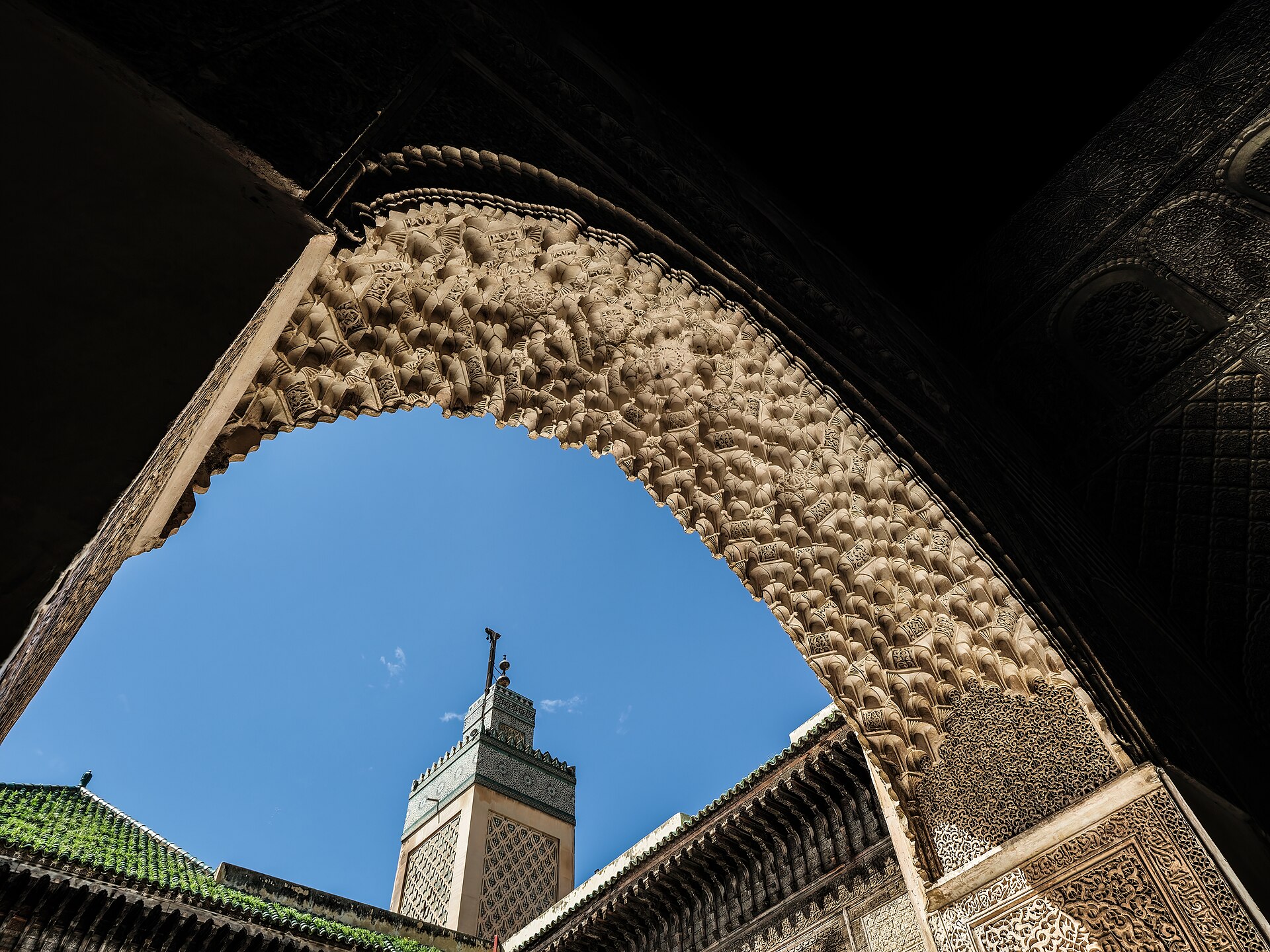
Sultan Abu Inan Faris commissioned this theological school between 1351 and 1356, and legend holds that when presented with the staggering construction bill, he threw the accounts into the river and declared, "A thing of beauty is beyond the considerations of accounting." That extravagance shows in every surface. The Bou Inania stands as the finest surviving example of Marinid architecture in Morocco, combining three layers of ornamentation — zellige tilework on the lower walls, carved stucco (gebs) in the middle band, and carved cedarwood above — in a harmony that has inspired architects for seven centuries. It is the only madrasa in Fez that also functions as a congregational mosque, possessing its own minaret.
Guides draw connections to the Alhambra in Granada, which shares Marinid decorative DNA, and explain the Quranic inscriptions carved into the walls that tell a theological program readable only by a trained eye. Combine with Al-Qarawiyyin and the wider Fes el Bali medina to understand Fez's intellectual golden age.
Visitor Etiquette
The three-layer decoration system — zellige geometric mosaics below, carved stucco calligraphy in the middle, cedarwood arabesques above — represents the pinnacle of Marinid decorative arts, and a guide explains the symbolic meaning encoded in each layer. Quranic inscriptions carved into the stucco walls compose a theological program that was intended to be read and contemplated by the students who lived here. The Marinid dynasty invested heavily in educational architecture, and understanding why puts the madrasa in context with contemporary European institutions of the 14th century. The exterior features a 14th-century hydraulic water clock with thirteen wooden brackets and brass bowls — a medieval timekeeping device whose exact mechanism has never been fully reconstructed. Students lived in tiny upper-floor cells above the courtyard, studying theology, law, and astronomy for years at a time.
Spiritual Significance
The courtyard zellige features geometric mosaics in green, white, and blue covering every lower surface, each tiny piece hand-cut by Fassi artisans. The middle decoration band of carved stucco contains interlocking floral and calligraphic patterns of stunning complexity. The honey-colored cedarwood ceiling and brackets, carved from Atlas cedar, still carry a faint forest scent after 670 years. A white Carrara marble ablution basin sits at the courtyard's heart. The water clock on the street facade — thirteen wooden brackets and brass bowls — is a medieval timekeeping marvel. The minaret, decorated in green and white zellige, makes Bou Inania the only madrasa in Fez with its own tower for the call to prayer. Peering into the small student cells above the courtyard gives a tangible sense of how theology students lived in scholarly austerity surrounded by artistic splendor.
When to Visit
Hours: Daily 9:00 AM - 5:00 PM (closed during Friday midday prayers). Prayer closure: Brief closures during the five daily prayers; guides time visits between them. Best time: 9:00-10:00 AM when morning sunlight illuminates the courtyard's zellige and the crowds are thin. Avoid: Midday during the peak tour bus window (11 AM - 1 PM). Allow: 30-45 minutes with a guide for a proper appreciation.
Admission and Costs
Admission: 30 MAD (€2.80) per person. Private guide for the madrasa: 200-400 MAD (€18-37) for a focused 30-45 minute tour. Included in medina walking tours: Most half-day and full-day Fez guides include Bou Inania as a standard stop. Islamic art specialist: 800-1,400 MAD (€74-130) for a tour connecting Bou Inania, Attarine, and Al-Qarawiyyin.
Tips for Visitors
Located on Talaa Kebira: The madrasa sits on Fez's main thoroughfare, making it an easy first stop on a medina tour from Bab Boujloud. Photography: Allowed inside the courtyard; the best light is mid-morning when the sun reaches the zellige walls. Shoes off: Remove shoes at the entrance (this is both a madrasa and an active mosque). Look up: The most intricate details are on the upper walls and ceiling; bring binoculars if you are serious about art history. Brief but essential: Do not skip this because it is small; 30 concentrated minutes here outweigh hours at lesser sites.