
Zócalo & Templo Mayor timeline
-
Tenochtitlan founded
The Mexica founded their island capital on Lake Texcoco, setting the sacred center beneath today's plaza.
-
Temple demolished
After the Spanish conquest, the Templo Mayor was dismantled and buried beneath the colonial city.
-
Coyolxauhqui stone found
The accidental discovery triggered the modern Templo Mayor excavation project.
-
Museum and UNESCO listing
The site museum opened as the historic center entered the World Heritage List.
Excavation History
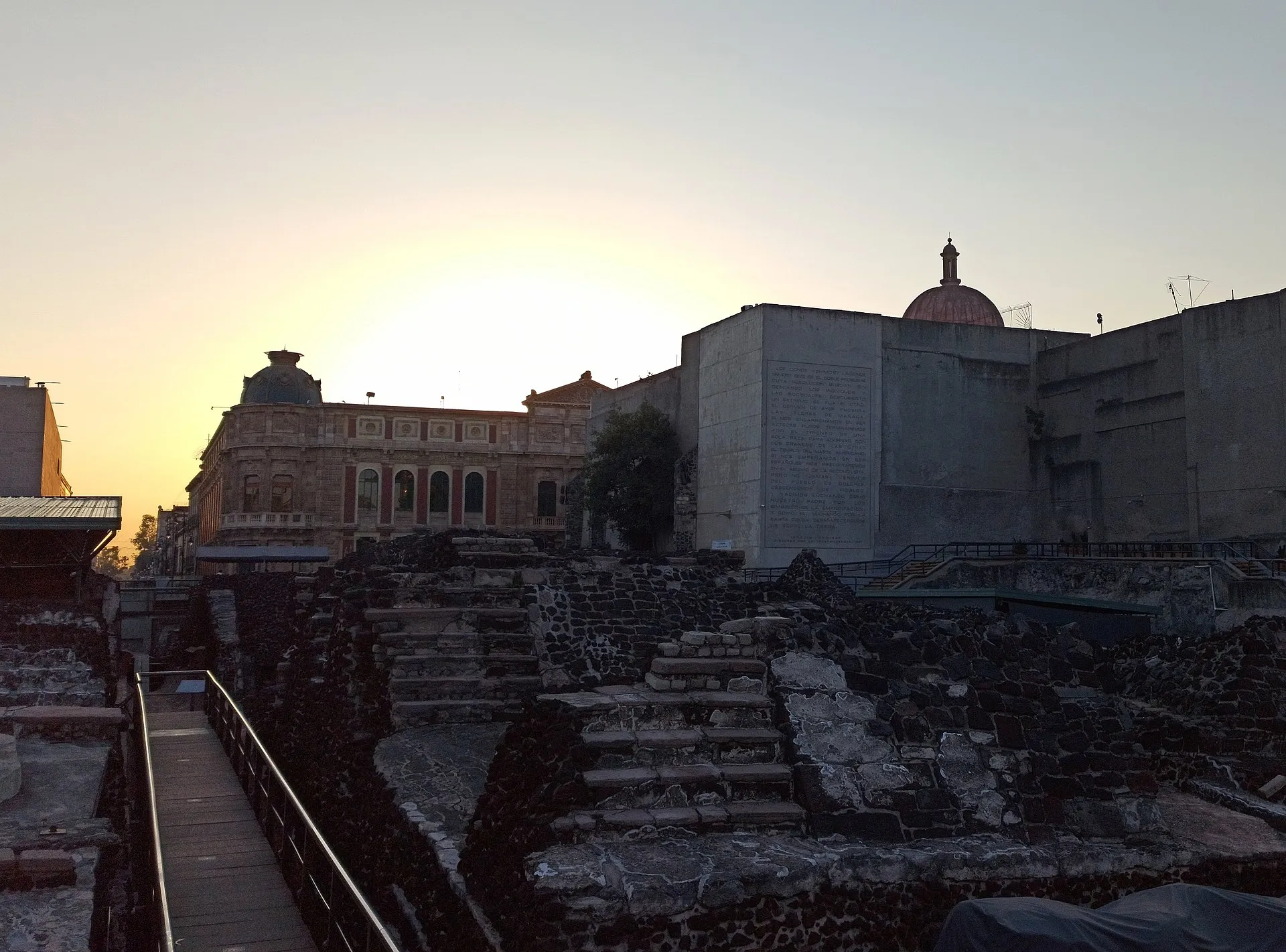
The accidental discovery of the Coyolxauhqui stone in 1978 triggered one of the most important urban archaeological excavations in the Americas — the Proyecto Templo Mayor, directed by archaeologist Eduardo Matos Moctezuma, which controversially demolished a block of colonial buildings to reach the Aztec ruins beneath. Over the following decades, archaeologists uncovered seven superimposed construction phases of the Templo Mayor, each a larger pyramid swallowing the previous one — a physical timeline of Aztec imperial expansion from the city's founding in 1325 through the Spanish arrival in 1519. The twin shrines at the summit were dedicated to Huitzilopochtli (god of war and the sun) and Tlaloc (god of rain and agriculture), reflecting the two pillars of Aztec society: military conquest and agricultural sustenance.
The temple was not lost so much as deliberately buried. The Spanish razed it in 1521 and reused its stone, and for nearly two centuries the only hints of it were chance finds — the Coatlicue statue and the 24-ton Sun Stone, both unearthed during repaving of the Zócalo in 1790. Archaeologist Manuel Gamio exposed a corner of the actual foundations in 1914, but systematic excavation only became possible after 1978. Digging in the heart of a sinking megacity brings its own hazards: the water table sits just below the offerings, so conservators pump and treat groundwater constantly to keep waterlogged wood, textiles, and bone from disintegrating on contact with air.
Excavations continue to yield extraordinary finds. In 2017, archaeologists documented the Huei Tzompantli, a tower and rack built from over 650 human skulls, confirming Spanish accounts once dismissed as exaggeration — and unsettling earlier assumptions, since many of the skulls belonged to women and children rather than only captured warriors. The adjacent museum's 7,000+ artifacts include lifesize ceramic eagle warriors, obsidian sacrificial knives, and offerings that traveled thousands of kilometers from both the Pacific and Gulf coasts.
Key Artifacts
A short list rewards a slow, guided pass through the site and museum:
- The Coyolxauhqui stone — a 3.25-meter carved disc depicting the dismembered moon goddess — is the museum's centerpiece and the artifact that launched the entire excavation. According to Aztec mythology, Huitzilopochtli killed and dismembered his sister Coyolxauhqui at the moment of his birth, and this stone lay at the base of the pyramid's stairs so that sacrificial victims would symbolically reenact her fall.
- The Tlaltecuhtli monolith — a 12-tonne relief of the earth goddess uncovered in 2006 — is the largest Aztec monolith ever found, and the excavation around it opened a rich sequence of buried offerings beneath the temple platform.
- The eagle warriors and chac-mool — near-lifesize ceramic warriors and a reclining stone messenger figure — stand in the Casa de las Águilas, the precinct's best-preserved ceremonial building.
- The Huei Tzompantli — the excavated skull rack — revealed that the Aztec practice of displaying enemy skulls was conducted on a scale previously considered mythological by historians.
Above ground, the Metropolitan Cathedral — 240 years in the building (1573-1813) — blends Gothic, Baroque, and Neoclassical styles; watch how the floor tilts as the structure sinks unevenly into the ancient lakebed. Across the plaza, Rivera's murals in the National Palace compose a sweeping visual history of Mexico from pre-Columbian paradise through the conquest, revolution, and industrial age — the most ambitious narrative mural cycle in the Americas, and a free counterpart to the muralism on show at Palacio de Bellas Artes.
When to Visit
Templo Mayor & Museum: Tuesday - Sunday, 9 AM - 5 PM (closed Mondays, last entry around 4:30 PM). Zócalo (the square): Open 24 hours — it is a public plaza. National Palace murals: Tuesday - Sunday, 9 AM - 5 PM (free entry, bring government-issued ID).
- Best: Arrive at the Templo Mayor at 9 AM opening, then walk the square and palace before lunch, when the light is soft and the ruins are quietest.
- Avoid: National holidays and election periods, when the Zócalo hosts massive political rallies, concerts, or celebrations that can close the plaza to sightseeing.
- Duration: Allow 3-4 hours for the Templo Mayor museum, the Zócalo, and the National Palace; a full Historic Centre walking tour runs 5-6 hours.
- Ceremony: Soldiers raise the enormous national flag at 8 AM and lower it at 6 PM each day — arrive early to catch the morning ceremony before the ruins open.
Admission and Costs
- Templo Mayor entry: MX$90 ($5) — free on Sundays for the general public.
- National Palace: Free (bring a photo ID such as a passport).
- Zócalo: Free — it is a public square.
- Metro: MX$5 (about $0.30) to reach Zócalo/Tenochtitlan station on Line 2.
- Guided Historic Centre walking tour: MX$600-1,200 ($33-65) per person.
- Private guide for Templo Mayor + Historic Centre: MX$1,500-2,500 ($85-140).
An INAH-certified guide hired for the site is the single upgrade that most changes the visit — see the case for a guide below.
The Case for a Guide
The Templo Mayor is the hardest major site in Mexico City to read on your own. What survives is a stack of low stone platforms from seven overlapping temples, with no reconstructed façade to anchor the imagination — a guide who can rebuild the twin 60-meter pyramids in your mind's eye is the difference between "jumbled walls" and a coherent sacred precinct.
- They reconstruct the invisible pyramid — pointing out which platform belongs to which of the seven building phases, and where the staircases to Huitzilopochtli and Tlaloc once rose above the plaza.
- They connect ruins to museum — linking the Coyolxauhqui stone in the galleries to the exact spot at the foot of the stairs where it lay, so the mythology and the archaeology finally lock together.
- They read the layered city — explaining how Aztec temple, colonial cathedral, and modern plaza came to share one block, and why the whole ensemble is slowly sinking.
- They decode the National Palace murals — Rivera's dense visual history of Mexico is nearly illegible without someone to name the figures and events crowded into it.
- They navigate logistics — timing the free flag ceremony, the ID rules for the palace, and the Sunday free-entry crowds so you spend time looking rather than queuing.
Tips for Visitors
- Start at the Templo Mayor: Visit the ruins and museum first while you are fresh and the morning is cool, then explore the Zócalo and palace afterward.
- The National Palace murals are free: You just need a government-issued ID; Rivera's murals here are arguably more impressive than those in Bellas Artes, and they cost nothing.
- Walk Calle Madero to Bellas Artes: This pedestrianized street connects the Zócalo to Palacio de Bellas Artes in a 15-minute stroll past colonial mansions, tile-covered buildings, and the golden Torre Latinoamericana.
- Watch the flag ceremony: Every morning at 8 AM and evening at 6 PM, soldiers in ceremonial dress raise or lower the enormous Mexican flag in the center of the Zócalo.
- A guide transforms the ruins: Without expert commentary, the Templo Mayor's stone walls are hard to interpret — a guide who can reconstruct the twin pyramids is essential.
- Sunday mornings: Free Templo Mayor entry combines with free access to other Historic Centre sites — but arrive early, as lines build quickly.
- Take Metro Line 2: The Zócalo/Tenochtitlan station exits directly onto the plaza; it is faster and cheaper than a taxi through the Historic Centre's congested streets.
Frequently Asked Questions
When is the best time of year to visit the Zócalo and Templo Mayor?
March through May and November through December are the top-rated months, with dry skies and pleasant temperatures in the low 20s Celsius that make walking the open-air ruins and vast plaza comfortable. The Dia de Muertos celebrations in late October and early November transform the Zocalo into one of Mexico City's most spectacular public spectacles. Summer rains from June through September can flood the low-lying Historic Centre streets and make outdoor exploration of the Templo Mayor less enjoyable.
What are the opening hours for the Templo Mayor, Zócalo, and National Palace?
Templo Mayor & Museum: Tuesday - Sunday, 9 AM - 5 PM (closed Mondays). Zócalo (the square): Open 24 hours — it's a public plaza. National Palace murals: Tuesday - Sunday, 9 AM - 5 PM (free entry, bring government-issued ID).
What is the entrance fee for Zócalo & Templo Mayor?
Templo Mayor entry: MX$90 ($5) — free on Sundays. National Palace: Free (bring a photo ID). Zócalo: Free (it's a public square). Guided Historic Centre walking tour: MX$600-1,200 ($33-65).
What is the best order for visiting the Zócalo and Templo Mayor?
Start at the Templo Mayor: Visit the ruins and museum first while you're fresh and the morning is cool, then explore the Zócalo and palace afterward.
How do you get to the Zócalo by metro, and is the site accessible?
Metro Line 2 (the blue line) stops directly beneath the square at Zócalo/Tenochtitlan station, a one-minute walk to the plaza and a three-minute walk to the Templo Mayor entrance on Calle Seminario. The Templo Mayor museum is fully accessible with ramps and a lift between floors, but the open-air ruins are crossed on raised metal walkways with some steps and no step-free alternative on every branch — staff can advise on the most accessible route. The Zócalo itself is flat, paved, and step-free.
What are the biggest unsolved mysteries at the Templo Mayor?
The full extent of the Aztec sacred precinct is still unknown because most of it lies sealed beneath occupied colonial buildings that cannot be demolished, so archaeologists excavate only where redevelopment or subsidence exposes new ground. The tomb of a Mexica emperor has never been found despite decades of digging, and the 2017 discovery of a skull tower with far more women and children than expected has reopened debate about exactly who was sacrificed and why. Each new offering recovered from the water table adds detail without closing the questions.