
Landmarks Along
Monumento a la Patria: The boulevard's monumental anchor at its northern roundabout — a semicircular carved-limestone relief of Mexican history by Rómulo Rozo, completed in 1956, with a reflecting pool and one of the city's signature night-time views. Palacio Cantón: An opulent beaux-arts mansion built 1909–1911 for General Francisco Cantón, now the Museo Regional de Antropología, with Maya artifacts inside and marble interiors worth the entry alone. Casas Gemelas (Twin Houses): A matched pair of French-style mansions from the 1910s; one is preserved as a house museum showing how the henequén elite actually lived. Casa del Minarete: An eccentric eclectic residence crowned with a slender tower, a local landmark and favorite photo subject. Remate de Montejo: The leafy southern terminus near the old center, with a fountain, benches, and a colonial-style arch that links the boulevard to the historic grid. El Minaret cafés and galleries: The renovated ground floors along the central stretch now host restaurants, ice-cream parlors, and shops housed in former mansions.
Photo Spots
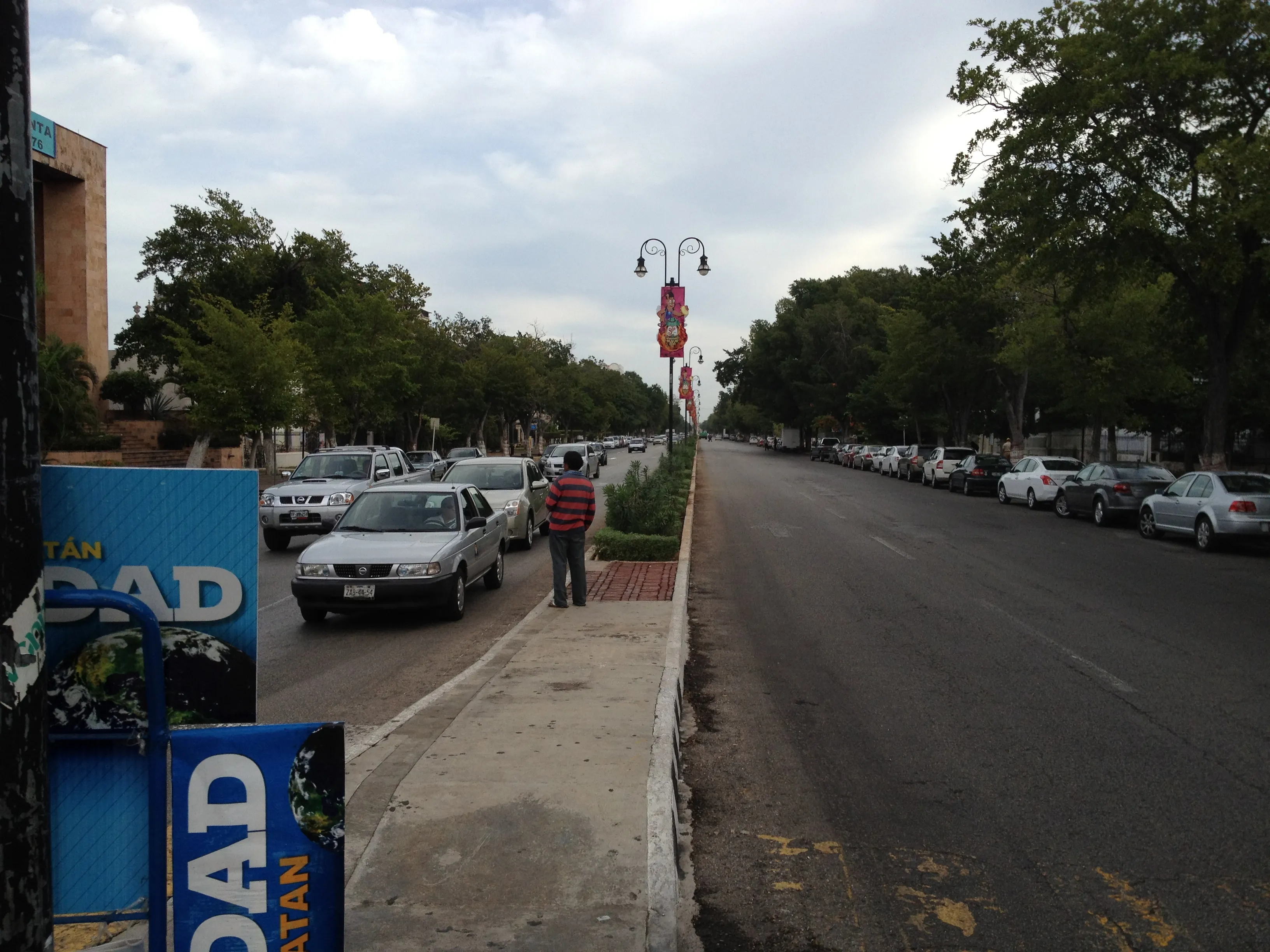
Monumento a la Patria at blue hour: Shoot the curved relief and reflecting pool just after sunset when the floodlights come on — the carved figures read dramatically against the dark sky. The boulevard's tree tunnel: From the central median looking south, the rows of mature trees and the carriage lanes give the classic Champs-Élysées-style perspective, best in soft morning light. Mansion facades in raking light: Early morning and late afternoon side-light brings out the relief on the French and Italian stonework of the Casas Gemelas and Palacio Cantón. A passing calandria: Frame a horse-drawn carriage against a mansion backdrop for a quintessential Mérida shot — easiest on weekends when they queue near the Remate. Sunday Bici-Ruta crowds: With cars gone, you can stand in the middle of the avenue for wide, people-filled street scenes impossible on any other day. Casa del Minarete's tower: Its unusual silhouette stands out against the sky and makes a strong vertical composition.
When to Visit
The boulevard is a public street, open 24 hours and free to walk. The most pleasant hours are early morning (7–9 AM) and after 5 PM, when the heat eases and the mansions glow in low light. Avoid the midday window of 12–4 PM, when the unshaded sections are punishing. The Bici-Ruta closes the avenue to cars most Sundays from roughly 8 AM to 12:30 PM — the best time to see it car-free. Individual attractions keep their own hours: the Palacio Cantón (Museo Regional de Antropología) opens Tuesday–Sunday, 8 AM–5 PM, closed Mondays. Allow 1–2 hours to stroll the historic stretch, or half a day with museum and café stops.
Admission and Costs
Walking the boulevard is free. A calandria (horse-drawn carriage) ride costs roughly MX$300–400 (about $17–23) for a 45-minute circuit. The hop-on open-top tourist bus runs about MX$200 (about $11). Bike rental is roughly MX$50–100 per hour (about $3–6), and Sunday Bici-Ruta loaner bikes are free with ID. Entry to the Palacio Cantón anthropology museum is about MX$90 (about $5); Mexican nationals enter free on Sundays. A guided walking tour of the avenue typically runs MX$400–800 (about $23–46) per person; a private guide for a small group is roughly MX$1,500–2,500 (about $85–145).
The Case for a Guide
The mansions of Paseo de Montejo look handsome from the sidewalk, but their meaning is mostly invisible without context — a guide turns a pleasant stroll into a coherent story of money, architecture, and social upheaval.
- Decoding the henequén economy: A guide explains how a spiky agave plant generated the fortunes behind every facade, and why the boom collapsed when synthetic fiber arrived
- Reading the architecture: French Second Empire, Italian Renaissance revival, Moorish, and eclectic styles sit side by side; a guide points out which family built what and which architect they imported
- The Monumento a la Patria in detail: Rómulo Rozo's relief packs hundreds of figures and symbols into its curve, and almost none of them are labeled — interpretation is essential
- The social subtext: The casta divina fortunes rested on exploited Maya and Yaqui labor; a good guide gives the boulevard's beauty its honest historical weight
- Finding the open interiors: Several mansions now house museums, banks, or cafés you can enter — a guide knows which doors are open and what survives inside
Tips for Visitors
Go early or late: The boulevard has limited shade in stretches, and midday Yucatán heat is no joke — start by 8 AM or wait for the evening paseo. Carry water and a hat: Even in winter the sun is strong this far south. Aim for Sunday morning if your schedule allows, for the car-free Bici-Ruta and the festive street life. Combine with the city center: The boulevard's southern end (the Remate) is a short walk or quick taxi from Plaza Grande, so you can chain it with the cathedral and main square. Pace yourself with stops: Treat the cafés and the Palacio Cantón as rest points rather than trying to march the whole avenue in one go. Negotiate the calandria fare before you climb in, and confirm the route and duration. Evenings are magical: The Monumento a la Patria and several mansions are floodlit after dark.
Frequently Asked Questions
Why is Paseo de Montejo so much grander than the rest of Mérida?
The boulevard was a deliberate display of wealth. Between roughly 1880 and 1915 the Yucatán produced almost all the world's henequén — the agave fiber spun into rope and twine for global shipping and agriculture — and the plantation families grew fabulously rich. They commissioned French and Italian architects to build European-style mansions along a new avenue modeled on the Champs-Élysées in Paris, complete with a central carriage promenade, side roads, and rows of trees. The contrast with the older Spanish-colonial grid around Mérida's Plaza Grande is the whole point: Montejo was the new money announcing itself.
How long is the boulevard and can you walk the whole thing?
The historic stretch runs roughly 2 kilometers from the Remate de Montejo near the old city center north to the Monumento a la Patria roundabout, then continues as a wider commercial avenue beyond. Walking the historic section end to end takes about 30–40 minutes at a stroll, longer if you stop for the mansions and cafés. Many visitors rent a bike, take a calandria (horse-drawn carriage), or ride the open-top tourist bus to cover it comfortably in the heat.
Is the Sunday Bici-Ruta worth planning around?
Yes, if you can. Most Sunday mornings the city closes Paseo de Montejo and connecting streets to cars for the Bici-Ruta, roughly 8 AM to 12:30 PM, and the boulevard fills with cyclists, joggers, families, food carts, and free rental bikes. It is the single best time to experience the avenue at human scale rather than dodging traffic, and it pairs naturally with the open-air market and concerts that animate central Mérida on weekends.
What is the Monumento a la Patria and why does everyone photograph it?
It is a monumental semicircular stone sculpture carved by Colombian artist Rómulo Rozo between 1945 and 1956, depicting the whole sweep of Mexican history in a neo-Maya style — pre-Hispanic deities, the conquest, independence, and the revolution rendered in carved limestone around a central reflecting pool. It anchors the northern end of the boulevard at a large roundabout and is one of the most photographed landmarks in the Yucatán, especially when lit at night.