
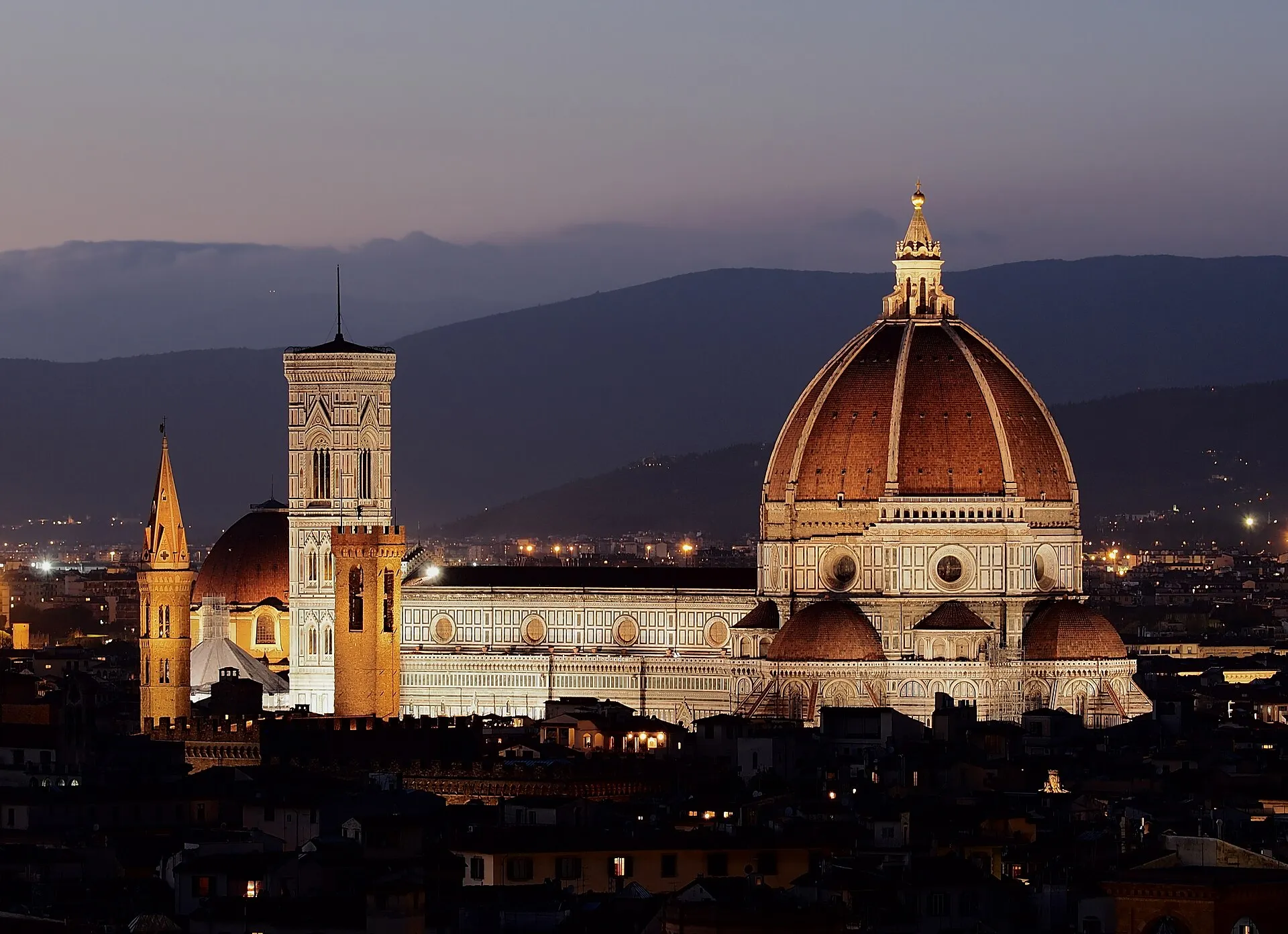
Spiritual Significance
Dedicated to Santa Maria del Fiore — Our Lady of the Flower — Florence's cathedral has stood at the heart of the city's spiritual life for more than 700 years. The dedication to the Virgin Mary was itself a theological statement: the flower (fiore) evoked both the city's name and the purity attributed to the Mother of God, binding civic identity to religious devotion from the moment the foundation stone was laid in 1296.
Brunelleschi's dome, completed in 1436, was conceived as far more than an engineering triumph. Its soaring profile was understood by contemporaries as a visible sign of human aspiration toward the divine, consciously echoing the Pantheon in Rome while surpassing it in scale — a Christian response to antiquity that proclaimed Florence as the new Rome under God's protection. The vast Last Judgment fresco covering the dome's interior was never merely decorative: it confronted worshippers with a stark warning about divine justice, placing them physically beneath the gaze of Christ in judgment every time they entered the nave.
The Battistero di San Giovanni beside the cathedral carries its own deep spiritual weight. Every Florentine child was baptized there for centuries, including Dante Alighieri, who later called it il mio bel San Giovanni — my beautiful Saint John. The baptistery was the threshold between the secular and sacred world for an entire civilization.
The cathedral also witnessed one of the most dramatic violations of sacred space in Renaissance history. During the Pazzi Conspiracy of 1478, assassins attacked Lorenzo and Giuliano de' Medici at the moment of the elevation of the Host during High Mass — choosing that precise instant because they knew the Medici, as devout Catholics, would be unarmed and bowed in prayer. The attack transformed the Duomo into a site where political history and religious gravity are permanently intertwined.
Visitor Etiquette
Dress code enforced: shoulders and knees must be covered -- no shorts or tank tops. The dome climb (463 steps, no elevator) involves narrow passages between the inner and outer shells with no exit until the top -- avoid if claustrophobic. Giotto's Bell Tower (414 steps) offers similar panoramic views with a less confined climb. The baptistery's Gates of Paradise on display outside are reproductions -- the originals are preserved in the Museo dell'Opera.
When to Visit
Cathedral: Monday-Friday 10 AM - 5 PM (free entry). Dome climb: Monday-Friday 8:30 AM - 7 PM, Saturday 8:30 AM - 5 PM. Book 2-4 weeks ahead on duomo.firenze.it -- dome tickets sell out weeks in advance. The dome is sold only as a fixed timed-entry slot, and the free cathedral entrance has its own separate queue on the piazza, so factor both lines into your plan. Climb early: mornings are cooler and less crowded.
Admission and Costs
Duomo Pass: €18 (cathedral, dome, baptistery, bell tower, museum). Dome only: €18 (most popular). Guided tour: €40-60 including skip access.
The Case for a Guide
Brunelleschi's dome is the most audacious engineering feat of the Renaissance, and climbing inside it without expert company means missing the technical genius that makes the climb genuinely astonishing rather than merely tiring.
- The impossible dome without centering: Brunelleschi built the world's largest brick dome without the wooden centering scaffolding that all previous domes required — a guide explains his herringbone brick pattern and the self-supporting rings that allowed each course to lock into place before the next was laid
- Hidden staircase inside the dome walls: The climb between the inner and outer shells of the cupola passes through a space Brunelleschi designed as a structural buffer — a guide explains why this double-shell construction was the key innovation that made the whole project possible
- Lantern crown access: The final climb to the lanterna at the very top offers the best views in Florence — a guide provides context for the panorama and points out landmarks across the Tuscan hills invisible on any signboard
- The Vasari fresco at eye level: Partway up the dome, the massive Last Judgment fresco by Vasari and Zuccari is close enough to examine individual brushstrokes — a guide identifies the scenes, explains the iconography, and notes which figures were added by Zuccari after Vasari's death
- The Baptistery doors competition: In 1401, Ghiberti beat Brunelleschi for the commission to create the Baptistery's bronze doors — a guide tells how that loss redirected Brunelleschi toward architecture, making the dome's existence a direct consequence of a failed bid
Tips for Visitors
The dome climb requires a timed reservation booked days ahead on the official site -- walk-ups are rarely available. Florence has no metro, so arrive on foot: the piazza sits inside the city's limited-traffic zone (ZTL) and is closed to cars, and Santa Maria Novella station is about a 10-minute walk away. The Uffizi Gallery is a 10-minute walk south, and the Accademia Gallery is 10 minutes north. Combine all three for a full Florence Renaissance day. If your dome slot leaves an hour to fill, the free Santa Reparata crypt beneath the nave and the counter-façade clock rarely draw a queue. Giotto's Bell Tower is a good alternative climb if dome tickets are sold out.
Frequently Asked Questions
When is the best time to visit Florence's Duomo and climb the dome?
April through June and September through October deliver the best combination of comfortable temperatures for the 463-step dome climb, manageable crowds, and clear Tuscan skies that make the rooftop panorama unforgettable. The enclosed staircase between the inner and outer shells of Brunelleschi's dome gets stifling in July and August heat. Winter visits from November through February offer shorter ticket queues but overcast skies can diminish the views from the top.
What are the opening hours for Florence Duomo and the dome climb?
Cathedral: Mon-Fri 10 AM - 5 PM (free). Dome climb: Mon-Fri 8:30 AM - 7 PM, Sat 8:30 AM - 5 PM. Book ahead: Dome tickets sell out weeks in advance
How much does it cost to visit Florence Duomo and climb the dome?
Duomo Pass: €18 (cathedral, dome, baptistery, bell tower, museum). Dome only: €18 (most popular). Guided tour: €40-60 including skip access
What booking tips help when planning a visit to Florence Duomo?
The dome climb requires a timed reservation booked days ahead as walk-ups are rarely available. The climb involves narrow passages with no exit until the top. Giotto's Bell Tower offers similar views with a less confined climb.
How do you get to Florence's Duomo?
The Duomo stands in Piazza del Duomo at the centre of Florence's historic core, which is pedestrianised and closed to most traffic inside the limited-traffic zone (ZTL). Florence has no metro, but the main Santa Maria Novella railway station is roughly a 10-minute (600-metre) walk away, and the compact centre puts the cathedral within easy walking distance of most hotels.