Walking Route
Walking Routes
The best photographs in the quarter are about scale and reflection, so linger where water meets glass.
- European Parliament (Louise Weiss building) — the glass drum of the hemicycle and its deliberately unfinished tower, opened in 1999 to a design by Architecture-Studio, is the quarter's signature shot, best framed from the footbridge over the Ill with the ring of national flags in the foreground.
- Palais de l'Europe — Henry Bernard's monumental 1977 headquarters of the Council of Europe; its rust-brown grid photographs cleanly against a blue sky from the canal bank.
- European Court of Human Rights — Richard Rogers's 1995 building of twin glass cylinders, engineered to evoke the scales of justice; the reflections in the water channel below are the reward for arriving early.
- Parc de l'Orangerie lake — the golden-hour angle back across the water toward the Parliament, often with a white stork in frame, is the picture most visitors miss.
Local Life
Beyond the institutions, the quarter keeps its own rhythm. Weekday mornings fill with multilingual staff — you will hear a dozen languages over coffee — and the streets empty on plenary Fridays when the Parliament decamps. The neighbourhood blends into the Neustadt, the grand German-imperial district begun after 1871 and inscribed on the UNESCO World Heritage list in 2017 alongside the Grande-Île, so a short walk south trades glass and steel for Wilhelmine boulevards and the university's botanical garden.
- Parc de l'Orangerie — laid out in 1692 in a design linked to André Le Nôtre, Versailles's own gardener, it is Strasbourg's oldest park; its lake, waterfall, and free-flying storks make it the locals' favourite picnic ground.
- Le Buerehiesel — a Michelin-starred restaurant set in a reassembled 17th-century Alsatian farmhouse inside the Orangerie, for a special-occasion matelote or foie gras.
- Lieu d'Europe — as much a leafy garden as an exhibition, with a café terrace over the canal that explains the European project for families and first-timers.
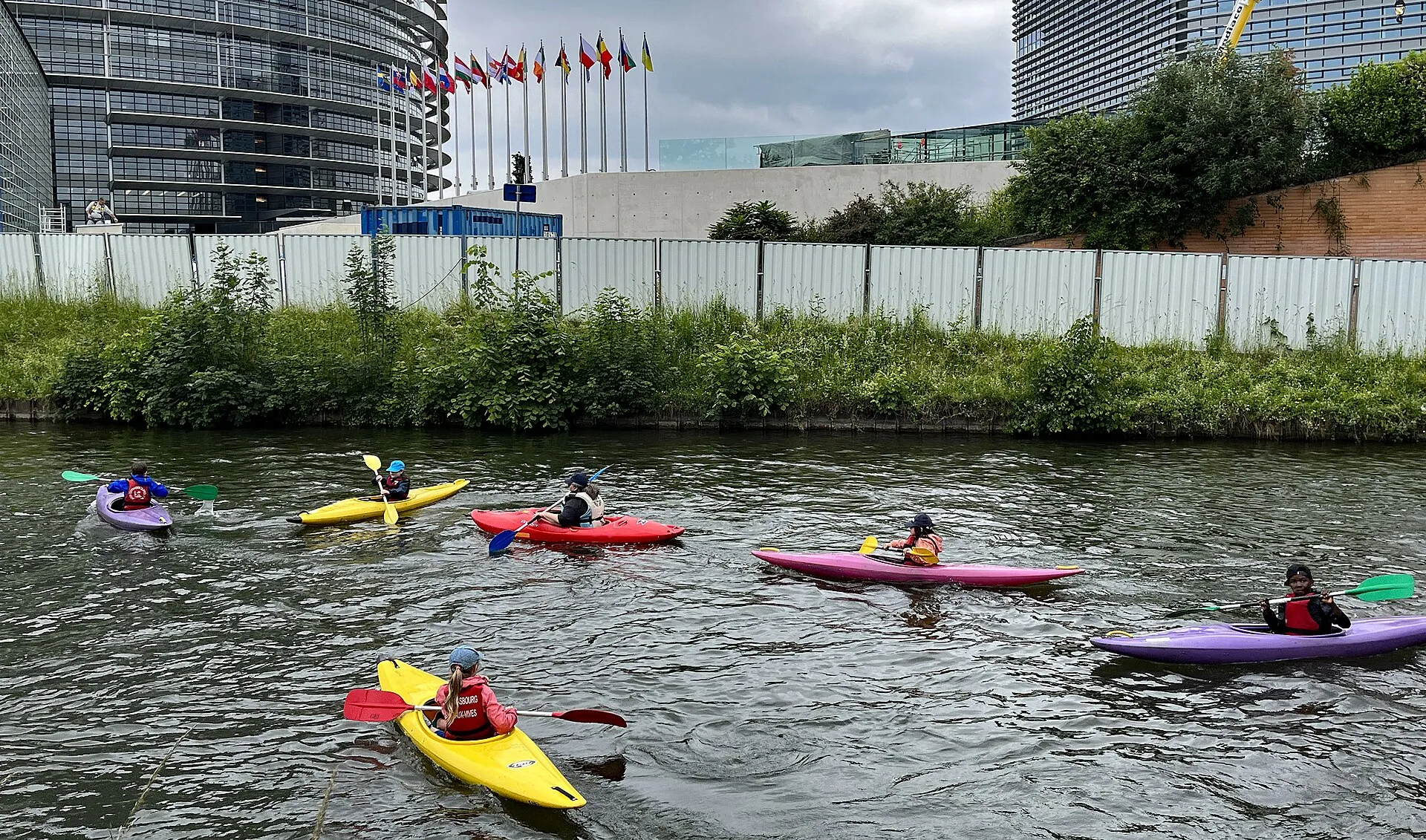
- Rowers on the Ill — the river and the Marne–Rhine canal draw rowing clubs and canoeists whose wakes set the flag reflections shimmering.
For the medieval counterpoint, it is a 15-minute tram ride back to the cathedral, Petite France, and — in winter — Europe's oldest Christmas markets.
When to Visit
The district is outdoors and free to walk at any hour, but access to the institutions follows the calendar. The European Parliament holds twelve four-day plenary sessions a year in Strasbourg — clustered in March–July and September–December — when the public galleries above the hemicycle open to watch live debate and voting; between sessions, guided visits run on selected weekdays (check the calendar at europarl.europa.eu). The Parlamentarium Simone Veil visitor centre is open daily and needs no session in progress. The Council of Europe offers guided tours of the Palais de l'Europe by advance appointment, usually on Fridays outside its own assembly weeks. April through October is the most rewarding stretch to explore on foot, when the riverside lawns are green and the light flatters the modern architecture.
Admission and Costs
Public access to European democracy is, fittingly, free. A guided visit to the European Parliament costs nothing — a valid passport or national ID and an advance online booking are the only requirements. The Parlamentarium Simone Veil interactive exhibition is free, as are the Council of Europe guided tours. To go deeper, a private political or architecture guide runs roughly €150–250 for a half-day covering all three institutions and their symbolism. Airport-style security screening applies at every building, so leave large bags at your hotel. You can also see the Parliament from the water on a Batorama canal cruise (€15–25).
The Case for a Guide
The European Quarter rewards context more than almost any sight in Strasbourg: the buildings look plain until you understand what happens inside them. A specialist guide turns a walk past glass façades into a working lesson in how Europe governs itself.
- Decode the institutions: guides untangle the frequently confused trio — the EU's European Parliament, the separate 46-nation Council of Europe, and the European Court of Human Rights — and explain what each actually decides.
- Read the architecture: learn why the Louise Weiss tower was deliberately left looking unfinished, and how Richard Rogers turned the Human Rights court into a symbolic ship of justice.
- Follow the law-making: understand how a directive travels from committee to the hemicycle floor and out to 27 member states.
- Navigate the bureaucracy: guides handle the booking windows, ID rules, and security procedures that baffle first-time visitors.
- Hear the history: the story of European integration from the ruins of 1945 to today, told on the ground where it is still being written.
Tips for Visitors
- Book the Parliament early: individual visits and gallery seats for plenary weeks are released online and fill fast — reserve two to three months ahead.
- Bring photo ID: a passport or national identity card is mandatory for every institutional building, and the name must match the booking.
- Check the plenary calendar: live debate in the hemicycle only happens on the twelve session weeks listed at europarl.europa.eu — plan around them.
- Take tram line E to the Parlement Européen stop; it runs straight from the city centre and drops you at the Parliament's forecourt.
- Pair it with a park: the Parc de l'Orangerie, Strasbourg's oldest park, is a five-minute walk away and ideal for a picnic between visits.
- Mind photography rules: exteriors are freely photographed, but security may restrict cameras inside the chambers.
Frequently Asked Questions
When should visitors time a trip to Strasbourg's European Quarter?
April through October provides the best weather for walking between the modern glass-and-steel institutional buildings along the River Ill, with spring greenery and summer light framing the architectural district beautifully. The European Parliament holds twelve four-day plenary sessions per year, concentrated in March through July and September through December, when public gallery access lets you witness live democratic debate and voting. August sees most EU institutions operating at reduced capacity during the summer recess, so time an institutional visit for a spring or autumn session week.
What are the opening hours of the European Quarter?
The district itself is an open, free-to-walk neighbourhood at any hour. European Parliament: guided visits on selected weekdays outside plenary, plus public galleries during the twelve annual sessions (check the calendar at europarl.europa.eu). Parlamentarium Simone Veil: interactive exhibition open daily, no session required. Council of Europe: guided tours of the Palais de l'Europe by advance appointment, usually Fridays.
How much does it cost to visit the European Quarter?
Walking the quarter: free. European Parliament guided visit: free (valid passport or national ID required, advance online booking). Parlamentarium Simone Veil: free. Council of Europe guided tour: free (advance booking). Private political or architecture guide: €150-250 for a half-day covering all three institutions. A Batorama canal cruise past the Parliament runs €15-25.
What is the difference between the European Parliament and the Council of Europe?
They are separate bodies that happen to share a city. The European Parliament is the directly elected legislature of the European Union, where 720 MEPs from the 27 member states vote on EU law affecting some 449 million citizens. The Council of Europe is an older and broader human-rights organisation of 46 nations, founded in Strasbourg in 1949, whose Palais de l'Europe houses a Parliamentary Assembly and which oversees the European Court of Human Rights. A guide's first job is usually to untangle exactly this confusion.
Is a guide recommended for visiting the European Quarter?
Guides provide political context on EU decision-making and how a directive travels from committee to the hemicycle and out to 27 member states, share the historical arc of European integration from the ruins of 1945 to the present union, and decode the deliberate architectural symbolism of buildings by Architecture-Studio, Henry Bernard, and Richard Rogers. They also handle the booking windows, ID rules, and airport-style security that confuse first-time visitors.