
Seasonal Calendar
Each square keeps its own character, so plan a loop rather than a single stop:
- Place Broglie — the historic heart of the Christkindelsmärik and its largest concentration of chalets.
- Place de la Cathédrale — the most atmospheric market, ringed by the pink sandstone of Strasbourg Cathedral.
- Place Kléber — the Great Christmas Tree and its nightly lighting, plus a market often themed around the year's invited guest.
- Place Gutenberg — craft-focused chalets around the statue of the printing pioneer who once worked in the city.
- Petite France — smaller, quieter stalls against the half-timbered, canal-side backdrop.
- OFF market at Place Grimmeissen — an alternative, artisan- and sustainability-focused market away from the busiest lanes.
What to buy, and what to skip: reach for hand-painted glass baubles — the boule de Noël was invented in the glassworks of nearby Meisenthal and Goetzenbruck — along with Alsatian pottery, bredele by weight, pain d'épices, and foie gras. Give a wide berth to the identical mass-produced ornaments and generic souvenirs that carry no maker's mark.
Booking Tips
- Come by train: Strasbourg's station is a short walk or one tram stop from the markets, and the Grande Île is pedestrianised — leave the car behind, as December parking near the centre is scarce and expensive.
- Reserve a guided slot early: the best Alsatian-culture and food guides sell out for December weekends weeks in advance.
- Check the year's invited guest: a different country or region is honoured each year with its own market and crafts, well worth building your route around.
- Pair it with the rest of the city: the same visit reaches the cathedral's astronomical clock, Petite France, and the modern European Quarter a few tram stops north.
When to Visit
The Christkindelsmärik runs from late November through 24 December (Christmas Eve), with the precise opening and closing dates set each year by the city and published on noel.strasbourg.eu. Most stalls trade daily from around 11:00 to 20:00 — later on Place Kléber and near the cathedral — with reduced hours on 24 December.
- Opening weekend brings the ceremonial switch-on of the Great Christmas Tree on Place Kléber in late November.
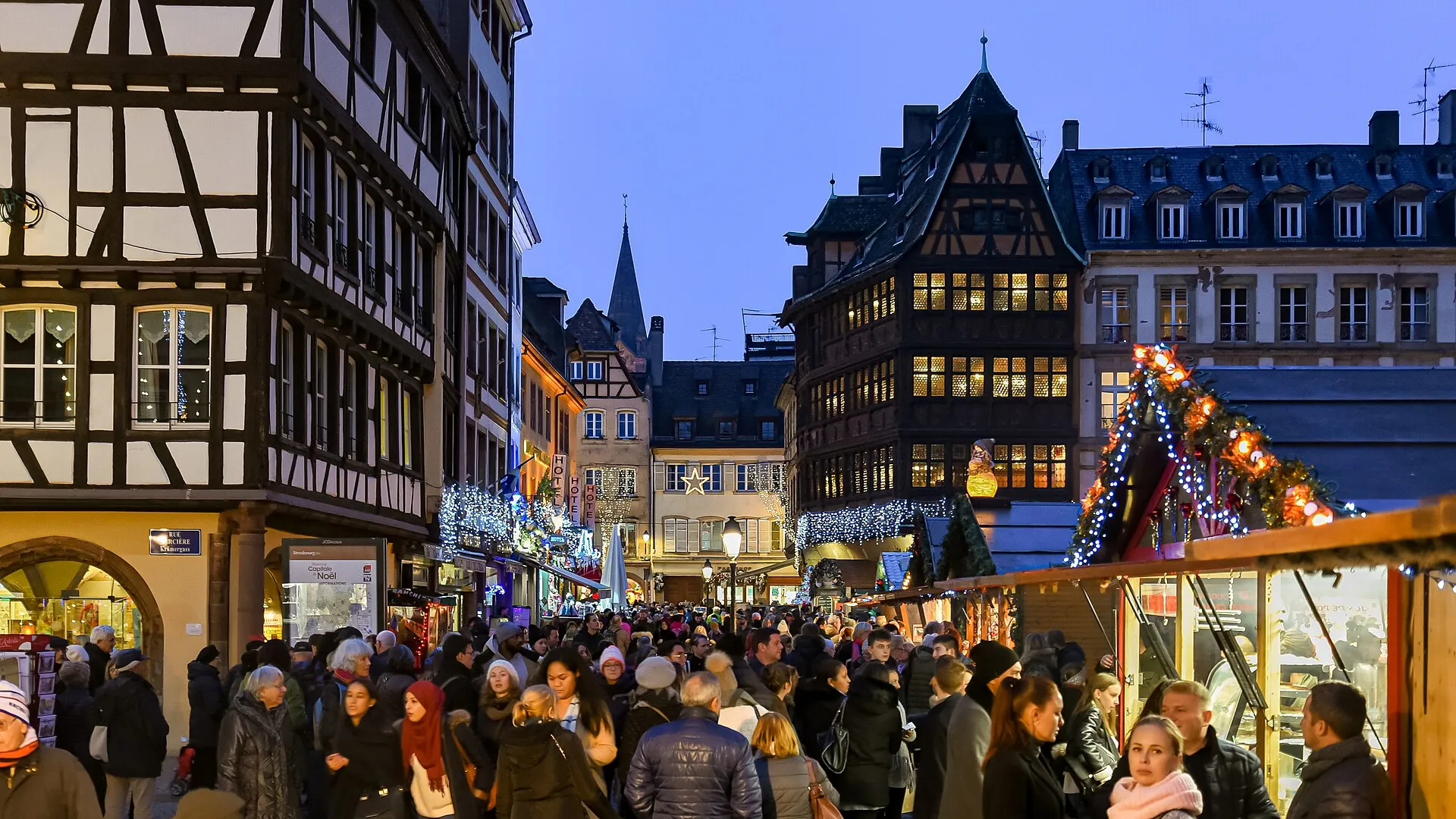
- Weekday evenings are the sweet spot: the lights blaze against the half-timbered façades and the crowds are a fraction of Saturday's.
- Avoid Saturday afternoons and the final days before Christmas, when the pedestrianised Grande Île can become shoulder to shoulder.
- Outside this roughly four-week Advent window the markets simply do not exist, so a visit has to land inside it.
Admission and Costs
Wandering the markets is free — you pay only for what you eat, drink, and carry home. Budget roughly:
- Vin chaud (mulled wine): €3–5 (about $3–6) a cup, plus a €1–2 (about $1–2) deposit on the souvenir mug — return it for a refund or keep it as a memento.
- Guided Christmas walking tour: €15–30 (about $16–33) per person for about two hours.
- Private guide: €150–250 (about $165–275) for a two- to three-hour tour.
- Food and crafts: highly variable — genuine Alsatian bredele, pain d'épices (gingerbread), and foie gras are fairly priced, but mass-produced trinkets are marked up for tourists.
The Case for a Guide
The markets look simple — chalets, lights, mulled wine — but their pleasures reward context, and a local guide turns a crowded stroll into a genuine taste of Alsatian Christmas.
- Read the traditions: why the Christkindel replaced Saint Nicholas at the Reformation, and what the bredele, Mannele, and evergreen wreaths actually mean.
- Eat and drink well: the stalls locals trust for the best vin chaud, foie gras, and freshly baked bredele — not the tourist markup.
- Shop for the real thing: genuine Alsatian pottery and hand-blown glass baubles over imported look-alikes.
- Beat the crowds: back lanes and quiet hours that skip the worst Saturday queues on Place Kléber and around the cathedral.
Tips for Visitors
- Book accommodation months ahead: central hotels fill three to six months before December, and room rates can double during the market weeks.
- Dress for real cold: Alsace in December often hovers near freezing after dark — layers, gloves, and warm footwear for the cobbles are essential.
- Carry cash: many chalets now take cards, but smaller artisan stalls and mug deposits are far easier with coins.
- Expect security checks: since the December 2018 attack near the market, the city funnels visitors through controlled entry points with bag searches — arrive with a small bag and a little patience.
- Go early or late on weekdays and let the illuminations after dusk, not the daytime bustle, be your memory of the market.
Frequently Asked Questions
When exactly do the Strasbourg Christmas Markets operate?
The Christkindelsmärik runs from late November through 24 December (Christmas Eve). The precise opening and closing dates are set each year by the city and published on noel.strasbourg.eu, so confirm them before you book travel. Opening weekend brings the ceremonial switch-on of the Great Christmas Tree on Place Kléber. Weekday evenings are the most magical — twinkling lights wash over the half-timbered houses and the crowds are far thinner than on Saturday afternoons. Outside this roughly four-week Advent window the markets simply do not exist.
What are the opening hours of the Strasbourg Christmas Markets?
Most chalets trade daily from around 11:00 to 20:00, with stalls on Place Kléber and near the cathedral often staying open later. Hours are reduced on 24 December, when the market closes early for Christmas Eve. For the least crowded, most atmospheric visit, aim for a weekday evening after dark and steer clear of Saturday afternoons and the final days before Christmas, when the pedestrianised old town fills shoulder to shoulder.
How much does it cost to visit the Strasbourg Christmas Markets?
Wandering the markets is free — you pay only for what you eat, drink, and carry home. A cup of vin chaud (mulled wine) runs €3–5 (about $3–6), plus a €1–2 (about $1–2) deposit on the souvenir mug that you can reclaim or keep. A guided Christmas walking tour is €15–30 (about $16–33) per person, and a private guide roughly €150–250 (about $165–275) for two to three hours. Genuine Alsatian bredele, pain d'épices, and foie gras are fairly priced; mass-produced trinkets are marked up for tourists.
What should I buy at the Strasbourg markets, and what should I avoid?
Reach for hand-painted glass baubles — the boule de Noël was invented in the nearby glassworks of Meisenthal and Goetzenbruck — along with traditional Alsatian pottery, bredele sold by weight, pain d'épices (gingerbread), and foie gras. Warm up with a cup of vin chaud made with the local spice blend. What to skip: the identical, mass-produced ornaments and generic "Alsatian" souvenirs that carry no maker's mark and could come from anywhere. A local guide steers you toward the genuine artisans instead.
What do guided tours of the Strasbourg Christmas Markets include?
Guides map an efficient loop through the dozen themed markets and steer you to authentic Alsatian artisans rather than mass-produced imports. They explain the traditions behind the decorations — why the Christkindel replaced Saint Nicholas at the Reformation, and what the bredele, Mannele, and evergreen wreaths mean — recommend the vin chaud, bredele, and foie gras stalls that locals actually frequent, and use back lanes and quiet hours to skip the worst queues.
Why does Strasbourg call itself the Capital of Christmas?
Strasbourg has promoted the title Capitale de Noël since 1992, but it earned the claim centuries earlier: its Christkindelsmärik has been held every Advent since 1570, making it the oldest Christmas market in France and among the oldest in Europe. The market was born of the Protestant Reformation, which replaced the older Catholic Saint Nicholas fair (the Klausenmärik) with a market honouring the infant Christ — the Christkindel whose name it still carries. Today it fills the UNESCO-listed old town and draws close to two million visitors.