

Overview
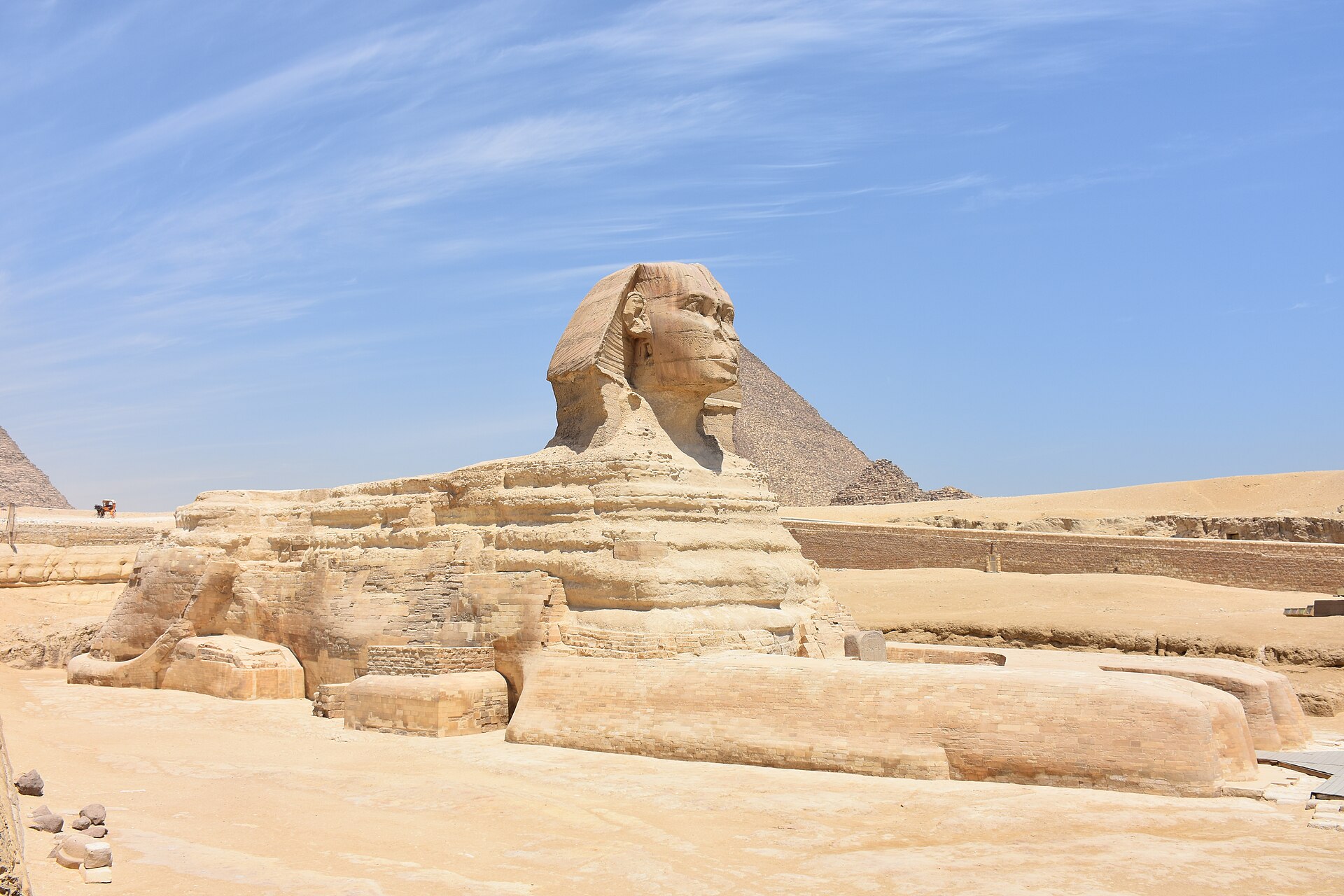
Carved from a single natural limestone outcrop on the Giza Plateau, the Great Sphinx stretches 73 meters from its outstretched paws to its tail and rises 20 meters from base to crown. Its hybrid form -- the body of a reclining lion fused with a human head wearing a royal nemes headdress -- makes it the largest monolithic statue in the ancient world. Most Egyptologists date its construction to the reign of Pharaoh Khafre around 2500 BC, positioning it as a sentinel for his adjacent pyramid complex. Pair your Sphinx visit with the full Giza city guide and the broader Egypt overview.
Key Artifacts
Between the Sphinx's paws stands a granite slab known as the Dream Stele, erected by Pharaoh Thutmose IV around 1401 BC. Its hieroglyphic inscription tells a remarkable story. The young prince Thutmose, son of Amenhotep II but not the designated heir, was hunting near the pyramids when he fell asleep in the Sphinx's shade. In his dream, the statue spoke to him as the god Horemakhet, promising the throne of Egypt if Thutmose would clear the sand that was slowly swallowing its body. Thutmose fulfilled the request and, as the inscription proudly records, became pharaoh. Whether this represents a genuine religious experience or a retroactive legitimization of an unexpected succession is impossible to determine. What the Dream Stele reveals beyond doubt is that by 1400 BC, more than a millennium after its creation, the Sphinx was already ancient and partly buried, its original purpose uncertain even to Egyptians of the New Kingdom. This layer of accumulated mystery only deepened over subsequent centuries. The missing nose, roughly a meter wide, was long blamed on Napoleon's artillery practice during his 1798 Egyptian campaign. This legend is demonstrably false: 15th-century Arab historian al-Maqrizi recorded that a Sufi named Muhammad Sa'im al-Dahr chiseled the nose off in 1378, outraged that local farmers left offerings at the statue as if to an idol. Drawings by Danish explorer Frederic Louis Norden from 1737, predating Napoleon's arrival, already show the noseless face.
Excavation History
The Sphinx's origins remain genuinely mysterious. While the mainstream scholarly consensus attributes it to Khafre, whose face may be represented in the statue and whose Valley Temple sits beside it, this identification is not universally accepted. No contemporary inscription names the Sphinx's builder. The statue sat largely forgotten beneath sand for much of its history, and even the ancient Egyptians of the New Kingdom, a thousand years after its creation, regarded it as an enigmatic inheritance from a dimly remembered past. Alternative theories propose earlier dates. Geologist Robert Schoch has argued that the vertical erosion patterns on the Sphinx enclosure walls suggest prolonged rainfall erosion, which would place construction before 5000 BC when the Sahara climate shifted from wet to arid. Most Egyptologists reject this water-weathering hypothesis, attributing the erosion to wind, sand abrasion, and salt crystallization cycles. The Sphinx has required constant maintenance almost since its creation. Pharaoh Thutmose IV cleared sand from around the buried statue around 1401 BC and may have added limestone veneer blocks to protect the paws. Later pharaohs, including Ramesses II, continued restoration efforts, and by the Ptolemaic period the Sphinx had become a pilgrimage destination associated with the god Horemakhet, "Horus of the Horizon." Roman-era visitors added their own repairs, patching the paws with brick that can still be distinguished from earlier limestone work. After centuries of Islamic rule during which the Sphinx attracted little attention beyond its use as a quarry for building materials, European explorers in the 18th and 19th centuries found the statue buried to its shoulders in drift sand. Modern conservation began in earnest in the 1920s and intensified through the 1980s and 1990s, when Egyptian authorities added thousands of new limestone blocks to stabilize the chest, shoulders, and haunches. Today, a monitoring system tracks groundwater seepage, humidity fluctuations, and micro-fractures that threaten the statue's integrity.
When to Visit
The Sphinx has required constant maintenance almost since its creation. Ancient Egyptians themselves recognized the problem: the soft limestone of the body erodes far faster than the harder stone of the head. Pharaoh Thutmose IV cleared sand from around the buried statue around 1401 BC and may have added limestone veneer blocks to protect the paws. Later pharaohs, including Ramesses II, continued restoration efforts, and by the Ptolemaic period the Sphinx had become a pilgrimage destination associated with the god Horemakhet, "Horus of the Horizon." Roman-era visitors added their own repairs, patching the paws with brick that can still be distinguished from earlier limestone work.
After centuries of Islamic rule during which the Sphinx attracted little attention beyond its use as a quarry for building materials, European explorers in the 18th and 19th centuries found the statue buried to its shoulders in drift sand. Modern conservation began in earnest in the 1920s and intensified through the 1980s and 1990s, when Egyptian authorities added thousands of new limestone blocks to stabilize the chest, shoulders, and haunches. Today, a monitoring system tracks groundwater seepage, humidity fluctuations, and micro-fractures that threaten the statue's integrity. The Sphinx sits at a water table that has risen over the past century as urbanization and irrigation have increased ground moisture levels. No simple solution exists: the monument is too large to move, too fragile to seal, and too iconic to abandon.
Admission and Costs
Between the Sphinx's paws stands a granite slab known as the Dream Stele, erected by Pharaoh Thutmose IV around 1401 BC. Its hieroglyphic inscription tells a remarkable story. The young prince Thutmose, son of Amenhotep II but not the designated heir, was hunting near the pyramids when he fell asleep in the Sphinx's shade. In his dream, the statue spoke to him as the god Horemakhet, promising the throne of Egypt if Thutmose would clear the sand that was slowly swallowing its body. Thutmose fulfilled the request and, as the inscription proudly records, became pharaoh.
Whether this represents a genuine religious experience or a retroactive legitimization of an unexpected succession is impossible to determine. What the Dream Stele reveals beyond doubt is that by 1400 BC, more than a millennium after its creation, the Sphinx was already ancient and partly buried, its original purpose uncertain even to Egyptians of the New Kingdom. This layer of accumulated mystery only deepened over subsequent centuries. Viewing the Sphinx requires only the standard Giza Plateau admission (EGP 540, roughly $11) -- no separate ticket is needed. Group tours covering the Sphinx, Valley Temple, and causeway run $25-45 per person for 2-3 hours. Private Egyptologist guides charge $80-160 for up to five people. A comprehensive tour combining the Sphinx with the Great Pyramid runs $150-300 for a full day.
Tips for Visitors
After the plateau closes to daytime visitors, the Sphinx becomes the narrator of an evening spectacle. The Sound and Light Show projects colors and images onto the pyramids while a deep recorded voice, emanating from speakers positioned near the Sphinx, recounts the story of pharaonic civilization. The performance runs in multiple languages on different evenings -- typically English, French, Arabic, Spanish, Italian, German, and Japanese on rotating schedules. Each show lasts about an hour. Ticket prices range from EGP 400 to 600 (roughly $8-12) depending on seating category, with premium seats offering closer views and better audio. Shows begin after sunset, with timing shifting seasonally -- typically 7:00 or 7:30 PM in winter, later in summer.
The viewing platform to the northeast offers the classic composition: the Sphinx in profile with Khafre's pyramid rising directly behind. Morning light illuminates this view best. For a less conventional perspective, approach from the lower plateau entrance near the Valley Temple, where the Sphinx emerges dramatically as you round a wall. The southeastern corner offers another underused vantage, showing the Sphinx from behind with the three Giza pyramids arrayed along the horizon. The no-touch policy means you cannot get closer than about 15 meters from the nearest paw, so a moderate telephoto lens (70-200mm equivalent) proves useful for detail shots. Bring a light jacket for evening visits; desert temperatures drop rapidly after sunset, and the evening breeze on the open plateau can feel surprisingly cool.