
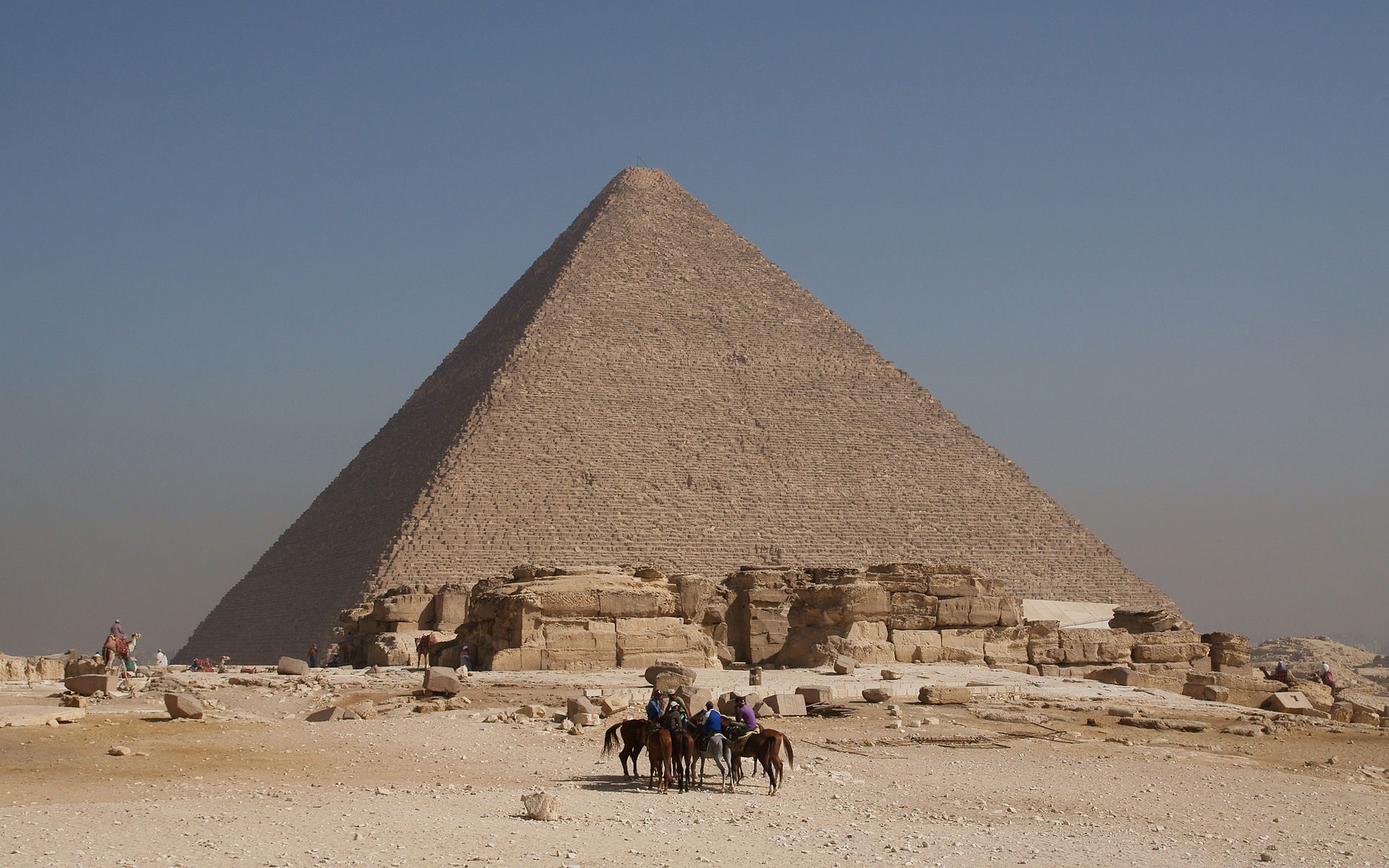

Overview
Constructed around 2560 BC for Pharaoh Khufu (known to the Greeks as Cheops), the Great Pyramid originally rose to 146.6 meters, making it the tallest structure on Earth for an unbroken stretch of nearly 3,800 years. Approximately 2.3 million stone blocks were quarried, transported, and stacked with astonishing precision -- the average block weighs 2.5 tons, though some granite slabs in the King's Chamber tip the scales at 80 tons. The four sides of the base align to the cardinal compass points with an error of less than one-twelfth of a degree, a feat that modern surveyors struggle to replicate without satellite equipment. For official information, see UNESCO Memphis and its Necropolis.
Key Artifacts
Three known chambers reward those willing to crouch through narrow ascending passages. The Descending Passage plunges downward at a 26-degree angle, leading to a rough-hewn subterranean chamber carved into the bedrock 30 meters below ground level. This unfinished room, abandoned mid-construction for reasons that remain debated, contains only a mysterious pit in its floor that some early explorers believed led to hidden treasures. The Ascending Passage branches upward from the junction, requiring visitors to duck through a low corridor before emerging into the Grand Gallery. This corbelled limestone corridor stretches 47 meters long and soars 8.6 meters high, its walls stepping inward in seven courses as they rise toward the ceiling. Walking its length remains one of the most awe-inspiring experiences in archaeology. At its upper end, a final horizontal passage leads to the King's Chamber -- a stark granite room measuring 10.5 by 5.2 meters, housing a lidless sarcophagus carved from a single block of Aswan granite. Five relieving chambers stacked above the ceiling distribute the immense weight of the masonry overhead. The Queen's Chamber sits at a lower level, accessible via a horizontal corridor branching from the Ascending Passage. Despite its name (given by Arab explorers who assumed it held a queen), this room likely served a ritual purpose related to the pharaoh's ka, or spiritual double. Narrow shafts extend from both the King's and Queen's Chambers toward the pyramid's exterior, their purpose -- whether astronomical alignment, ventilation, or conduit for the pharaoh's soul -- still fiercely debated.
Excavation History
How did laborers without iron tools, wheeled vehicles, or pulleys raise 2.3 million blocks averaging 2.5 tons each? The question has occupied engineers and archaeologists for centuries, and no theory has achieved consensus. The ramp hypothesis suggests a long external ramp rising alongside the pyramid, but such a structure would require as much material as the pyramid itself. Internal ramp theories propose spiraling passages within the masonry, allowing blocks to be dragged upward in stages -- recent thermal scans have detected anomalies that might support this idea. Lever-and-rocker systems, counterweight mechanisms, and even water lubrication have all been proposed. Ancient papyri discovered at the Red Sea port of Wadi al-Jarf describe a team leader named Merer transporting limestone blocks by boat from Tura quarries to Giza, offering rare firsthand evidence of the logistics involved. What remains clear is that the project required extraordinary organizational capacity: feeding, housing, and coordinating tens of thousands of workers over roughly 20 years demanded bureaucratic sophistication that rivaled the engineering achievement itself. In 2017, physicists using cosmic-ray muon tomography detected a previously unknown void above the Grand Gallery. This space, roughly 30 meters long, was not built as a chamber but may be a construction gap or relieving space. Its discovery demonstrates that even after millennia of exploration, the Great Pyramid still guards secrets.
When to Visit
The Giza Plateau opens daily at 8 AM and closes at 5 PM (4 PM during Ramadan), with last entry one hour before closing. The best time to visit is right at opening, when temperatures are cooler and crowds have not yet built. Interior tickets for the Great Pyramid sell out quickly — 150 are released at the morning session and 150 in the afternoon, so arriving before 8 AM is essential if you want to go inside. By 10:30 AM, tour buses from Cairo hotels begin arriving in force, and the plateau becomes congested through the early afternoon. Late afternoon (after 3 PM) brings a second window of relative calm, with warm golden light ideal for the classic three-pyramid panorama from the southwest viewpoint. October through March is peak tourist season with the most comfortable temperatures, while summer months (June–August) see extreme heat exceeding 40°C but noticeably fewer visitors. Weekdays are always less crowded than weekends and Egyptian holidays.
Admission and Costs
Visiting the Great Pyramid involves layered ticketing. The Giza Plateau general admission (EGP 540, roughly $11) grants access to the pyramid complex exterior, allowing you to walk around the base, examine the remaining casing stones, and photograph the monument from multiple angles. This ticket also covers the Great Sphinx and the other pyramids' exteriors. Interior access requires an additional ticket (EGP 600, roughly $12), and only 300 are sold per day -- 150 in the morning session and 150 in the afternoon. These sell out quickly, especially during peak tourist season from October through March. Arrive before the 8 AM opening or ask your guide to purchase tickets in advance if possible. The interior experience takes 30-45 minutes and involves climbing through narrow passages with low ceilings and minimal ventilation; it is not recommended for those with claustrophobia or mobility limitations. Group guided tours typically cost $30-50 per person for 2-3 hours covering the plateau and exterior explanations. Private Egyptologist guides charge $100-200 for up to five people over 3 hours, providing in-depth architectural and historical commentary. A comprehensive tour combining the Great Pyramid, Sphinx, and Solar Boat Museum runs $150-300 for up to five people over 5-6 hours.
Tips for Visitors
The difference between a forgettable visit and a transcendent one often comes down to timing and preparation. Arrive at 8 AM sharp if you want interior tickets; by mid-morning, they are gone, and the exterior crowds make contemplation difficult. The best light for photography falls in the early morning on the eastern entrance face, while the classic three-pyramid panorama from the southwest viewpoint is best captured in late afternoon when the setting sun warms the limestone to gold. Sturdy, closed-toe shoes with good grip are essential. The interior passages have metal ramps and uneven stone steps, and even walking around the base requires careful footing on ancient blocks. Carry at least a liter of water -- there is no shade on the plateau, and walking between the three pyramid complexes covers several kilometers under the Egyptian sun. Weekdays from November through February offer the most manageable combination of bearable heat and reduced tour-bus volume. A licensed Egyptologist guide transforms raw stone into living history. They decode the quarry marks left by ancient work gangs (with names like "Friends of Khufu"), explain the theological reasoning behind each chamber's placement, and shield you from the unlicensed operators who pressure visitors into overpriced camel rides and dubious "secret entrance" schemes. The Great Pyramid rewards those who come prepared to look closely; a guide teaches you where to look and what you are seeing.