
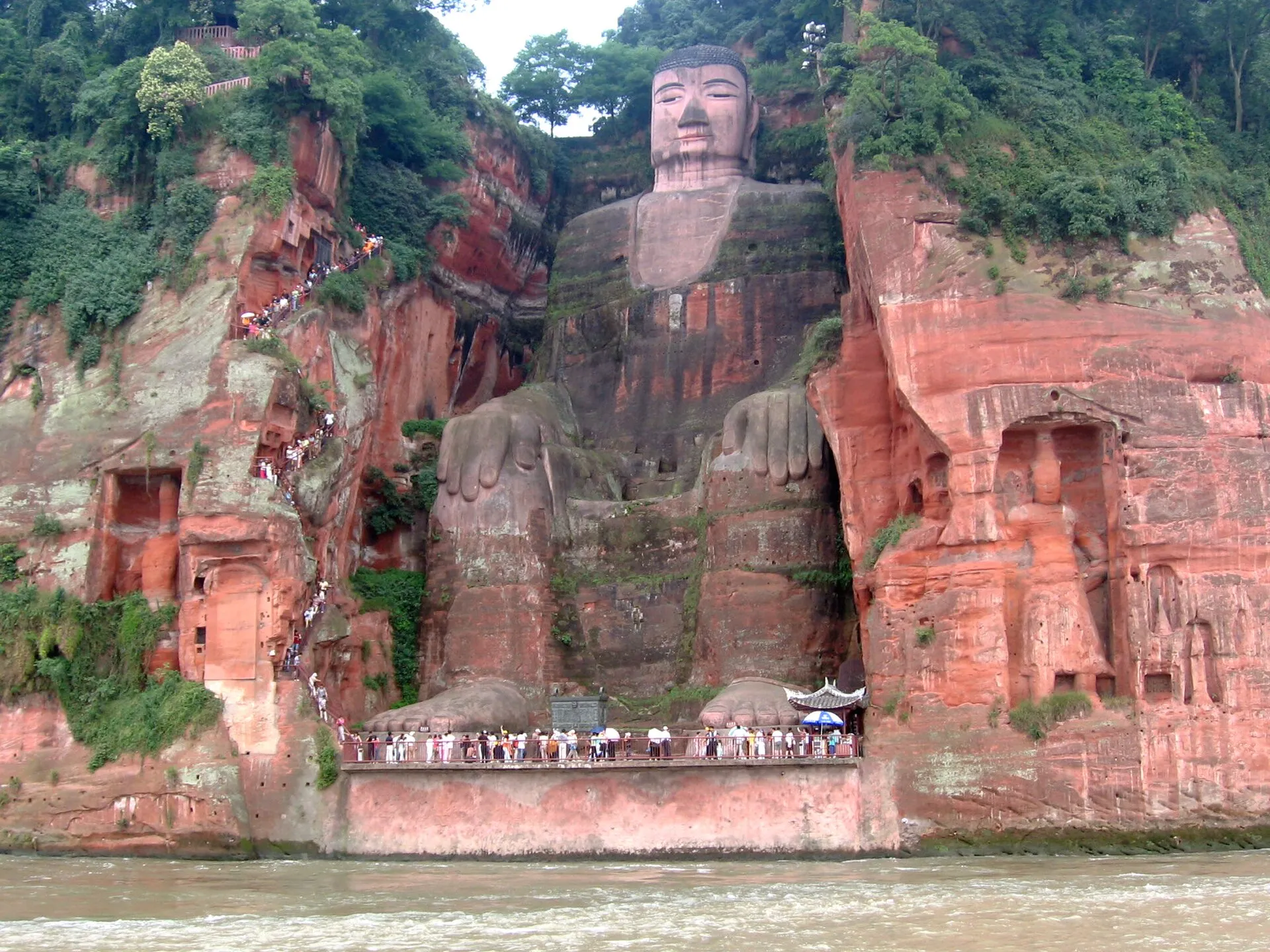
Spiritual Significance
The Leshan colossus is not a generic Buddha but a seated Maitreya, the Buddha of the future whose worship surged under the Tang dynasty and who was believed to bring blessings and protection — the perfect guardian for a monk who wanted the statue to still the deadly rivers below. Haitong's original purpose was as much practical piety as art: by anchoring an immense sacred figure above the confluence, he hoped the merit of the work — and the rubble tipped into the water as it was carved — would quiet the currents that had drowned so many. In a sense it worked, as the debris genuinely reshaped and calmed that stretch of river.
- Nine-Turn Staircase descent: A dizzying path carved into the cliff beside the Buddha's body, revealing the statue's immense scale as you drop from head to feet.
- River cruise perspective: From the water the full figure emerges from the cliff face in a way the staircase never shows, framed by the three merging rivers.
- Standing at the feet: The Buddha's feet alone are 8.5 meters wide — pausing beside a single toe makes any visitor feel wonderfully small.
- Lingyun Temple: The Tang-dynasty monastery crowning the cliff above the Buddha's head still burns incense in halls that command sweeping river views.
- Three-river confluence: The Min, Dadu, and Qingyi meet directly below, their currents swirling in visible eddies the Buddha has watched over for thirteen centuries.
- Hidden drainage system: Look for the concealed channels in the hair curls, collar, and chest — devotional artistry and flood engineering carved as one.
Visitor Etiquette
The Giant Buddha is a working pilgrimage site as well as a tourist landmark, and a little decorum goes a long way. Lingyun Temple on the clifftop is an active monastery: speak quietly in its halls, remove hats before the altars, and step over the raised wooden thresholds rather than on them, an old custom held to avoid misfortune. If you light incense, buy it at the temple, offer an odd number of sticks, and place them in the communal burner rather than carrying lit incense between halls.
Safety is its own courtesy on the crowded cliff. The Nine-Turn Staircase is steep, single-file, and edged by long drops, so keep to one side, do not stop on the treads to photograph, and never try to climb onto the Buddha, its feet, or the railings — the statue is fragile thirteen-century stone and barriers exist to protect both you and it. Keep a firm grip on children and loose belongings, since anything dropped is gone into the ravine. On the boat cruise, wear the provided life jacket and stay seated while the vessel holds its position for photographs. Expect the site to be busiest, and the stairway effectively one-way, during the early-April Qingming period and the two national "Golden Week" holidays, when domestic pilgrims and travellers arrive in their thousands.
When to Visit
- Park hours: Daily 7:30 AM - 6:30 PM in summer; 8:00 AM - 5:30 PM in winter (last entry roughly an hour before closing).
- River boat tours: Typically 8:00 AM - 5:00 PM, departing every 20-30 minutes once enough passengers gather.
- Best window: Early morning on a weekday, when the narrow cliff-side staircase is least crowded and the light on the Buddha's face is softest.
- Avoid: Weekend afternoons and any national holiday period — during Labour Day and National Day "Golden Weeks," the single-file stairway queue can exceed 3 hours.
Admission and Costs
- Park admission: ¥80 (about $11), covering the cliff staircase, Lingyun Temple, and the Giant Sleeping Buddha viewpoints.
- River boat cruise: ¥70 ($10) — views the statue from the water and does not include park entry, so budget for both if you want the full-body and up-close perspectives.
- High-speed train from Chengdu: ¥55-65 ($8-9) each way, roughly 1 hour from Chengdu East or Chengdu South to Leshan station.
- Local bus from Leshan station to the site: ¥2 (about $0.30); a taxi runs ¥20-30 ($3-4).
Tips for Visitors
- Do both the boat and the staircase. The river cruise gives you the full-body view no photograph captures, while the cliff staircase delivers the up-close detail — together they tell the whole story of the Buddha's scale.
- Arrive before 9 AM. The Nine-Turn Staircase is single-file and becomes a slow shuffle by mid-morning; early birds descend freely.
- Wear grippy shoes. The cliff stairs are steep, narrow, and slick in damp weather — sandals or heels are genuinely dangerous here.
- Consider a guided day trip. Juggling the Chengdu-to-Leshan train, the boats, entrance tickets, and stairway timing is far easier with a knowledgeable local guide who can also unpack the statue's Tang-dynasty history.
- Budget a full day. Between the round-trip train ride, the park grounds, the staircase queue, and the optional boat, the Giant Buddha comfortably fills an entire day out of Chengdu.
Frequently Asked Questions
When is the best season to visit the Leshan Giant Buddha?
April-May and September-October offer the driest conditions and most comfortable temperatures for both the steep cliff-side staircase descent and the river boat cruise that provide complementary views of the 71-meter statue. Summer monsoon rains (June-August) make the narrow carved steps slippery and sometimes close the staircase entirely, while river mist and haze in winter can obscure the statue's face from the boat.
When should visitors plan to arrive at Leshan Giant Buddha?
Open: Daily 7:30 AM - 6:30 PM (summer) / 8:00 AM - 5:30 PM (winter). River boat tours: Typically 8:00 AM - 5:00 PM, departing every 20-30 minutes. Best: Early morning on weekdays when the narrow cliff-side staircase is least crowded.
How much does admission to the Leshan Giant Buddha cost?
Park admission: ¥80 (about $11). River boat cruise: ¥70 ($10, views the statue from the water and does not include park entry). High-speed train from Chengdu: ¥55-65 ($8-9) each way, roughly 1 hour. Local bus from Leshan train station to the site: ¥2 (about $0.30).
How do you get from Chengdu to the Leshan Giant Buddha?
The easiest route is a high-speed train from Chengdu East or Chengdu South to Leshan station (about 1 hour), then bus 3 or 13, or a short taxi, to the north gate. The scenic area sits roughly 130 km south of central Chengdu; without the train, direct tourist coaches and guided day trips run from the city centre and take around 2 hours each way.
What is the "Giant Sleeping Buddha" at Leshan?
Viewed from the river or the opposite bank, the forested hills flanking the seated Buddha line up into the silhouette of a reclining figure - Wuyou Hill forms the head, Lingyun Hill the body - with the carved Giant Buddha sitting at the heart. This "Giant Sleeping Buddha" landscape illusion was widely popularised in the 1980s and is best appreciated from the water on the boat cruise.
What should visitors know before visiting Leshan Giant Buddha?
Do both the boat and the staircase: the river cruise gives you the full-body view while the cliff staircase provides up-close detail, and they complement each other perfectly. Wear grippy shoes for the steep, single-file Nine-Turn Staircase, and budget a full day for the round trip from Chengdu.