
Observation Spots
Formation
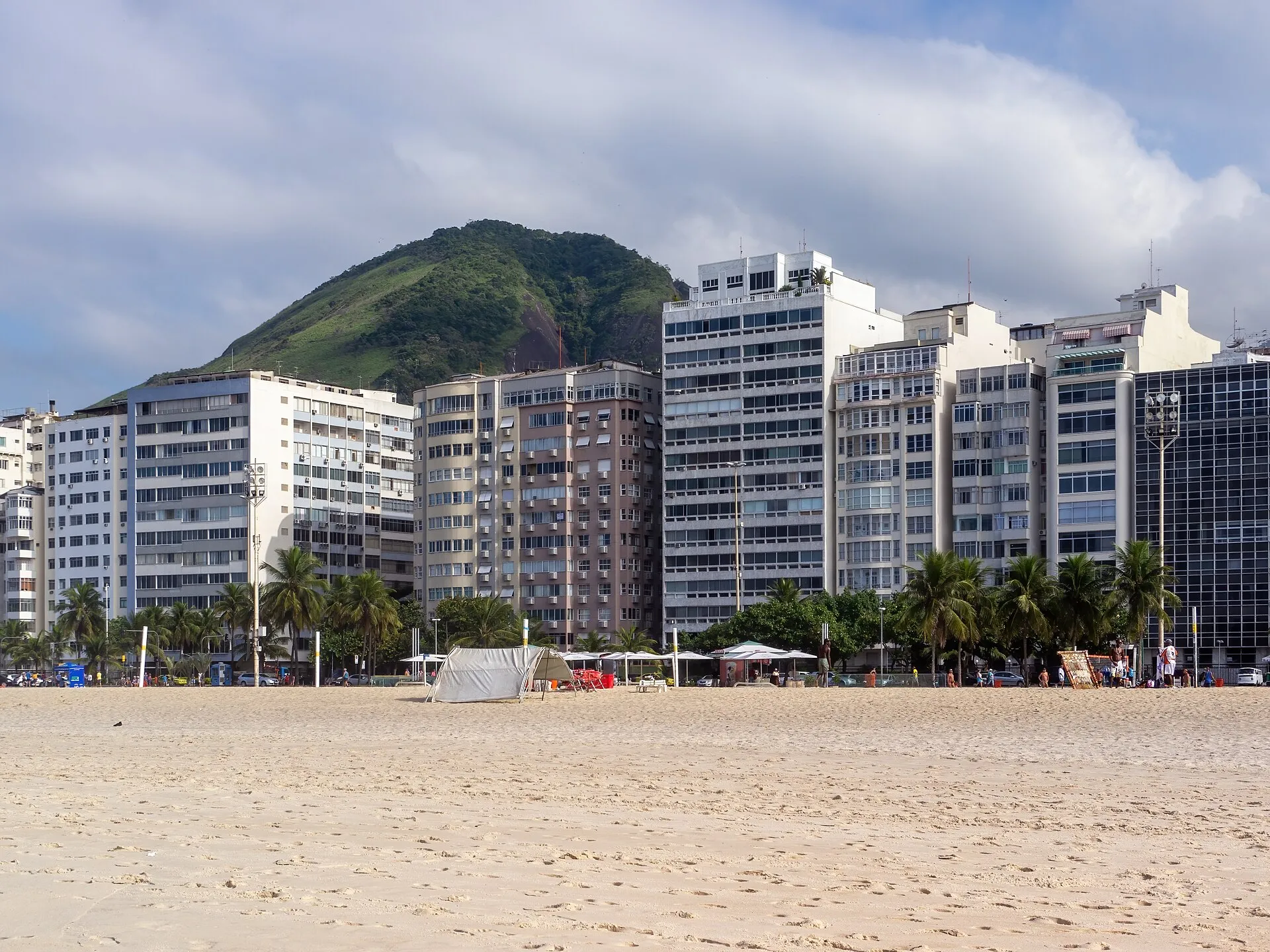
Copacabana sits at the seaward edge of the Serra do Mar, the coastal escarpment whose Precambrian granite and gneiss — crystalline rock over 500 million years old — forms the bald domes that give Rio de Janeiro its skyline. The same basement rock surfaces as the Leme headland closing the north end and the Arpoador–Forte promontory to the south; between them the beach is a pocket of quartz sand eroded from those massifs and reworked by the open Atlantic swell. Unlike the calm beaches inside Guanabara Bay, Copacabana faces the ocean directly, so it gathers genuine surf and a steeper, faster-draining shoreface — the reason lifeguard postos, not still water, define its geography.
Much of what visitors actually walk on, though, is engineered ground. The beach seen today is far wider than the Victorian strand: a major 1969–70 aterro (landfill) pumped sand dredged from offshore to push the shoreline seaward, roughly doubling the beach and creating room for the six-lane Avenida Atlântica. It was across this new ground that Roberto Burle Marx extended the undulating wave pavement — a modern reworking of a calçada portuguesa motif first laid in 1906 and inspired by Lisbon's Rossio square — into the 4-kilometre promenade now as much a symbol of Rio as the sand itself.
Trails
The 4-kilometre Copacabana promenade is itself the primary walking route, running from the Forte de Copacabana at the southern tip to Posto 1 beneath Leme hill at the north, with Burle Marx's wave mosaic underfoot the whole way. At the southern end the Forte de Copacabana opens its ramparts and gun batteries to visitors (small ticketed entry) and rewards the walk with the classic view back along the entire curve. From the northern end, the short Caminho dos Pescadores fishermen's path rounds the base of Pedra do Leme, and a steeper trail climbs Morro do Leme through Atlantic-Forest remnants — about 20 minutes up — for an elevated look over the full arc toward Sugarloaf Mountain. Continue south past the fort and the promenade runs on without a break into neighbouring Ipanema, adding roughly 2 kilometres of seafront to a single flat walk.
Wildlife
Copacabana is first of all an urban beach, yet its rocky bookends hold more life than the sand suggests. The forested slopes of Morro do Leme shelter troops of sagui marmosets (small tufted-ear New World monkeys) that come close to walkers, along with bem-te-vi (great kiskadee), tropical tanagers and the occasional toucan in the canopy. At first light, before the crowds arrive, quero-quero (southern lapwing) patrol the open sand, and offshore the rocky Ilhas Cagarras — visible on the horizon — host colonies of frigatebirds and boobies. In the water, small fish shoal around the Forte de Copacabana rocks and sea turtles surface in calmer spells; during the southern winter (June–September), humpback whales migrating up the Brazilian coast are sometimes spotted from the elevated rocks at Leme.
Copacabana Beach timeline
-
Chapel gives the beach its name
A modest hillside chapel to Nossa Senhora de Copacabana — named for the Virgin's shrine on Lake Titicaca in Bolivia — lends the fishing district and its beach their enduring name.
-
Túnel Velho opens
The tunnel from Botafogo pierces the hills to reach the isolated beach, triggering the urbanisation that turned Copacabana from a fishermen's cove into a city neighbourhood.
-
Forte de Copacabana inaugurated
A coastal fortress replaces the demolished chapel on the southern promontory to guard the approach to Guanabara Bay; it now houses the Army Historical Museum.
- July 5, 1922
Revolt of the 18 of the Fort
Rebel army officers march out from the fort against the federal government in a founding episode of Brazil's tenente movement.
-
Copacabana Palace opens
Joseph Gire's Belle Époque hotel launches Rio's golden age of seaside glamour and fixes Copacabana as the city's premier resort address.
-
Beach widened, boardwalk redesigned
A vast landfill roughly doubles the strand, and Roberto Burle Marx lays out the sweeping black-and-white wave promenade seen today.
-
Olympic beach volleyball
A temporary stadium on the sand hosts the Games' beach volleyball, broadcasting Copacabana to a worldwide audience.
When to Visit
Access: the sand is open and free 24/7, year-round. Early morning (7–10 AM) is the quietest and most local hour — swimmers, runners and fresh água de coco carts before the heat builds. Midday (11 AM–4 PM) brings peak sun and crowds, with intense UV that demands high-SPF cover. Late afternoon (4–7 PM) is the beach at its best: futevôlei and beach-soccer games, golden light down the curve, and sunset drinks at the kiosks. Metro trains run until around midnight, so the promenade stays lively into the evening. Best season: the Brazilian summer (December–March) for maximum energy and the biggest crowds; the shoulder months (April–May, October–November) trade a little warmth for far more room. The single most crowded night is 31 December, when the Réveillon fireworks draw the year's largest gathering.
Admission and Costs
Beach access: free (public beach). Beach-chair and umbrella rental: R$10–15 from an established barraca vendor. Água de coco (coconut water): R$5–10; a caipirinha at a kiosk: R$15–25; a stack of Biscoito Globo: about R$5. Entry to the Forte de Copacabana ramparts and Army Historical Museum is a modest ticket (roughly R$6–20). Getting there is cheap: a single MetrôRio fare runs about R$6.50. On the water, a surf lesson is R$100–150 for 1–2 hours with a board, and stand-up paddleboard rental about R$50–80 an hour. A cultural beach walk with a local guide — history, etiquette and food — runs R$150–250.
The Case for a Guide
The sand is free and the view is obvious, but Copacabana rewards someone who can read it. Much of the beach's value is social and unwritten — knowing which vendors and postos are relaxed, when the open-ocean surf is safe, and how not to look like a target — and that local fluency is exactly what turns a wary first visit into an easy afternoon.
- Reading the beach safely: A guide knows the current lifeguard-flag system, the pickpocket patterns of the crowded central postos, and how to carry nothing you would mind losing — the difference between a relaxed day and a ruined one.
- The posto map: Each numbered station has a distinct crowd — families, futevôlei and frescobol players, a rainbow-flag stretch, older Cariocas at Posto 6 by the fort — and a guide steers you to the one that fits.
- Beach food and drink like a local: From ordering Biscoito Globo with matte to choosing a barraca that grills fresh queijo coalho, a guide handles the Portuguese and the pricing.
- History underfoot: The name borrowed from a Bolivian shrine, the 1922 revolt at the fort, and the 1970 landfill that built the promenade are invisible without someone to point them out.
- Slotting it into the day: Guides pace Copacabana between Sugarloaf Mountain at sunset and Christ the Redeemer at sunrise, so the beach becomes the relaxed centre of a bigger Rio itinerary.
Tips for Visitors
Do not bring valuables onto the sand — carry minimal cash, and leave phones and jewellery at your hotel or in a waterproof pouch, especially in crowds. The sun is fierce year-round, so high-SPF sunscreen is essential even under cloud. Rent a barraca chair from a fixed vendor near your posto rather than from walking sellers, and read the lifeguard flags: a red flag or a visible undertow means the open-ocean surf is not safe for casual swimmers. For a calmer scene, head to Posto 6 by the Forte de Copacabana where locals gather for frescobol; the Copacabana Palace stretch around Posto 3 is liveliest for people-watching. The promenade is flat and fully paved end to end, making the whole 4 km step-free on foot or by wheelchair, and the accessible MetrôRio stations put you two blocks from the sand. After dark, take a ride-share rather than walking unfamiliar blocks, and treat the Réveillon crowds — more than two million people in white — as spectacular but demanding of real patience. Neighbouring Ipanema beach is a short walk south past the fort if you want to compare the two iconic stretches.
Frequently Asked Questions
When is the best season to visit Copacabana Beach?
Year-round destination with warm temperatures. Brazilian summer (December-March) brings the biggest crowds and highest energy. April-November is slightly cooler but still swimmable, with fewer tourists. Avoid rainy spells in June-August when overcast skies reduce the experience.
How much does it cost to access Copacabana Beach?
Beach access is free as it is a public beach. Chair rental runs R$10-15 from beach vendors. Coconut water costs R$5-10 and caipirinhas R$15-25 at beach kiosks. Entry to the Forte de Copacabana ramparts is a modest ticket (roughly R$6-20), and cultural tours with a local guide range from R$150-250.
What should visitors bring when visiting Copacabana Beach?
Don't bring valuables to the sand — carry minimal cash and leave phones at your hotel or in a waterproof pouch. The sun is intense year-round so high-SPF sunscreen is essential, even on overcast days. Watch the lifeguard flags, since the open-Atlantic surf can be strong, and for a quieter experience head to Posto 6 near the Forte de Copacabana.
How do you get to Copacabana Beach?
The quickest way from central Rio is the metro: Line 1 stations Cardeal Arcoverde, Siqueira Campos and Cantagalo run beneath Avenida Nossa Senhora de Copacabana, two blocks from the sand, for a single fare of about R$6.50. Line 4 continues on toward Ipanema and Barra da Tijuca. After dark, ride-share apps such as Uber and 99 are the safer choice over walking unfamiliar blocks or hailing taxis in the street.
Is Copacabana Beach accessible for visitors with reduced mobility?
Yes for the promenade: Roberto Burle Marx's wave-pattern boardwalk is flat, fully paved and step-free along its entire 4-kilometre length, so wheelchair users and pushchairs can travel the whole beachfront with ease. The Cantagalo and Cardeal Arcoverde metro stations have lift access, and the kiosks and the Forte de Copacabana are reachable without stairs, though crossing the soft sand to the water still needs assistance.